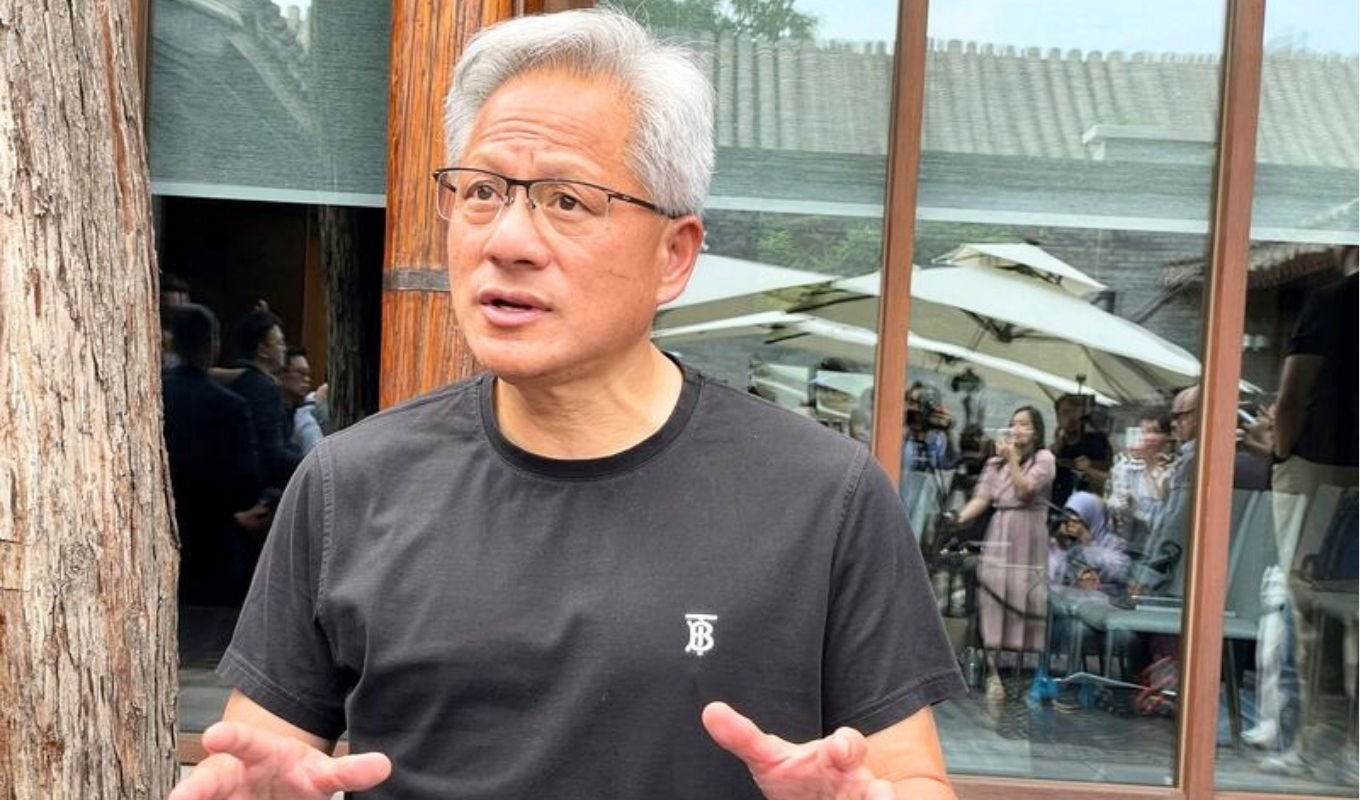
Nvidia’s Chief Executive Officer, Jensen Huang, has cautioned that China is “going to win” the global race to develop next-generation artificial intelligence, urging the United States to accelerate its own innovation efforts before it loses ground.
Speaking at an event in London, Huang told the Financial Times that Beijing’s extensive energy subsidies are fuelling its semiconductor industry and driving its ambitions to dominate the AI landscape.
“China is going to win the AI race,” the British daily quoted him as saying. In a statement posted later on X by Nvidia, he added, “As I have long said, China is nanoseconds behind America in AI. It’s vital that America wins by racing ahead and winning developers worldwide.”
Nvidia, the California-based chipmaker that briefly became the world’s first $5 trillion company last week, now has a market valuation of around $4.7 trillion. The firm’s advanced chips — essential for training and powering generative AI systems — remain banned for export to China under US national security restrictions and reciprocal Chinese regulations.
Earlier this week, the White House reiterated its stance, stating it would not permit Nvidia to sell its latest Blackwell chip model in China, citing concerns that doing so could give Beijing a military advantage.
Huang has repeatedly appealed to Washington to ease restrictions on chip exports, warning that such policies risk accelerating China’s technological self-sufficiency rather than containing it.
The tech magnate, known for his trademark leather jacket, also criticised state-level regulations on AI in the United States during his interview with the Financial Times. He contrasted these with China’s more supportive approach, highlighting how the Chinese government subsidises electricity to power large-scale AI operations.
Western nations, particularly the United States and the United Kingdom, are being hampered by “cynicism” over AI, Huang argued, warning that scepticism and bureaucracy could slow innovation at a critical time.
However, analysts remain divided on China’s prospects. While Beijing’s semiconductor sector is expanding rapidly, experts note that Chinese chipmakers still face significant challenges. These include the development of sophisticated software needed to maximise chip performance and the upgrade of manufacturing tools to compete with Nvidia’s cutting-edge technology.
Despite Huang’s warning, many analysts believe that China will struggle to match Nvidia’s technological leadership before the end of the decade.