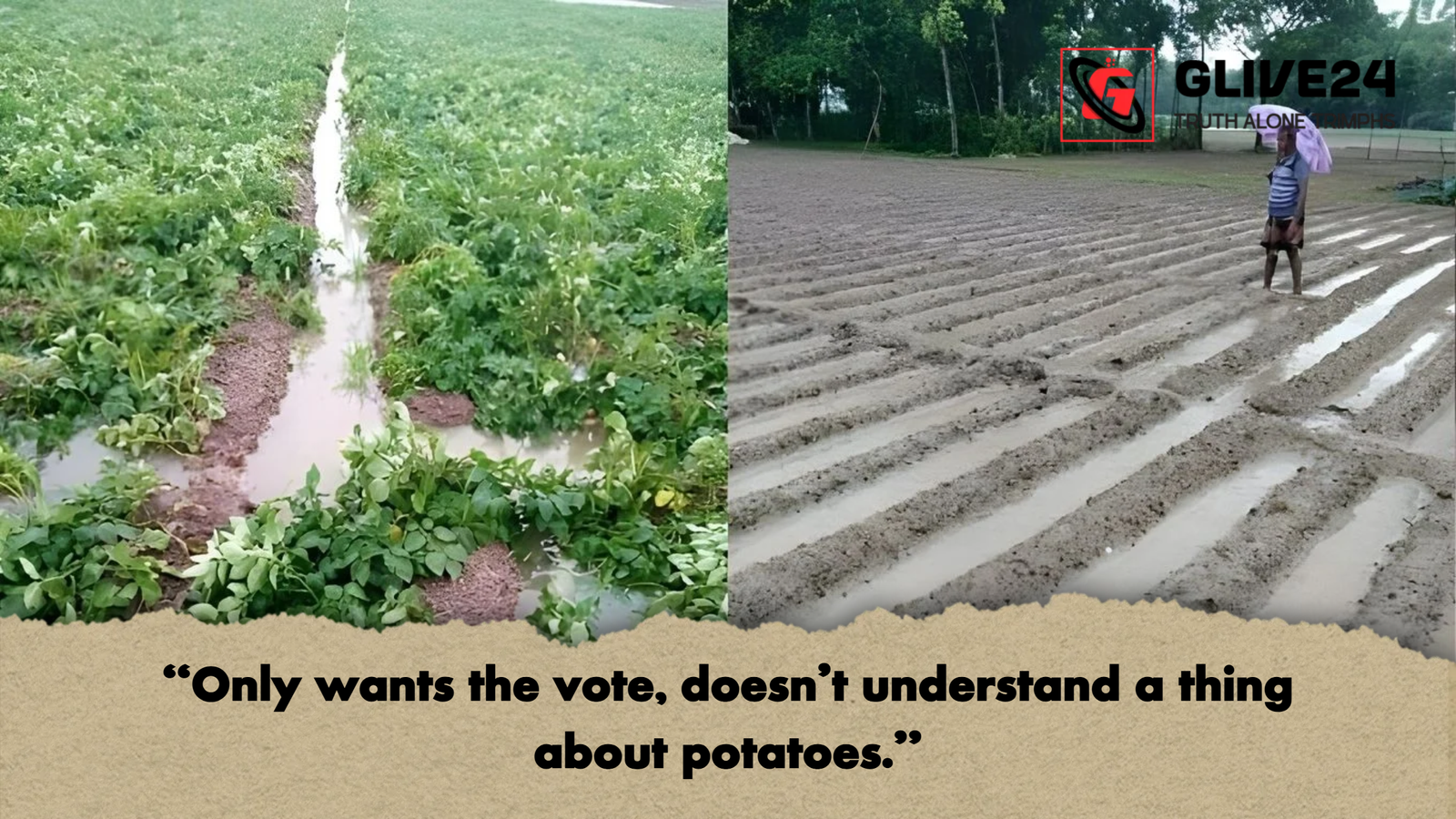
Last year, Masum Mia faced a devastating loss from potato cultivation. On his ten-acre plot, he incurred a loss of 1.8 million taka, a financial blow that has weighed heavily on his family. To make ends meet, he has already sold three cows. This year, fearful of further losses, Masum has drastically reduced his potato cultivation, planting on just 3.48 acres. He warns that if he cannot secure a fair price this season, he may be forced onto the streets.
On Thursday morning, Masum and four other potato farmers spoke to journalists at Taltala Market, situated along the Rangpur–Sundarganj regional highway in the Rangpur-4 constituency (Pirganj–Kaunia). The main contenders for this seat are Akhtar Hossain of the NCP, supported by the 11-party electoral alliance; Mohammad Emdadul Haque of the BNP; and Abu Naser Shah Md. Mahbubar Rahman of the Jatiya Party. While other candidates are contesting, the principal competition is expected among these three.
Farmers in the region claim that while politicians seek their votes, they are largely silent on the real issues affecting potato growers. Traversing villages such as Choto Kalyani, Swachhash, Boro Dorga, Kaluk Poshua, Boro Hajra, and Nabdigunj, one finds fields dominated almost entirely by potatoes—either cultivated on owned land or leased plots. Local estimates suggest that around 95% of the population here is engaged in potato farming.
Chalim Uddin from Choto Kalyani village summed up the sentiment: “They only want our votes. They don’t speak about our potatoes or our hardships.” He lost 150,000 taka last year and relies on an NGO loan to support his family. With the harvest still 30 to 40 days away, uncertainty and anxiety dominate his days.
Rangpur has earned a reputation as a leading potato-producing district. Over the past three years, it has recorded the highest potato output among the country’s 64 districts. According to the Rangpur District Office of the Department of Agricultural Extension:
| Year | Total Cultivated Area (hectares) | Potato Area (hectares) | Notes |
|---|---|---|---|
| Last Year | 189,514 | 66,280 | Peak cultivation |
| This Year | 189,514 | 54,500 | Decline of 11,780 hectares |
Despite this prominence, storage infrastructure remains inadequate. Private cold storages are often dominated by brokers and middlemen, with poor-quality potatoes limiting export potential. Processing initiatives are minimal, and several farmers have left the area after sustaining losses from loan-financed cultivation.
Farmers cite rising costs as a deterrent to potato farming. High prices for seeds, fertilisers, and pesticides, coupled with irrigation and labour expenses, have escalated the cost of cultivation. On average, producing one kilogram of potato last year cost 17.80 taka, while farmers earned only around 8 taka per kilogram. Additional expenses include 380 taka to store a 65-kg sack in a cold storage, making profit margins unsustainable.
Officials acknowledge the transformative impact of potatoes on the local economy, with improved infrastructure and housing attributed to potato profits. Yet, farmers’ enthusiasm for cultivation is waning. Many believe government intervention is necessary, including the construction of larger cold storages, better oversight of input prices and quality, and support for processing initiatives.
Even amidst these challenges, dedicated farmers like Suman Kumar Sharma continue to tend their fields. “Even if I incur losses, this is my livelihood. There is no other way for us farmers,” he said, underscoring both the resilience and the precariousness of Rangpur’s potato economy.