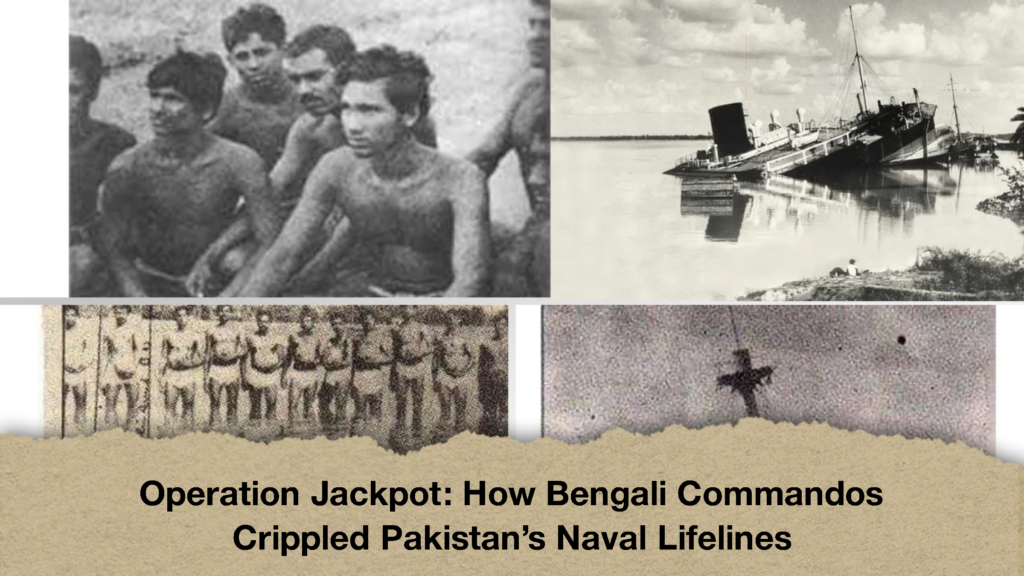
One of the most daring and strategically significant guerrilla operations of Bangladesh’s Liberation War was Operation Jackpot, a coordinated naval commando assault aimed at disrupting the Pakistani military’s maritime supply network. Carried out in August 1971, the operation struck key ports and river terminals and demonstrated that the Bengali resistance could mount sophisticated attacks against strategically important targets despite having limited resources.
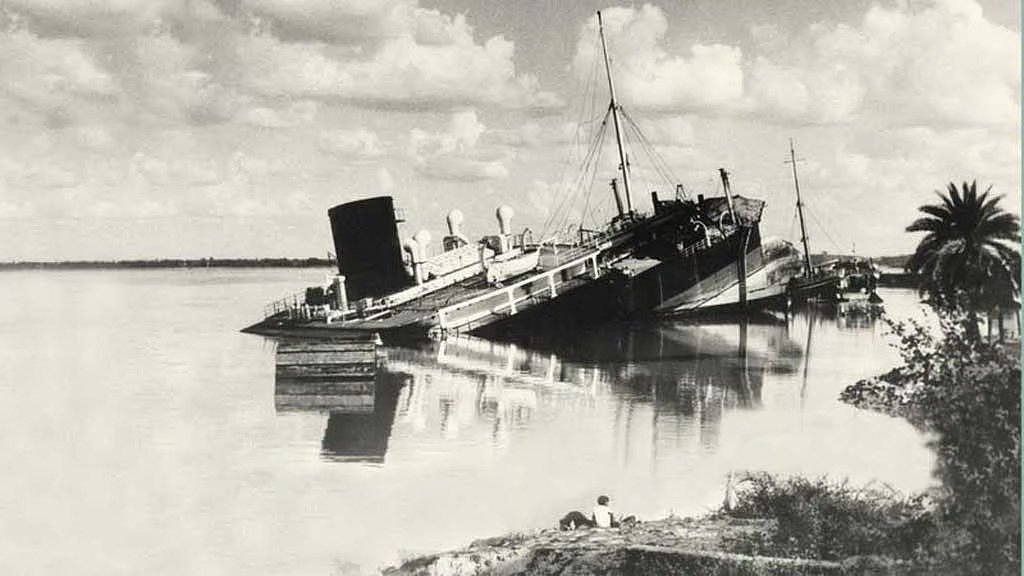
In the early hours of 16 August 1971, separate teams of naval commandos launched attacks on the ports of Chattogram, Chandpur and Narayanganj. A further operation was conducted at Mongla Port around dawn. The commandos targeted vessels carrying arms, ammunition, fuel and other supplies associated with the Pakistani military effort. Several ships were destroyed or damaged, including vessels linked to foreign interests that were assisting Pakistan’s wartime supply arrangements.
Planning a covert naval operation
The operation was conceived after Bengali naval commandos had received specialised training to attack the Pakistani forces’ naval communications and supply routes. The first trained group of commandos was divided into four teams, with each team assigned a specific target: Chattogram Port, Mongla Port, Chandpur River Port and Narayanganj River Port.
The force was divided into two larger groups of around 60 commandos each and two smaller groups of around 20. Maintaining secrecy was considered essential. Communication with the team leaders therefore relied on specially arranged signals involving Bangladeshi and Indian military personnel. A number of officials associated with Kolkata’s All India Radio were also brought into the secret communication arrangement.
The operation’s most unusual feature was the use of two Bengali songs as coded signals.
The first signal was Alpona Banerjee’s song Amar Putul Ajke Prothom Jabe Shoshurbari. Its broadcast indicated that the commandos should make their final preparations. Within the following 24 hours, the second signal, Pankaj Mullick’s rendition of the Rabindra Sangeet Ami Tomay Joto Shuniyechhilam Gaan, was to be broadcast. Hearing the second song meant that the time had come to proceed with the attack.
The broadcast timing and radio-wave details were known only to the relevant commanders. To ordinary listeners, the songs were simply part of a radio programme. To the commandos, they carried instructions that could determine the timing of a highly dangerous military operation.
From Harina Camp to the targets
According to the operational plan, the teams began their journey from the Palashi Harina Camp in Kolkata towards their respective targets. The commandos were supplied with weapons and equipment suitable for underwater operations.
Each commando carried a limpet mine, a knife, a pair of swimming fins and dry food. One Sten gun was reportedly provided for every three commandos. Team leaders were equipped with transistor radios to receive coded instructions and operational signals.
The attack was scheduled for the night of 15 August, extending into the early hours of 16 August.
Around 1am, the commandos moved towards the water. At approximately 1.15am, they entered the water and began swimming silently towards the selected vessels. After reaching their targets, they attached limpet mines to the hulls of the ships before withdrawing to a safer distance.
At about 1.40am, the first explosion was heard at Chattogram. Further blasts followed at Chattogram, Chandpur and Narayanganj, turning several strategically important port areas into scenes of confusion. At Mongla, the operation began around dawn, with mines exploding one after another after approximately 6.30am.
The attacks struck vessels that were important to Pakistan’s military logistics, disrupting the movement of supplies through some of the country’s most significant waterways.
A major blow to Pakistan’s supply network
Operation Jackpot was significant because it did not depend on a conventional confrontation. Instead, the commandos exploited secrecy, surprise and knowledge of waterways to strike vessels that were part of the Pakistani military’s logistical system.
The simultaneous attacks at several locations also had a psychological and operational impact. Pakistani forces were confronted with coordinated acts of sabotage across distant ports and river terminals, demonstrating the reach of the Bengali resistance.
The destruction and damage inflicted on supply vessels affected the movement of military materials. The operation also drew attention to the wider international dimension of the Liberation War, particularly the importance of ports and shipping routes in sustaining Pakistan’s military operations in occupied Bangladesh.
Sacrifice of the naval commandos
The success of Operation Jackpot came at a heavy human cost. The commandos involved in these missions operated under extreme conditions, often at night and in waters where discovery could lead to arrest or death.
Several participants were killed or disappeared during operations associated with the naval commando campaign.
Among those identified as martyrs were Commando Abdur Rakib, who was killed during the Fulchhari Ghat operation; Commando Hossain Farid, who was captured by Pakistani forces and later killed during a second operation in Chattogram; and Commando Khabiruzzaman, who was killed during a second operation in Faridpur.
Commandos Sirajul Islam, M Aziz, Aftab Uddin and Rafiqul Islam were also reported missing during operations.
Their experiences reflected the extraordinary risks undertaken by the naval commandos, many of whom operated with limited equipment against a far more heavily equipped military force.
A landmark chapter of the Liberation War
Operation Jackpot was far more than a series of attacks on ships. It was a carefully coordinated naval guerrilla campaign built around intelligence, secrecy, specialised training and precise timing.
The use of coded radio broadcasts, the division of commandos into separate operational teams and the simultaneous targeting of important ports demonstrated a level of planning unusual for a guerrilla force operating during a war of liberation.
By attacking vessels connected to the Pakistani military’s supply system, the naval commandos struck at a vital part of the occupation forces’ logistical structure. Their actions also showed how waterways could become an important battlefield in the Liberation War.
More than five decades later, Operation Jackpot remains a prominent chapter in Bangladesh’s military history. The operation stands as a record of the courage, discipline and sacrifice of the Bengali naval commandos who undertook dangerous missions with the knowledge that failure could mean capture or death.
The martyrs and missing commandos of Operation Jackpot, along with all those who sacrificed their lives during the Liberation War, remain an enduring part of Bangladesh’s history of independence.