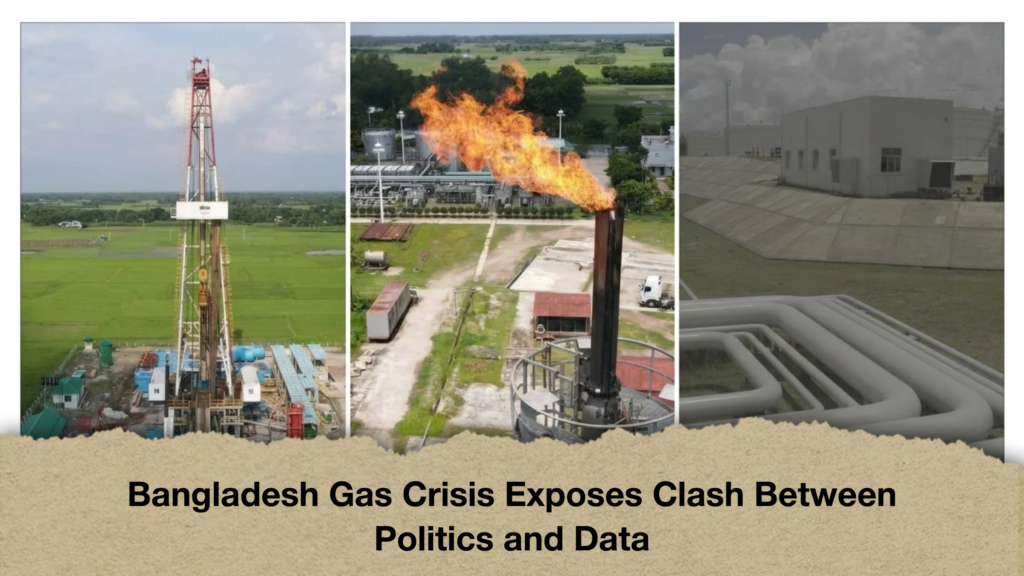
Bangladesh’s latest debate over the gas crisis has exposed a sharp discrepancy between political claims and official records, particularly over the scale of exploration carried out during the previous government’s tenure.
The controversy emerged during parliamentary discussions over gas supplies to the Ashuganj fertiliser factory. A question was raised about why the promised supply had not been secured despite an earlier assurance that gas would be made available by 1 May. In response, Energy and Mineral Resources Minister Iqbal Hasan Mahmud Tuku reportedly claimed that no gas exploration wells had been drilled in Bangladesh during the previous 17 years.
A similar political argument was subsequently made by Prime Minister Tarique Rahman, who said the previous government had not allowed the relevant agencies to drill a single new gas well during that period.
The claims, however, do not sit comfortably with records from Bangladesh’s energy authorities.
According to figures cited in official energy-sector records, 155 wells were drilled between 2009 and July 2024. Six new gas fields were also discovered during that period: Sundalpur, Srikail, Rupganj, Bhola North, Zakiganj and Ilisha. These figures present a substantially different picture from the assertion that no exploration wells were drilled.
The issue is not simply about the number of wells. It also concerns the broader development of Bangladesh’s exploration capacity and gas infrastructure.
When the Awami League government took office in 2009, Bangladesh’s daily gas production was around 1,744 million cubic feet. Domestic production subsequently rose, reaching roughly 2,750 million cubic feet a day before the Covid-19 pandemic. The country also expanded its capacity to undertake drilling. An inactive drilling rig was brought back into operation, followed by the acquisition of four additional rigs.
Exploration was extended through seismic surveys onshore and offshore. Official figures cited in the debate indicate that two-dimensional seismic surveys covered 31,281 line kilometres, while three-dimensional surveys covered around 6,986 square kilometres. Offshore exploration also included 12,642 line kilometres of multi-client 2D seismic surveys.
These activities do not, by themselves, mean that the previous government’s exploration policy was adequate. Bangladesh has continued to face declining domestic gas reserves, rising demand and an increasing dependence on imported LNG. Indeed, energy-sector analysts have repeatedly warned that exploration has not kept pace with the country’s growing requirements.
That distinction matters. A government can legitimately be criticised for failing to explore enough, drilling the wrong wells, moving too slowly or not discovering sufficient new reserves. But such criticism is different from saying that no wells were drilled at all.
The development of gas infrastructure provides another measure of what happened during the period.
Bangladesh had 23 operational gas fields in 2009. By 2024, the number had risen to 29. Total gas availability, including LNG, increased from around 1,744 million cubic feet per day to more than 3,100 million cubic feet. The gas transmission network expanded from 2,102 kilometres to 3,657 kilometres, an increase of roughly 1,555 kilometres.
The country’s LNG infrastructure also emerged during this period. Bangladesh began importing LNG in 2018, and two floating storage and regasification units, or FSRUs, were subsequently established at Maheshkhali. Their combined regasification capacity is around 1,100 million cubic feet per day.
The importance of those facilities became particularly clear during periods of disruption. In 2024, damage to one FSRU following Cyclone Remal reduced LNG supply substantially, demonstrating how dependent the national gas system had become on a small number of floating terminals.
This also illustrates why the current gas shortage cannot be explained through a single factor.
Bangladesh’s gas demand has grown rapidly, particularly from power plants and industrial consumers, while domestic production has faced depletion. Imported LNG has helped bridge the gap, but it has also exposed the country to international prices, shipping risks, foreign-exchange pressures and technical vulnerabilities at regasification facilities.
The energy sector’s expansion was not limited to natural gas. Petroleum-product supplies increased from about 3.326 million tonnes in 2009 to around 6.905 million tonnes in 2024. Oil storage capacity also expanded from approximately 893,000 tonnes to 1.57 million tonnes. Bangladesh, which had no dedicated fuel-oil pipeline network in 2009, had around 624 kilometres of such pipelines by 2024.
LPG use expanded particularly sharply, rising from roughly 45,000 tonnes in 2009 to more than 1.4 million tonnes in 2024. The growth reflects the increasing role of LPG in meeting energy demand outside the conventional natural-gas network.
There were also plans to expand domestic gas production further. Petrobangla had been pursuing a programme involving dozens of drilling and workover operations, with a broader plan to drill 100 wells by 2028. An official account from the Bangladesh Gas Fields Company says the programme was intended to add approximately 648 million cubic feet per day from 50 wells by 2025, while Petrobangla had planned for 100 wells by 2028.
Separately, records show that projects involving additional wells and seismic surveys remained part of Bangladesh’s development programme after 2024.
The political dispute therefore raises a broader question about how the energy crisis should be discussed.
There is ample room to argue that the previous government failed to do enough. Domestic gas production has fallen from its earlier peak, proven reserves have been under pressure and demand has continued to outstrip supply. Bangladesh’s increasing dependence on LNG has also created new vulnerabilities. Those are substantive issues that deserve scrutiny.
But factual criticism requires factual evidence.
If 155 wells were drilled during the period under discussion, claiming that not a single well was drilled is not merely a difference of political interpretation. It is a claim that can be tested against official records. Likewise, the existence of new gas fields, expanded transmission networks, seismic surveys and LNG infrastructure cannot be erased by political rhetoric.
The same principle applies to the present government. If it believes the previous administration failed in energy exploration, it should identify the specific failures: insufficient drilling, inadequate offshore exploration, poor reserve management, weak project selection, excessive reliance on imported LNG or shortcomings in infrastructure planning.
That would allow the public to judge the competing arguments on evidence rather than slogans.
Bangladesh’s energy challenge is too serious for a debate built around competing versions of history. Gas shortages affect fertiliser production, electricity generation, industrial output and household consumers. When supply falls, the consequences spread well beyond the energy ministry.
The country therefore needs a clear assessment of how much gas remains underground, how quickly new reserves can be developed, what level of LNG imports is financially sustainable, and which infrastructure projects can strengthen supply security.
Political parties will naturally differ over who should bear responsibility for the present situation. But the numbers should not change according to who is speaking.
The central issue is not whether one party should be praised and another condemned. It is whether Bangladesh’s energy policy will be based on verifiable records and realistic assessments.
A claim that 155 wells were drilled cannot reasonably be reconciled with a statement that not a single well was drilled without a detailed explanation of what each side means by its figures. The same applies to the country’s six reported new gas fields, thousands of kilometres of seismic surveys, expanded transmission network and 1,100-million-cubic-foot LNG regasification capacity.
Bangladesh’s gas crisis will not be resolved by political accusations. It will require sustained exploration, better reserve management, reliable LNG procurement, resilient infrastructure and long-term planning.
Most importantly, the public deserves an energy debate grounded in evidence. Governments may change, political narratives may shift, and parties may disagree over responsibility. Official records, however, provide a starting point that should remain above partisan rhetoric.