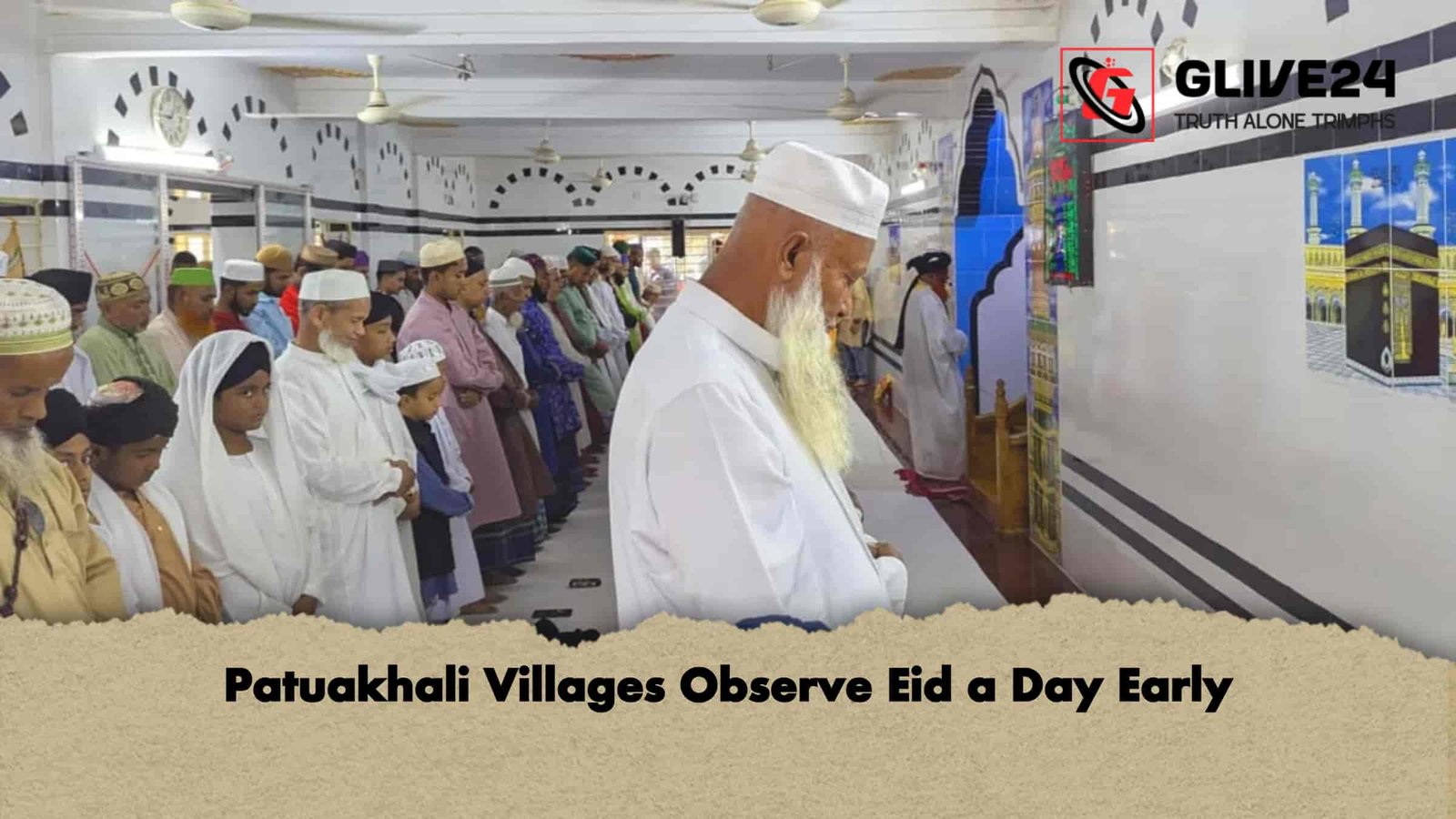
In a rare observance in Bangladesh, nearly 25,000 residents across 35 villages in Patuakhali District celebrated Eid al-Fitr a day earlier than the national date, in accordance with the lunar calendar followed in Saudi Arabia and other Middle Eastern countries. About 100 families in Badarpur Union led the early festivities on Friday, 20 January, with prayers and communal gatherings.
The Eid prayer commenced at 9:00 a.m. at Badarpur Darbar Sharif, officiated by the mosque’s imam and khatib, Maulana Md. Shafiqul Alam Gani. Locals explained that their community celebrates Eid as soon as the moon is sighted anywhere in the world, a practice that extends to both Eid al-Fitr and Eid al-Adha.
Abdur Rahman, a participant in the prayers, said, “We have followed this tradition for generations. For nearly 100 years, our families have observed Eid in this manner. Today, we prepared semai and payesh for all, and friends and relatives visit our homes to join in the celebration.”
Another local, Md. Abdus Sobahan, added, “Under the guidance of our spiritual leader, Pir Saheb, we fast a day earlier and celebrate Eid in advance. We also observe Eid al-Adha before the nationwide date.”
The community of early celebrants belongs to the Hanafi school of thought and follows the Qadiri spiritual order.
Eid prayers were performed across multiple villages, demonstrating widespread participation:
| Upazila | Villages / Areas |
|---|---|
| Sadar | Badarpur, Chotobighai |
| Galachipa | Pashuri Bunia, Sener Hawla, Kankuni Para, Maudubi, Nij Hawla |
| Bauphal | Rajnagar, Boga, Dhaulavanga, Madanpura, Surdi, Chandrapara, Dvipasha, Shapla Khali, Amirabad, Konkodia |
| Kalapara | Itbaria, Naiya Patti, Tiyakhali, Tegashia, South Devpur, others |
Maulana Md. Shafiqul Alam Gani stated, “The Hadith and the Qur’an instruct us to celebrate Eid upon receiving news of the moon’s sighting. Since 1928, our community has faithfully followed this practice. Through today’s Eid prayers, we prayed for peace, unity, and well-being for the Muslim Ummah.”
This early observance, maintained for nearly a century, underscores the community’s adherence to tradition while fostering collective celebration and spiritual reflection.