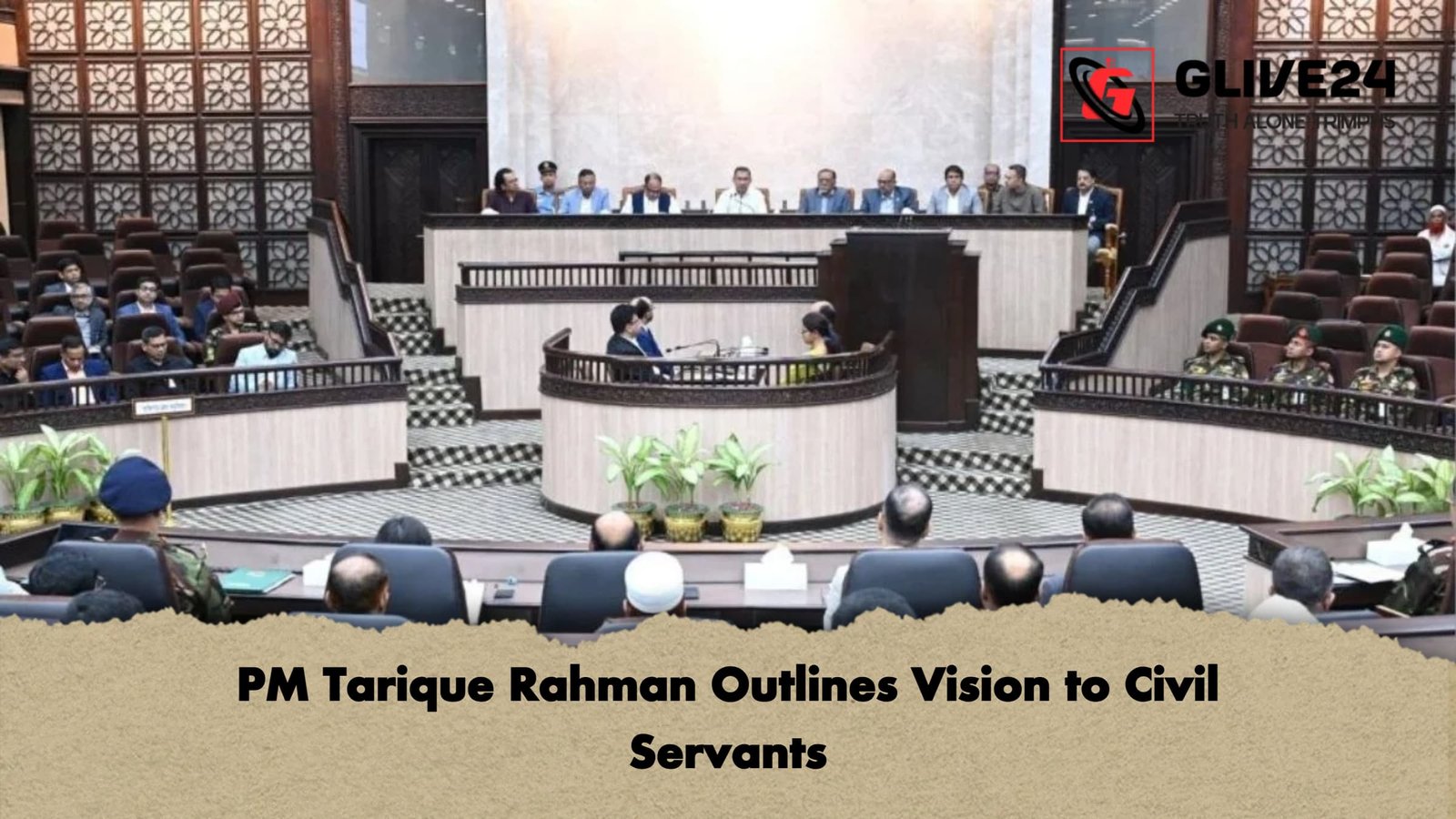
In his first formal engagement with the staff of the Prime Minister’s Office (PMO) since assuming leadership, Prime Minister Tarique Rahman delivered a resonant call to action, framing the civil service as the bedrock of national transformation. The exchange took place on Saturday, 28 February 2026, at the Shapla Hall in Tejgaon, marking a pivotal moment in the new administration’s efforts to align the executive machinery with its ambitious reform agenda.
A Shared Responsibility for National Destiny
Addressing the gathered officials and employees, the Prime Minister struck a patriotic chord, reminding them that the prosperity of Bangladesh rests solely in the hands of its own people and public servants. “We consider this country our first and final destination,” he remarked, emphasizing that the burden of changing the nation’s fortune lies with those within the halls of power.
He further asserted that civil servants are not merely observers but integral components of the governing structure. The Prime Minister noted that the public holds immense expectations for this administration—expectations that can only be met through seamless cooperation between the political leadership and the bureaucracy.
Strategic Priorities and Governance Reform
The Prime Minister specifically solicited the support of the PMO staff to actualize the pledges outlined in the government’s manifesto. He highlighted several critical sectors that require immediate and transparent intervention to ensure long-term stability and growth.
| Priority Sector | Key Focus Areas |
| Healthcare & Education | Modernising infrastructure and expanding access to rural regions. |
| Empowerment | Promoting female education and enhancing vocational training. |
| Economic Growth | Driving job creation and fostering an environment for innovation. |
| Integrity | A zero-tolerance approach to systemic corruption at all levels. |
| Youth & Culture | Expanding sporting facilities and national cultural programmes. |
Professionalism and Confidentiality
A significant portion of the Prime Minister’s address was dedicated to the ethics of governance. He issued a stern directive regarding the sanctity of state secrets, urging officials to uphold the highest standards of confidentiality in the interest of national security and the state.
The meeting was attended by a distinguished cohort of the Prime Minister’s inner circle, including advisors Mirza Abbas, Md. Ismail Zabiullah, Rashed Al Mahmud Titumir, Humayun Kabir, Brigadier General (Retd.) Shamsul Islam, Dr. Zahed Ur Rahman, and Mahdi Amin. Their presence underscored the collaborative nature of the new “Tejgaon Doctrine,” which seeks to bridge the gap between policy formulation and administrative execution.