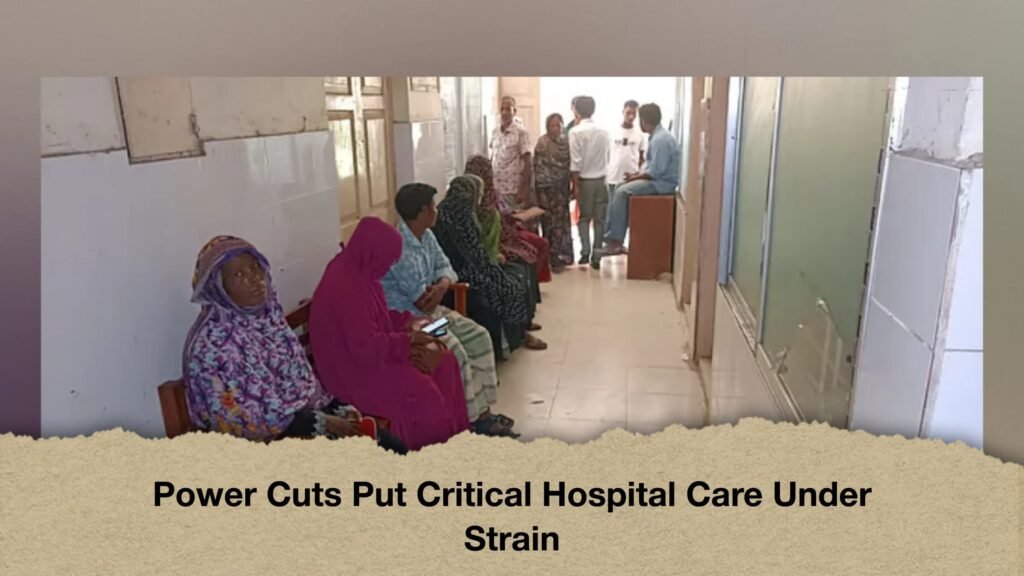
Prolonged power outages and load-shedding are disrupting medical services at hospitals and upazila health complexes across several districts of Bangladesh, affecting everything from nebuliser treatment and diagnostic tests to emergency surgery.
In some facilities, electricity has failed while operations were under way. Elsewhere, patients with breathing difficulties have been unable to receive nebuliser treatment at the required intervals. X-rays, electrocardiograms and other diagnostic services have also been suspended during outages. Although some hospitals have standby generators, shortages of fuel mean that these machines cannot always be operated when electricity fails.
At Matlab Dakshin Upazila Health Complex in Chandpur, the treatment of 58-day-old Hafsa Jahan, who is suffering from pneumonia, has been affected by the disruption. The infant needs nebuliser treatment several times a day to ease her breathing, but the service cannot always be provided when the power is out. Electric fans in the ward also stop working, leaving the baby struggling in the heat.
Her mother has had to hold her daughter while waiting for the electricity to return.
A similar situation has been reported elsewhere. In Patiya, Chattogram, a one-and-a-half-year-old child with pneumonia was supposed to receive nebuliser treatment six times a day, but only three sessions could be administered because of power interruptions. In Raipur, Lakshmipur, regular nebuliser treatment for a four-year-old child with pneumonia has also been disrupted.
Power failures reach operating theatres
The consequences become particularly serious when electricity cuts occur during surgery.
At Bagmara Upazila Health Complex in Rajshahi, a caesarean section was under way several days ago when the power suddenly failed. The operating theatre was plunged into darkness, causing alarm among the patient and her relatives. Staff used mobile phone lights temporarily before securing fuel and starting the hospital generator, allowing the procedure to be completed.
Shankar Kumar Biswas, the health and family planning officer at the facility, said that almost all hospital activities, including diagnostic services, come to a standstill when electricity is unavailable. A power failure after an operation has begun creates a particularly difficult situation, he said.
The hospital has a generator that has been repaired, but it cannot be operated regularly because there is no adequate allocation for the fuel required to run it.
A similar incident occurred at Nilphamari General Hospital. Electricity failed about 15 minutes after a caesarean operation had begun. The baby had been delivered, but the mother’s procedure was not yet complete. Staff subsequently started the generator and finished the surgery.
Operating theatre workers said generators allow essential procedures to continue during outages, but maintaining the air-conditioning system becomes difficult. Working in excessive heat places additional strain on doctors and nurses and makes it harder to maintain suitable conditions inside an operating theatre.
Generators without fuel
The lack of fuel has emerged as a major weakness in backup power arrangements at several hospitals.
The sole generator at Matlab Dakshin Upazila Health Complex is reportedly out of service because there is no fuel. Operating it requires roughly 15 to 20 litres of fuel a day, but the facility does not have sufficient funds allocated for the purchase.
Raipur Upazila Health Complex also has a generator, but inadequate fuel allocation means it cannot be used whenever the electricity supply fails. As a result, essential services such as X-rays, electrocardiograms and nebuliser treatment are interrupted.
At the other end of the scale, Bera Upazila Health Complex in Pabna does not have a generator at all. When the power goes off, diagnostic procedures stop and patients have to wait until electricity is restored.
At Kulaura Upazila Health Complex in Moulvibazar, patients and relatives have reported using candles during night-time outages. Doctors have sometimes had to examine patients using the light from their mobile phones.
Patients face higher costs for tests
Power disruption is also forcing patients to seek diagnostic services outside government hospitals.
At Sakhipur Upazila Health Complex in Tangail, repeated load-shedding and low voltage have reportedly caused the X-ray machine to become unusable at times.
One patient injured in a motorcycle accident went to the government facility for an X-ray but had to visit a private clinic because the machine was not functioning. The patient paid Tk500 for the test at the private facility, compared with Tk55 at the government hospital.
At Manikchhari Upazila Health Complex in Khagrachhari, low voltage has also frequently disrupted X-ray services. Patients are consequently being referred to private clinics and diagnostic centres when tests are needed.
In Raipur, a patient waited for around an hour to have an X-ray of a finger but eventually left without undergoing the test because the electricity had not returned. In Matlab Dakshin, another patient waited for almost two hours to have an X-ray for an ailing mother before deciding to seek the service at a private hospital.
For patients who rely on low-cost public healthcare, such disruptions can quickly translate into additional expenses. The cost is not limited to the test itself; travelling to another facility and paying private-sector charges can place a further burden on families.
Patients endure heat and darkness
The disruption is affecting the basic comfort of people admitted to hospital wards as well.
At Bera Upazila Health Complex, the mother of a young man suffering from fever was seen using a hand fan for a prolonged period as repeated power cuts made the ward uncomfortable. Relatives said patients were struggling with the heat when electricity disappeared at night.
At Taraganj Upazila Health Complex in Rangpur, a patient suffering from breathing difficulties said the problem became worse when the power went off. Without electricity, the nebuliser could not be operated and the patient had to rely on a hand fan. Power cuts reportedly sometimes lasted between one and two hours.
Patients and relatives at Kulaura and Juri health complexes in Moulvibazar said electricity was sometimes unavailable for eight to 12 hours across the day and night. A relative staying with a child suffering from pneumonia at Kulaura said candles had to be used when the power failed at night.
Supply falls short of demand
The problem is being reported against a wider backdrop of electricity shortages in several areas.
Local electricity authorities in different parts of Lakshmipur said load-shedding had increased in recent months, with available electricity reportedly 30 to 35 per cent below demand. Bera in Pabna has also experienced shortages during both daytime and night-time periods.
Information from the Bangladesh Power Development Board and the country’s power transmission authorities indicates that fuel shortages have constrained electricity generation, making it difficult to meet demand and contributing to continued load-shedding in different parts of the country.
For hospitals, however, an unreliable electricity supply carries consequences far beyond ordinary inconvenience. Diagnostic equipment requires stable power, while nebulisers are essential for some patients experiencing respiratory distress. Operating theatres need dependable lighting and supporting systems, and wards require ventilation and cooling, particularly during hot weather.
A generator can provide an essential backup, but only if it is functional and has sufficient fuel. The experiences reported from hospitals in Chandpur, Rajshahi, Nilphamari, Lakshmipur, Pabna, Moulvibazar, Tangail, Khagrachhari and Rangpur show how weaknesses in both the main electricity supply and backup arrangements can interrupt essential healthcare.
The immediate impact is being felt by patients who need urgent treatment, diagnostic tests and routine hospital support. For families already dependent on government facilities because of their lower costs, being forced to wait for electricity or seek treatment and tests elsewhere can also create an unexpected financial burden.
The situation therefore places pressure not only on hospital operations but also on the reliability of essential public healthcare services, particularly at the upazila level where patients may have fewer affordable alternatives nearby.