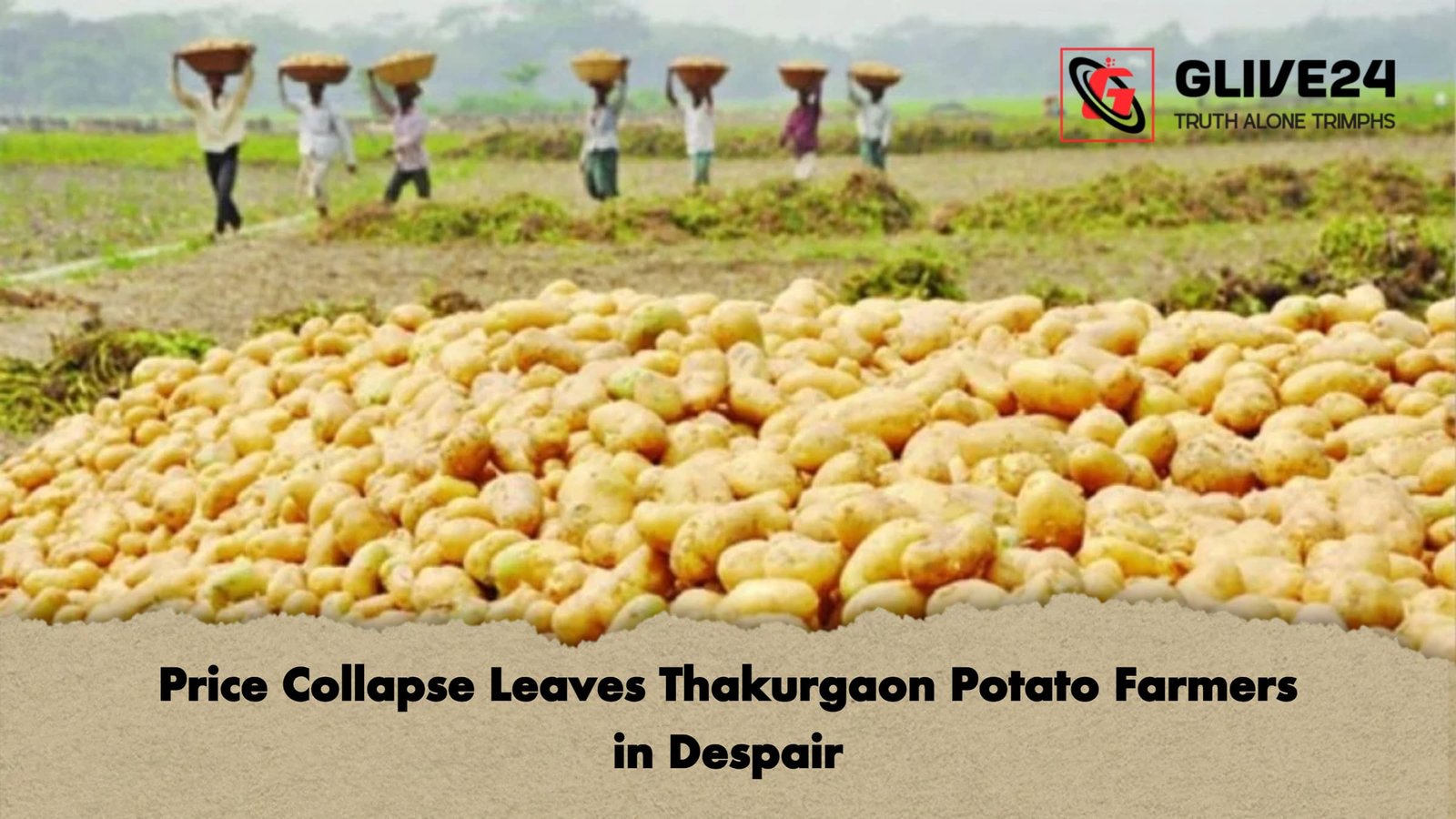
The agricultural heartland of Thakurgaon is currently witnessing a paradox of plenty. While the district has celebrated a bumper harvest of potatoes this season, the joy of high yields has been swiftly replaced by financial catastrophe. A dramatic slump in market prices has left farmers unable to recover even their cultivation costs, let alone the expenses incurred during the harvest itself.
In several regions, a 60kg sack of potatoes is struggling to fetch even 200 BDT, effectively pricing the produce at a meagre 3.33 BDT per kilogram. For many cultivators, this represents a total economic collapse.
A Crisis of Production and Storage
The Department of Agricultural Extension (DAE) in Thakurgaon reported that potato cultivation exceeded expectations this year, with 28,285 hectares of land under tillage against a target of 28,000 hectares. However, this surplus has met a formidable bottleneck: storage. The district’s 17 cold storage facilities can only accommodate roughly 145,532 tonnes, leaving a vast portion of the estimated 700,000-tonne yield exposed to market volatility and decay.
| Metric | Details |
| Cultivation Area (Actual) | 28,285 Hectares |
| Estimated Production Target | 700,000 Tonnes |
| Total Cold Storage Capacity | 145,532 Tonnes (approx. 20%) |
| Average Production Cost | 40,000 BDT per Bigha |
| Current Market Price | 3.33 BDT per kg (200 BDT/60kg sack) |
| Price Decline Status | Critical / Below Harvest Cost |
Voices from the Field
In the Newpara area of Begunbari Union, the desperation is palpable. Mansur Ali, a local farmer who invested heavily in the Granula variety across ten bighas of land, described his predicament as a nightmare. “I spent nearly 40,000 BDT per bigha on seeds, fertiliser, and irrigation. At current prices, I won’t even make 10,000 BDT back. Even worse, wholesalers are demanding an extra 3kg per sack for free to hedge their own risks,” he lamented.
Another farmer, Nurul Alam, noted that a late-season blight caused the potatoes to be smaller than usual, further diminishing their appeal to wholesalers. Meanwhile, traders in the municipal markets, such as Rafiqul Islam, point to a stagnant market caused by the intersection of the Ramadan season and a cooling national demand.
Administrative Perspective
Majedul Islam, Deputy Director of the DAE Thakurgaon, remarked that the department had initially advised farmers to diversify their crops following last year’s fluctuations. However, the allure of potential profits led to over-cultivation. He stressed that without a significant expansion in cold storage infrastructure or the development of a potato-processing industry, farmers remain trapped in a cycle of “boom and bust.”