
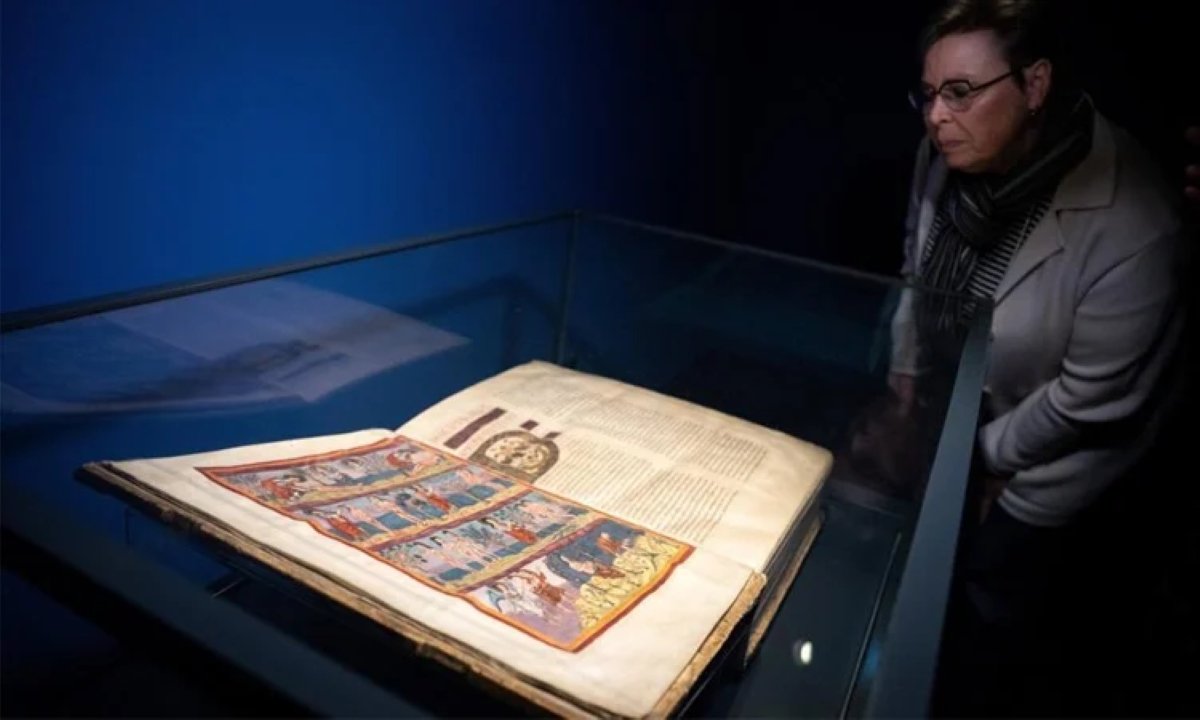
DELÉMONT, Switzerland, 7 March 2025 – The Moutier-Grandval Bible, a ninth-century illustrated manuscript of extraordinary historical and artistic significance, has returned to Switzerland for a rare public display. This mediaeval masterpiece, which miraculously survived the trials of history, is now on loan from the British Library to the Jura Museum of Art and History in Delémont for a three-month exhibition.
Produced in Tours, France, between 830 and 840 AD, the manuscript eventually made its way to Moutier-Grandval Abbey, nestled in the Jura region of northwestern Switzerland. Remarkably well preserved, the 22-kilogramme (50-pound) manuscript is considered one of the world’s most exquisite examples of early mediaeval script and illustration.
This marks only the second time the Bible has been loaned from London, the last occasion being in 1981, when it drew a staggering 32,000 visitors to the Jura Museum. “It is nothing short of a miracle that this mediaeval masterpiece has endured through the ages, escaping wars, looting, fires, and revolutions to remain in such remarkable condition,” said Nathalie Fleury, director of the Jura Museum.
The Bible’s arrival in Switzerland on Tuesday was met with deep emotion. “More than 1,200 years of history were in our hands,” Fleury added.
A Mediaeval Masterpiece
Of the approximately 100 Bibles produced in Tours during this period, only 18 have survived intact, and just three are illustrated. The Moutier-Grandval Bible is the most renowned of these.
Displayed in a secure basement gallery behind a thick steel door, the Bible is exhibited alone in a dimly lit room, enclosed within a glass case to ensure its preservation. The exhibition is highly regulated, with only five visitors permitted at a time, each allowed a five-minute viewing period.
The manuscript is open to a striking illustration from the Book of Genesis depicting the story of Adam and Eve, with its colours and gold accents remaining astonishingly vivid despite the passage of centuries.
“The Moutier-Grandval Bible is an extraordinary testament to the skill and dedication of early mediaeval scribes and artists,” said Claire Breay, head of ancient, mediaeval, and early modern manuscripts at the British Library. “It is one of the British Library’s greatest treasures, continuing to inspire awe and wonder to this day.”
An Object of Mystery and Legacy
The massive manuscript consists of 450 leaves, or 900 pages, each measuring 50 by 37.5 centimetres (20 by 15 inches). The parchment required the skins of between 210 and 225 sheep. The text, written in elegant Carolingian minuscule script, was produced by approximately 20 scribes, and the Bible contains four full-page illustrations.
Despite its well-documented craftsmanship, many aspects of the Bible’s history remain enigmatic. Its journey to Moutier-Grandval Abbey remains uncertain, and its rediscovery is shrouded in legend. According to local accounts, the manuscript was left behind by the canons of Moutier-Grandval Abbey and was only found in an attic in Delémont in the early 19th century. In 1822, it was sold to an antiques dealer before being acquired by the British Museum in 1836 for £750—equivalent to approximately $93,600 in today’s currency.
“The Bible’s significance for the Jura region is immense,” explained Angeline Rais, a book historian and co-curator of the exhibition. “The founding of Moutier-Grandval Abbey in the 7th century is seen as the beginning of Jura’s recorded history. There is a profound connection between the local community and this manuscript.”
The Future of the Bible’s Study and Display
The exhibition will be open to the public from 8 March until 8 June 2025. Ongoing research is being conducted on the Bible’s parchment and pigments to further understand its origins and artistic techniques.
Curators and historians in Jura hope that this will not be the last time the Bible returns to its homeland. By the time it makes its next visit, experts hope to have unravelled more of the manuscript’s secrets, shedding new light on its extraordinary journey through the centuries.
Supplementary Context:
The Carolingian Renaissance, during which the Moutier-Grandval Bible was created, was a period of renewed artistic and scholarly activity in mediaeval Europe, encouraged by Charlemagne. The script used in the manuscript, Carolingian minuscule, later influenced the development of modern European handwriting and typography.
The British Library, where the Bible is housed, contains some of the world’s most significant historical manuscripts, including the Lindisfarne Gospels and the Magna Carta. Switzerland’s Jura region, where the Bible is currently on display, has a long monastic history, with Moutier-Grandval Abbey playing a crucial role in the spread of Christianity and learning in the area during the early Middle Ages.