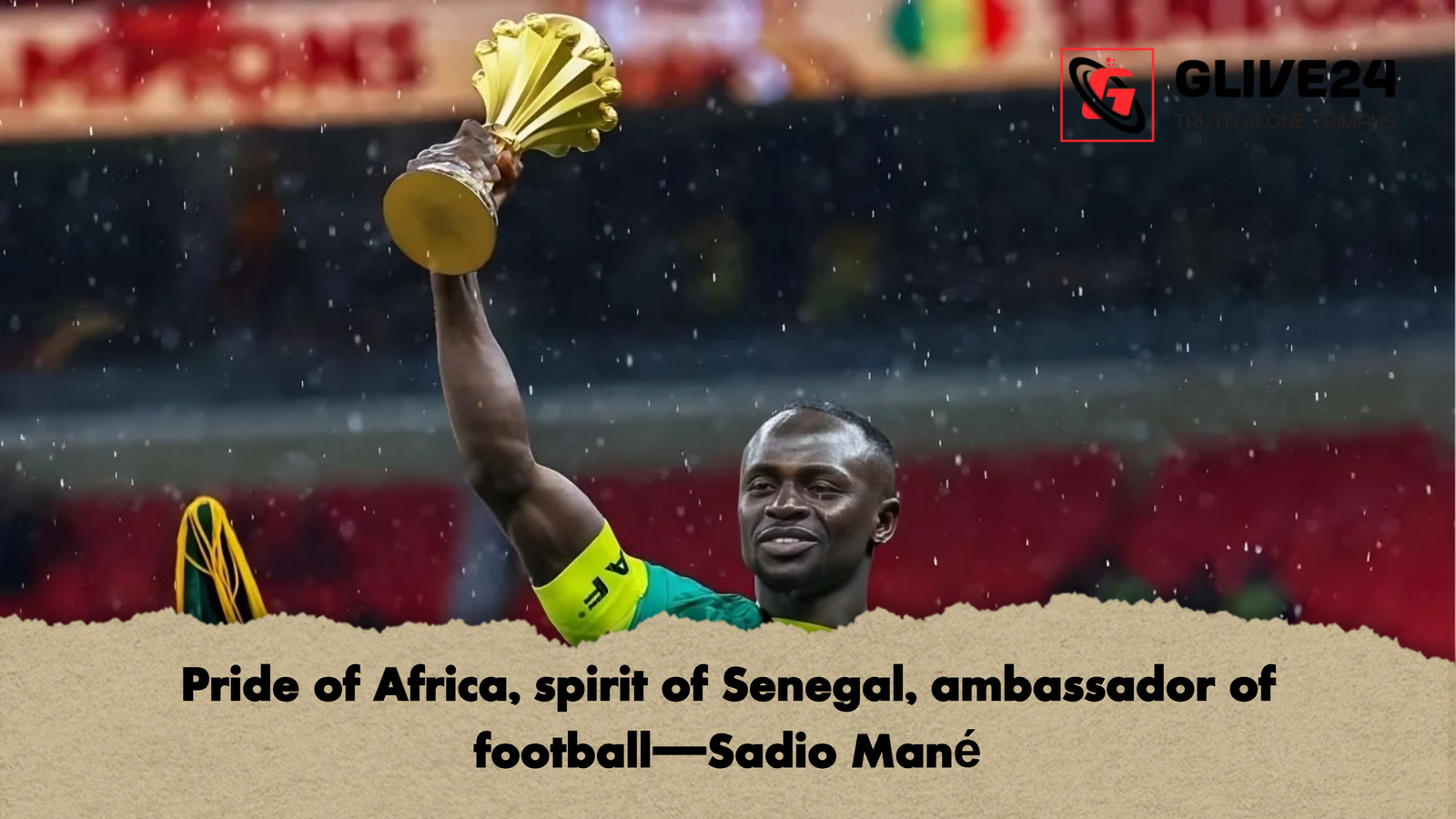
To be a hero or a legend, what must one achieve? History is replete with warriors, visionaries, and pioneers whose feats have echoed through time. But in the world of football, the criteria are different. Is scoring goals alone enough to earn the mantle of greatness? Legendary Diego Maradona offered one answer long ago, yet comparisons fall short when discussing Sadio Mané. In his homeland, the Senegalese forward has already carved a legacy befitting a hero.
The defining moment came not in ordinary circumstances but during the dramatic climax of the Africa Cup of Nations (AFCON). In the packed Stade Prince Moulay Abdellah in Rabat, Morocco, the hosts were on the cusp of glory, nearly half a century after their last continental triumph. The 90-minute battle had ended, and the eight minutes of stoppage time had nearly elapsed.
A sudden roar erupted as the referee awarded a penalty following a contentious incident. Earlier, Senegal defender Ismaïla Sarr had seen a goal disallowed, intensifying tensions. The sequence began with a Moroccan corner, which sent the ball toward the far post. Real Madrid forward Brahim Díaz went down under a challenge. After consulting the VAR, the referee confirmed the penalty, surrounded by an anxious crowd.
Senegal coach Aliou Cissé responded in shock, ordering his players off the field—a rare, unprecedented move. Only Sadio Mané remained, mediating between the players and officials, persuading his team to return to the pitch. After a 16-minute interlude, Díaz missed the Panenka penalty, and in extra time, Senegal’s Papé Gueye scored the decisive goal, delivering the nation its second AFCON trophy.
The match itself was overshadowed not by goals or misses, but by Mané’s leadership and integrity. Post-match, the 33-year-old forward reflected, “Football is a special game. The world was watching, and we must always represent it well. Walking off in anger over a penalty would have been foolish, especially for African football. We accepted the situation and finished the match—then things unfolded as they should.”
Mané’s heroism extends beyond the pitch. Former Nigerian international Darrell Amokachi praised him, saying, “He went above and beyond to bring his teammates back onto the field. He is truly an ambassador of football.” Even Morocco’s former player Hassan Kachloul noted, “Until Mané intervened, African football had lost a moment of pride. He showed the heart of a true man.”
From a dusty village in Bambali, Senegal, to lifting Europe’s most prestigious trophies, Mané’s journey is a testament to perseverance. Inspired as a 13-year-old by Liverpool’s legendary 2005 Champions League comeback in Istanbul, he went on to win the Premier League, Champions League, and two AFCON titles. In recognition, a stadium near his birthplace has been named in his honour.
His Senegalese teammate Papé Gueye hopes Mané’s story continues, aiming to retain him for the 2027 AFCON in Kenya, Tanzania, and Uganda. Whether on African soil or the global stage, Sadio Mané remains football’s guiding light—a player whose legacy transcends trophies. As fans, we can only say: Thank you, Mané, football is richer because of you.
Sadio Mané: Career Highlights
| Year | Achievement | Team |
|---|---|---|
| 2005 | Inspired by Liverpool’s Champions League final | — |
| 2011–2016 | European club debut & rise with Southampton | Southampton |
| 2016–2022 | Champions League, Premier League titles | Liverpool |
| 2019 | First AFCON title | Senegal |
| 2021 | Second AFCON title, scored decisive penalty | Senegal |
| 2021 | Stadium near birthplace named after him | Bambali, Senegal |