
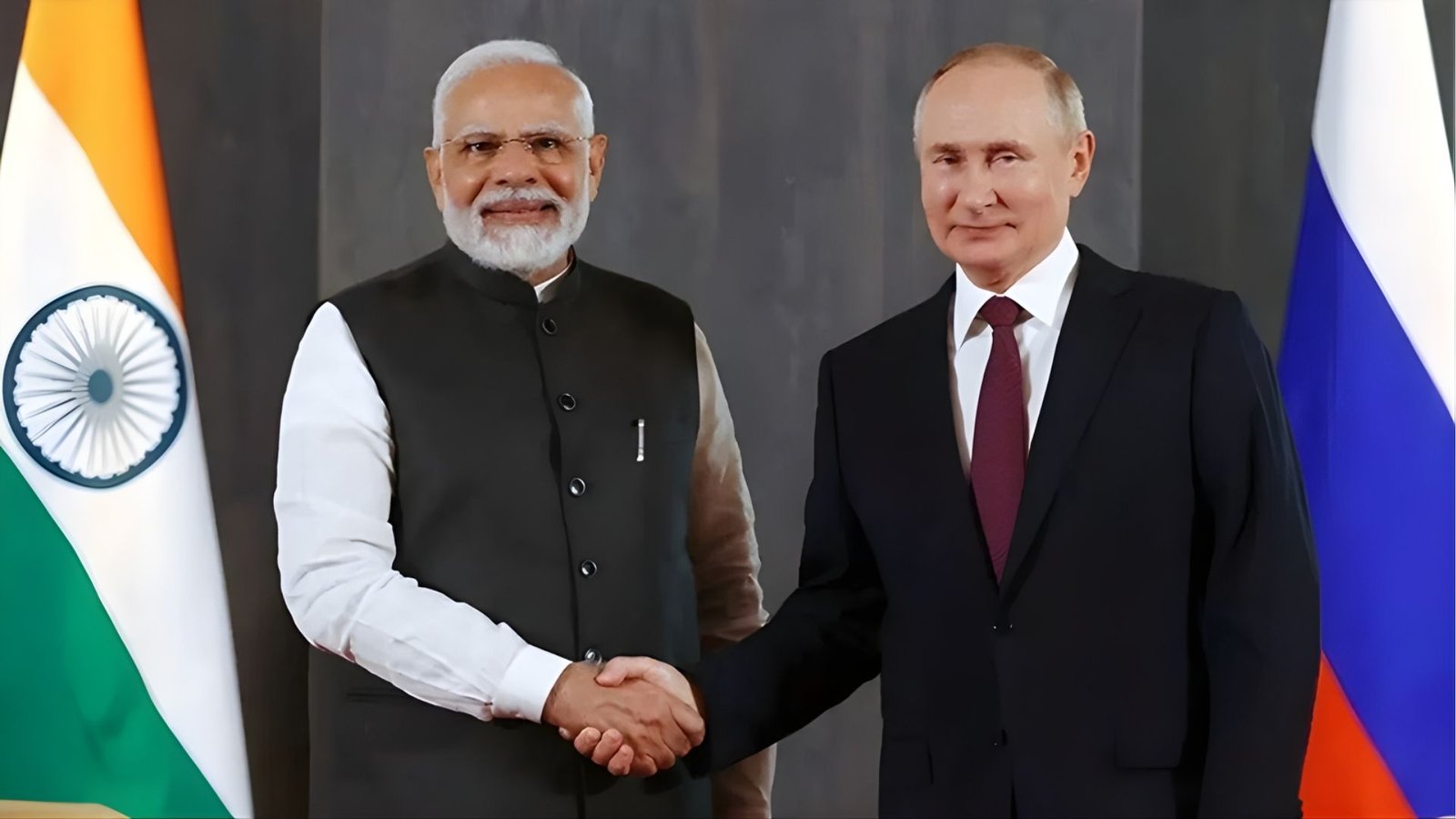
Russian President Vladimir Putin landed in New Delhi on Thursday for a two-day visit—his first to India since the outbreak of the Ukraine war. Prime Minister Narendra Modi welcomed him with a reception of full ceremonial splendour, the kind of elaborate protocol India reserves for its closest allies. On Friday, the two leaders will meet for high-level talks before attending the annual India–Russia summit.
Putin last travelled to India in late 2021. This time, he will be officially received at Rashtrapati Bhavan and join Modi for a luncheon at Hyderabad House, where he will also stay during the visit. The scale of the welcome underscores the durability of ties that stretch back to the Cold War.
But the optics also reveal the complexity of India’s modern diplomacy. Even as it hosts the Russian president with grandeur, New Delhi is locked in tough negotiations with Washington over a critical trade agreement. The US has imposed punitive tariffs of 50 per cent on Indian goods, partly in response to India’s continued purchase of discounted Russian oil—one of the few major lifelines for Moscow amid Western sanctions.
India has taken steps to ease American concerns, including reducing Russian crude imports and agreeing to buy significant quantities of US liquefied petroleum gas. Nevertheless, defence cooperation with Russia remains a priority. India views Russian systems—including advanced fighter aircraft—as vital to safeguarding its borders, especially given rising tensions with China and Pakistan.
Yet the strategic picture is full of contradictions. Russia is one of China’s closest partners. China supplies major weaponry, including fighter jets, to Pakistan. India must therefore navigate a delicate geopolitical ecosystem in which its principal rival and its traditional defence ally are increasingly aligned.
By giving Putin an exceptionally warm reception, New Delhi is signalling that it maintains strategic choices beyond Washington or Beijing, says Kanti Bajpai, visiting professor at Ashoka University. According to him, India is signalling loyalty to Moscow despite international criticism, using this relationship as diplomatic leverage.
India’s ties with Russia were cemented in the Cold War era, when the Soviet Union provided critical support in defence, industry and economic development. Moscow emerged as India’s most reliable partner at a time when the United States was arming Pakistan. That legacy still shapes New Delhi’s calculations: despite some decline, Russia remains India’s largest supplier of military hardware.
A large proportion of India’s current fighter aircraft fleet consists of Russian-made Su-30 jets, and Kremlin officials have hinted that talks this week may also cover the possibility of India acquiring Russia’s Su-57 stealth fighters.
The economic side of the relationship, however, has recently proved more contentious. Since 2022, India has dramatically increased purchases of Russian crude oil, becoming one of Moscow’s biggest export markets. Western governments have criticised this as undermining sanctions, but India maintains that its foremost duty is to its citizens and economy.
Observers warn that India must be cautious, especially with sensitive trade negotiations underway. Heavy US tariffs and sanctions on Russian energy companies have already caused Indian oil imports to drop sharply, expected this month to hit their lowest point in three years.
At the same time, tensions with China appear to be easing—if only marginally—as Modi recently visited Beijing for the first time in seven years, attending a summit hosted by Xi Jinping. Analysts view this as part of India’s broader strategy to ensure it is not boxed in by any single global power.
Despite its multidirectional diplomacy, New Delhi continues to deepen its partnership with Washington, including through technology transfer agreements, joint military exercises and a newly agreed ten-year industrial cooperation framework. Indian officials hope a trade deal with the US can be finalised by year’s end.
Still, the balancing act remains fraught. Putin’s visit, coming at this delicate juncture, places India’s strategic tightrope under sharper scrutiny. As Nandan Unnikrishnan of the Observer Research Foundation puts it, “India must tread very carefully—this is not the moment to add new complications.”