
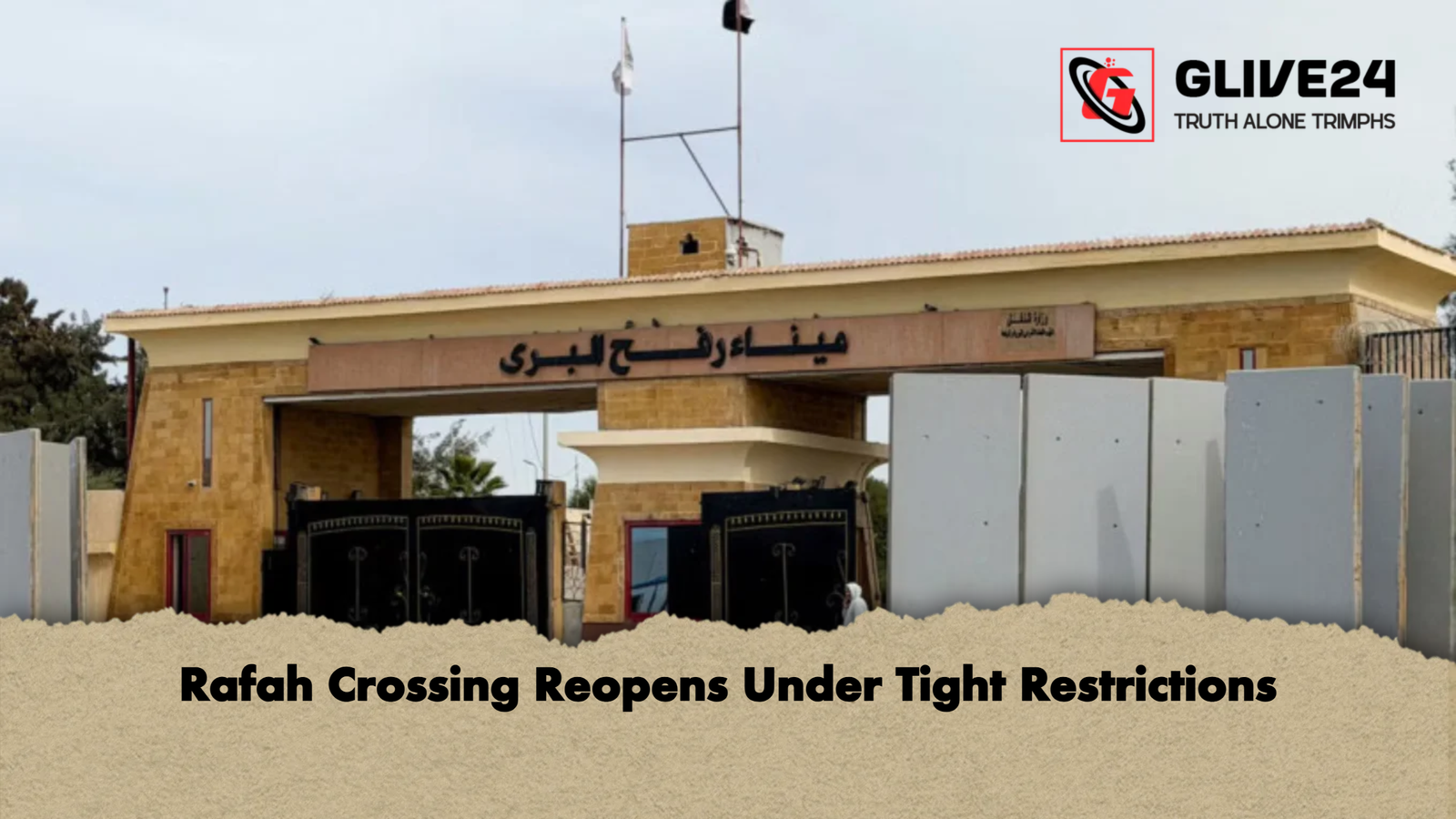
After months of closure amid intense conflict, the Rafah border crossing—vital for Palestinians in Gaza—has partially reopened, offering a narrow but symbolically significant lifeline to the besieged enclave. An Israeli security official confirmed on Monday that the crossing had resumed operations. However, Egyptian state-affiliated media reported that movement will initially be extremely limited, with permission granted for only 50 people per day in each direction.
The reopening follows a deadly weekend in Gaza, during which dozens of people were killed in a wave of Israeli air strikes, according to Gaza’s Civil Defence authorities. The Israeli military stated that the strikes were carried out in response to Palestinian fighters emerging from a tunnel in the Rafah area, underscoring the fragile and volatile security environment surrounding the crossing’s resumption.
Rafah is Gaza’s sole crossing point that does not pass through Israeli territory, connecting the enclave directly with Egypt. As such, it holds immense strategic and humanitarian importance. For Gaza’s more than two million residents, the crossing represents the primary gateway for travel abroad, medical evacuations, limited commercial movement, and the delivery of humanitarian assistance. Its prolonged closure has severely compounded Gaza’s humanitarian crisis, leaving thousands stranded and many critically ill patients unable to seek treatment outside the territory.
During the ongoing war between Israel and Hamas, Israeli forces took control of the Rafah crossing in May 2024. Since then, the crossing had remained largely closed, despite repeated appeals from international humanitarian organisations warning of catastrophic consequences for civilians. After months of diplomatic pressure and negotiations, a tightly controlled experimental phase began on Sunday. That initial phase allowed for limited logistical activity but did not include the movement of civilians.
According to the Israeli official, the current reopening has been made possible following the arrival of the European Union Border Assistance Mission (EUBAM) teams. These teams are tasked with monitoring and supporting border operations. “With the EUBAM teams now in place on behalf of the European Union, the Rafah crossing has been opened for residents, both for entry and exit,” the official said, highlighting the international oversight involved in the process.
Egyptian media outlets, including Al-Qahera News, citing sources linked to Egypt’s General Intelligence Service, confirmed that the initial daily quota would be strictly enforced. In the first few days, 50 people are expected to travel from Egypt into Gaza, while another 50 will be permitted to leave Gaza for Egypt each day. A border source added that on Monday, several dozen people had already gathered on the Egyptian side, waiting for clearance to enter Gaza.
Israel’s state broadcaster Kan reported that the crossing would remain open for approximately six hours per day, reflecting ongoing security concerns and the provisional nature of the arrangement.
For many Palestinians, even this limited reopening carries profound personal significance. Mohammed Nasser, a Palestinian man who lost his leg after being injured earlier in the war, described the crossing as a “lifeline”. “I need a surgical procedure that cannot be performed in Gaza,” he said. “Only by travelling abroad can I receive the treatment I need. Rafah is our only hope.”
The key features of the current reopening are summarised below:
| Aspect | Details |
|---|---|
| Status | Partially reopened |
| Daily passenger limit | 50 people each way |
| Operating hours | Approximately 6 hours daily |
| Supervising mission | EU Border Assistance Mission (EUBAM) |
| Primary purpose | Humanitarian travel and medical cases |
While the reopening of the Rafah crossing offers a glimmer of relief, its limited capacity and temporary framework highlight the continuing uncertainty facing Gaza’s population. Whether the crossing will expand its operations or remain constrained will depend largely on security developments and ongoing regional diplomacy.