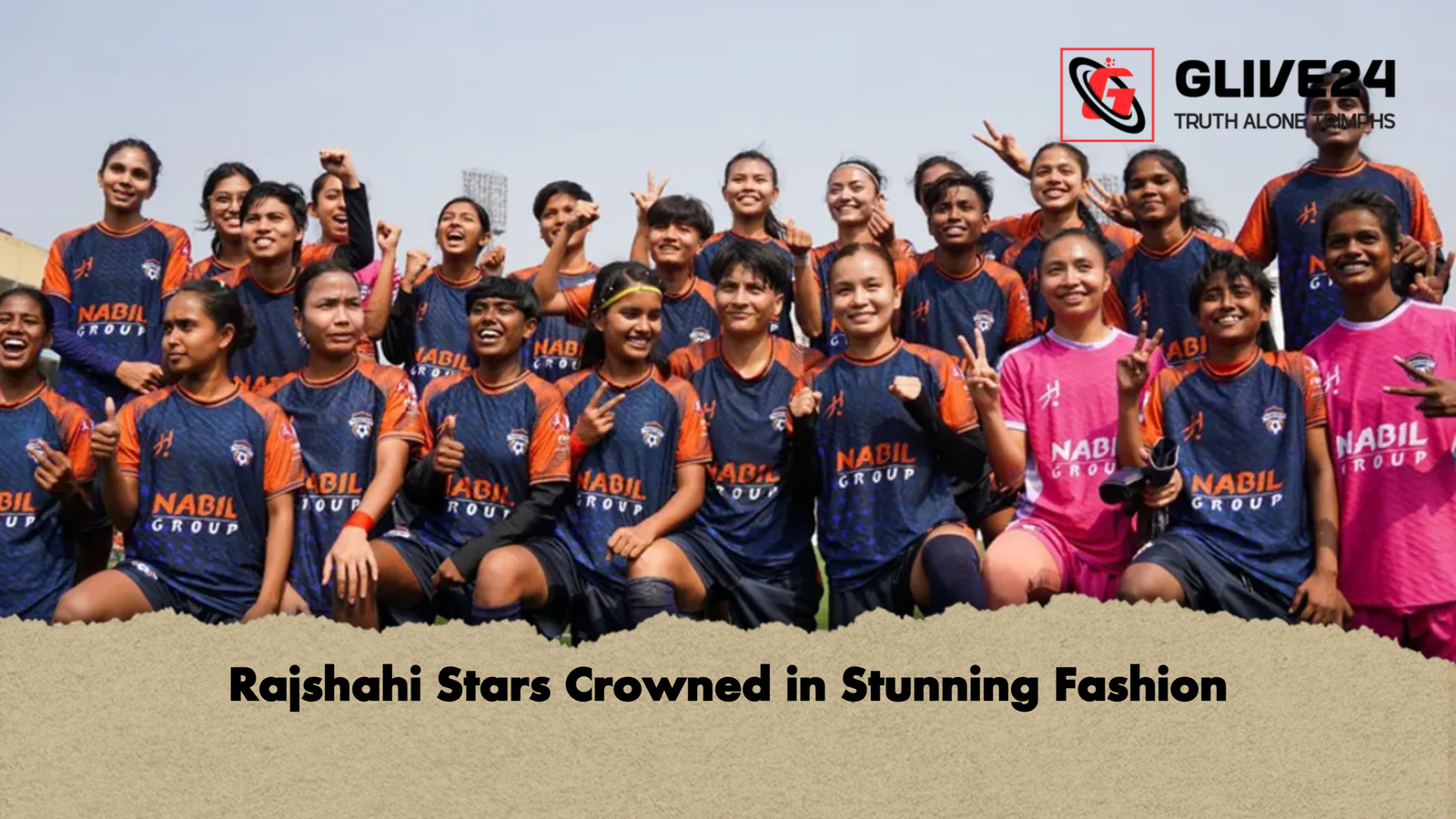
Rajshahi Stars completed a remarkable debut campaign by clinching the Bangladesh Women’s Football League title with a commanding 3–0 victory in the final round. Entering the decisive fixture, the equation was straightforward: a single point would suffice for Rajshahi to secure the championship, while Bangladesh Army required nothing less than victory to force the contest into a play-off. In the end, the newcomers dispensed with arithmetic and delivered a performance befitting champions.
To describe Rajshahi Stars as “astonishing” is no exaggeration. In their first-ever appearance in the top flight, they won all ten of their league matches. Such dominance, though rare, is not entirely unheard of in domestic competitions. What elevates this triumph into extraordinary territory is the defensive record: ten matches, ten clean sheets, and not a single goal conceded. Across those fixtures, Rajshahi scored an astonishing 90 goals—an average of nine per match—underscoring a level of supremacy seldom witnessed in Bangladesh’s women’s game.
Their campaign began with a resounding 12–0 demolition of reigning champions Nasrin Sports Academy. The momentum continued relentlessly as they brushed aside BKSP (4–0), Bangladesh Police (7–0), Bangladesh Ansar (8–0), Jamalpur Kacharipara XI (24–0), Dhaka Rangers (10–0), Farashganj Sporting Club (1–0), Siraj Smriti Sangsad (13–0) and Sadyapuskurni (8–0).
A statistical snapshot of their season illustrates the scale of their achievement:
| Category | Rajshahi Stars |
|---|---|
| Matches Played | 10 |
| Wins | 10 |
| Draws | 0 |
| Losses | 0 |
| Goals Scored | 90 |
| Goals Conceded | 0 |
| Clean Sheets | 10 |
| Average Goals per Match | 9.0 |
The title-deciding encounter, staged at Bir Sreshtha Shaheed Sepoy Mostafa Kamal Stadium, began cautiously. Bangladesh Army’s disciplined defensive shape ensured a goalless first half. However, Rajshahi’s attacking intent intensified after the interval. In the 48th minute, Suravi Akanda Preeti delivered a precise square pass across goal, which goalkeeper could not intercept. Alpi Akter calmly converted into an unguarded net, registering her 30th goal of the season and overtaking Farashganj’s Shamsun Nahar Junior (24) in the race for the golden boot.
Ten minutes later, Shaheda Akter Ripa doubled the advantage, volleying home from a cross by Rituparna Chakma. With four minutes remaining, Rituparna herself sealed the victory, ensuring there would be no late drama. Both Ripa and Rituparna concluded the league with ten goals apiece, adding further depth to Rajshahi’s formidable attacking arsenal.
Farashganj Sporting Club secured the runners-up position, their only defeat coming in a narrow 1–0 loss to the champions. Bangladesh Army finished third following their final-day setback.
Beyond domestic glory, Rajshahi Stars’ triumph carries broader significance. Their title secures qualification for the AFC Women’s Champions League and the SAFF Club Championship. Owing to previous structural limitations within the league, Bangladeshi clubs had been unable to participate consistently in continental competitions, compelling several leading players to represent Bhutanese sides instead. Rajshahi’s ascent, therefore, signals not merely the arrival of a new champion but a potential turning point for women’s club football in Bangladesh.