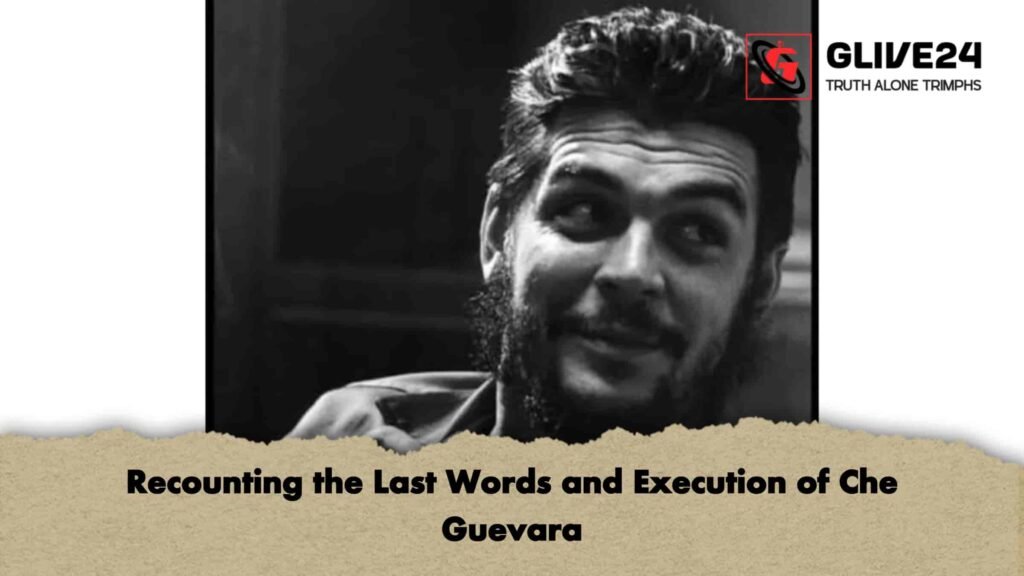
The final moments of Ernesto “Che” Guevara, one of the most widely debated revolutionaries in global history and an enduring symbol of Latin American radicalism, remain a subject of historical documentation and intense scrutiny. According to reports later detailed in The Washington Post, Guevara’s final words upon capture were highly pragmatic. Facing imminent death, he reportedly declared to his captors: “Do not shoot. I am Che Guevara. I am worth more to you alive than dead.”
The Capture in the Bolivian Jungle
On 8 October 1967, inside the remote and rugged mountainous terrain of Bolivia, Guevara was wounded in the knee during a prolonged clash with Bolivian government forces. A subsequent bullet struck his rifle, knocking the weapon from his hands. Completely surrounded by military personnel, he had no alternative but to surrender.
Originally an Argentine medical graduate, Guevara had evolved into a prominent figure of global revolution. He was a key lieutenant alongside Fidel Castro during the Cuban Revolution. Following their victory, he occupied several high-ranking ministerial positions within the newly formed Cuban government. Driven by a desire to spread anti-capitalist insurrections across borders, he subsequently left Cuba to instigate guerrilla movements, first in Africa and later in the dense forests of South America. His objective in Bolivia was to foster a continent-wide popular uprising, but this campaign ultimately marked the end of his life.
Detention and Foreign Involvement
Following his arrest, military forces transported Guevara to a makeshift detention site inside a single-room schoolhouse in the small Bolivian village of La Higuera. He was held there with his limbs bound, wearing torn and soiled clothing. It was in this condition that he was encountered by Félix Rodríguez, a CIA-affiliated operative working directly with the Bolivian military.
While certain factions within the United States government were interested in keeping Guevara alive for prolonged interrogation, the Bolivian military dictatorship feared that a public trial would merely amplify his status as a popular hero. Consequently, the top command decided on an immediate execution.
Reflecting on the encounter in later years, Rodríguez recalled looking into Guevara’s eyes, to which the revolutionary calmly replied: “It is better this way. I should never have been captured alive.” In an unusual historical exchange, the operative and his prisoner shook hands and embraced shortly before the execution sentence was carried out. According to journalist and biographer Jon Lee Anderson in his definitive work Che Guevara: A Revolutionary Life, the task of executing Guevara was assigned to Sergeant Jaime Terán.
Facing his executioner, Guevara reportedly uttered his final defiant remark: “I know you have come to kill me. Shoot, coward, you are only going to kill a man.” Terán then opened fire, ending Guevara’s life at the age of 39.
Aftermath and the Birth of a Legend
The Bolivian authorities subsequently moved Guevara’s body to the nearby town of Vallegrande, where his corpse was displayed to the international press on a concrete laundry sink inside the Nuestra Señora de Malta hospital. Photographs of his body circulated globally, with many commentators noting that the imagery bore a striking resemblance to historical depictions of the dead Christ.
To conclusively verify his identity, authorities amputated both of Guevara’s hands for fingerprint analysis. His remains were then buried secretly in an unmarked mass grave. Following the confirmation of his death, Cuban leader Fidel Castro delivered an emotional address, asserting: “Those who believe that Che’s ideas have died with him are mistaken.” Decades later, his stylized visage remains an internationally recognized symbol of protest, resistance, and leftist ideology.
Key Historical Timeline: The Final Chapter of Che Guevara
| Date / Detail | Historical Event and Location |
| 14 June 1928 | Ernesto Guevara is born in Rosario, Argentina. |
| 8 October 1967 | Wounded, disarmed, and captured by Bolivian forces in the Yuro Ravine. |
| 8–9 October 1967 | Detained and interrogated in a schoolhouse in La Higuera, Bolivia. |
| 9 October 1967 | Executed by Sergeant Jaime Terán under orders from the Bolivian high command. |
| Post-Execution | Body publicly displayed in Vallegrande; hands amputated for identification. |
| Legacy | Becomes an international symbol of revolution and anti-imperialist struggle. |