
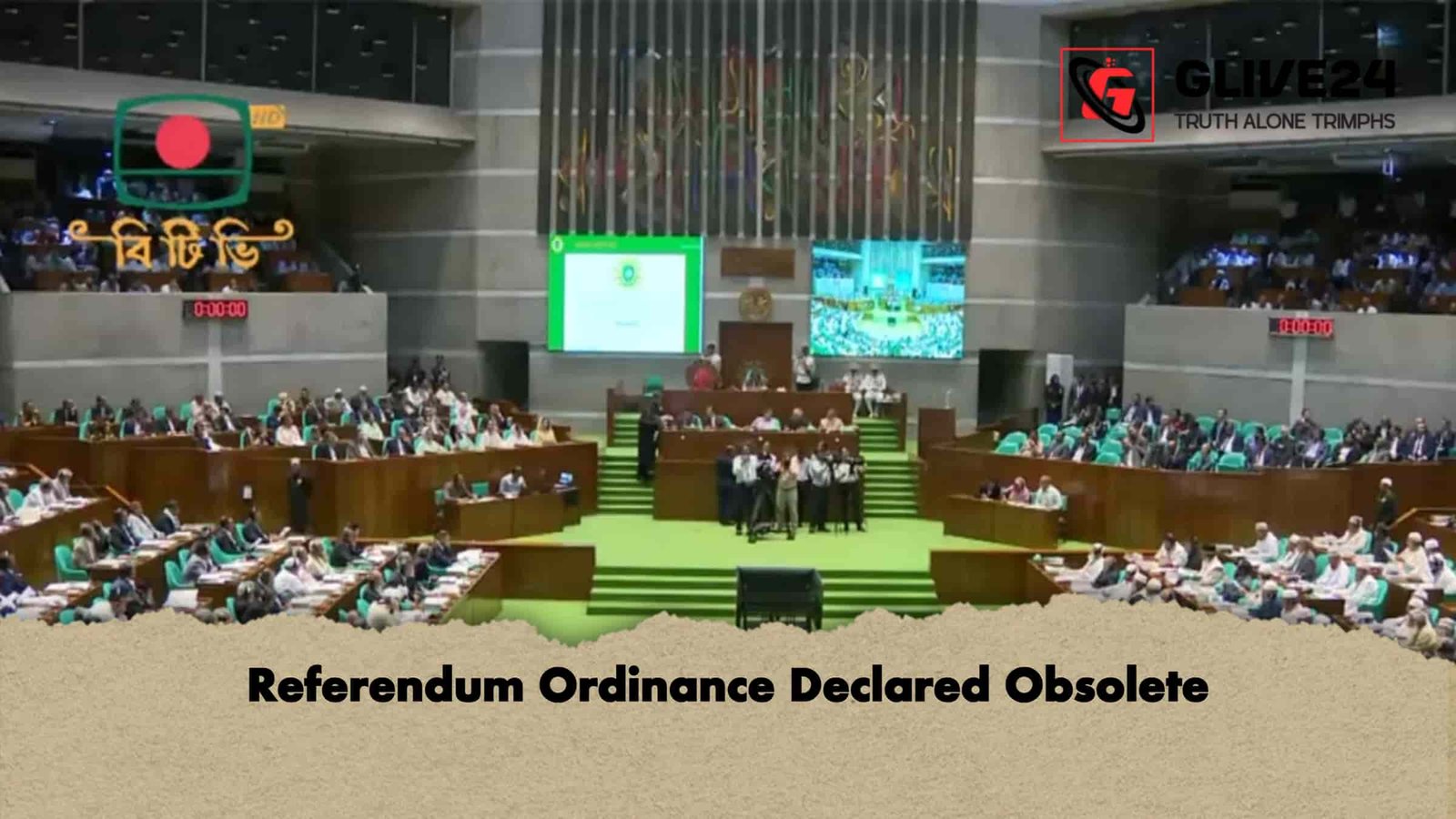
The Referendum Ordinance, under which the recently held national referendum was conducted, will not be converted into law, as its purpose has already been fulfilled, confirmed Home Minister Saluddin Ahmed.
Speaking to reporters on Sunday night (29 March) after a special committee meeting at the National Parliament Building, the minister clarified that there is no legal requirement to present the ordinance as a bill in Parliament.
The decision has drawn a formal note of dissent from Jamaat-e-Islami, highlighting continuing political disagreements over several ordinances issued by the caretaker government.
Of the 133 ordinances enacted by the interim administration, at least 15 remain contested between government and opposition parties. The ruling party has proposed amendments to ordinances on the Human Rights Commission, judicial appointments, prevention of enforced disappearances, and the Anti-Corruption Commission, prompting objections from Jamaat.
Responding to queries regarding the referendum ordinance, Minister Ahmed stated, “The ordinance has already served its purpose. The referendum has taken place, and there will be no further voting under its authority. There is no justification for reintroducing it as a bill.”
He further explained that under Article 93 of the Constitution, ordinances must be tabled in Parliament within a session and their fate determined within 30 days. “Since this ordinance was a temporary legal instrument, not a constitutional law, and the referendum has concluded, its role is finished,” he said.
Regarding the committee proceedings, the minister added that all 133 ordinances were reviewed in detail. Many will be passed as originally drafted, while some will return in amended form. Due to the limited time before the parliamentary deadline on 10 April, not all ordinances can be presented immediately; remaining ordinances will be introduced in the next session.
Minister Ahmed noted that several committee members, both from the government and opposition, issued notes of dissent on specific ordinances. “Their perspectives will be reflected in the final committee report. During the bill readings in Parliament, members will have the opportunity to state their positions,” he added.
He also addressed the automatic lapse of ordinances not tabled within 30 days, saying, “Any ordinance not presented will automatically expire, but critical measures, such as boundary demarcation and administrative appointments, will be reintroduced as bills to ensure legal effect.”
The third day of the committee meeting, chaired by Zainul Abedin, convened in the Cabinet Room from 8:30 pm for three hours. Attending were Chief Whip Nurul Islam, Law Minister Md. Asaduzzaman, Dr. Muhammad Osman Faruk, A.M. Mahbub Uddin, State Minister for Public Administration Md. Abdul Bari, Muhammad Nawshad Zamir, State Minister for Social Welfare Farzana Sharmin, and Md. Mujibur Rahman. Jamaat-e-Islami was represented by Mojibur Rahman, G.M. Nazrul Islam, and Mohammad Nazibur Rahman.
Overview of Key Ordinances
| Ordinance Category | Government Action | Opposition Reaction |
|---|---|---|
| Referendum Ordinance | Not required to convert | Note of dissent (Jamaat) |
| Human Rights Commission | Amend | Objection |
| Judicial Appointments | Amend | Objection |
| Anti-Corruption Commission | Amend | Objection |
| Prevention of Enforced Disappearances | Amend | Objection |
| Remaining 128 ordinances | Pass as-is or amend later | Mixed views |
The committee’s deliberations are intended to balance swift legislative action with the need to formally record dissenting opinions, ensuring both procedural compliance and political transparency.