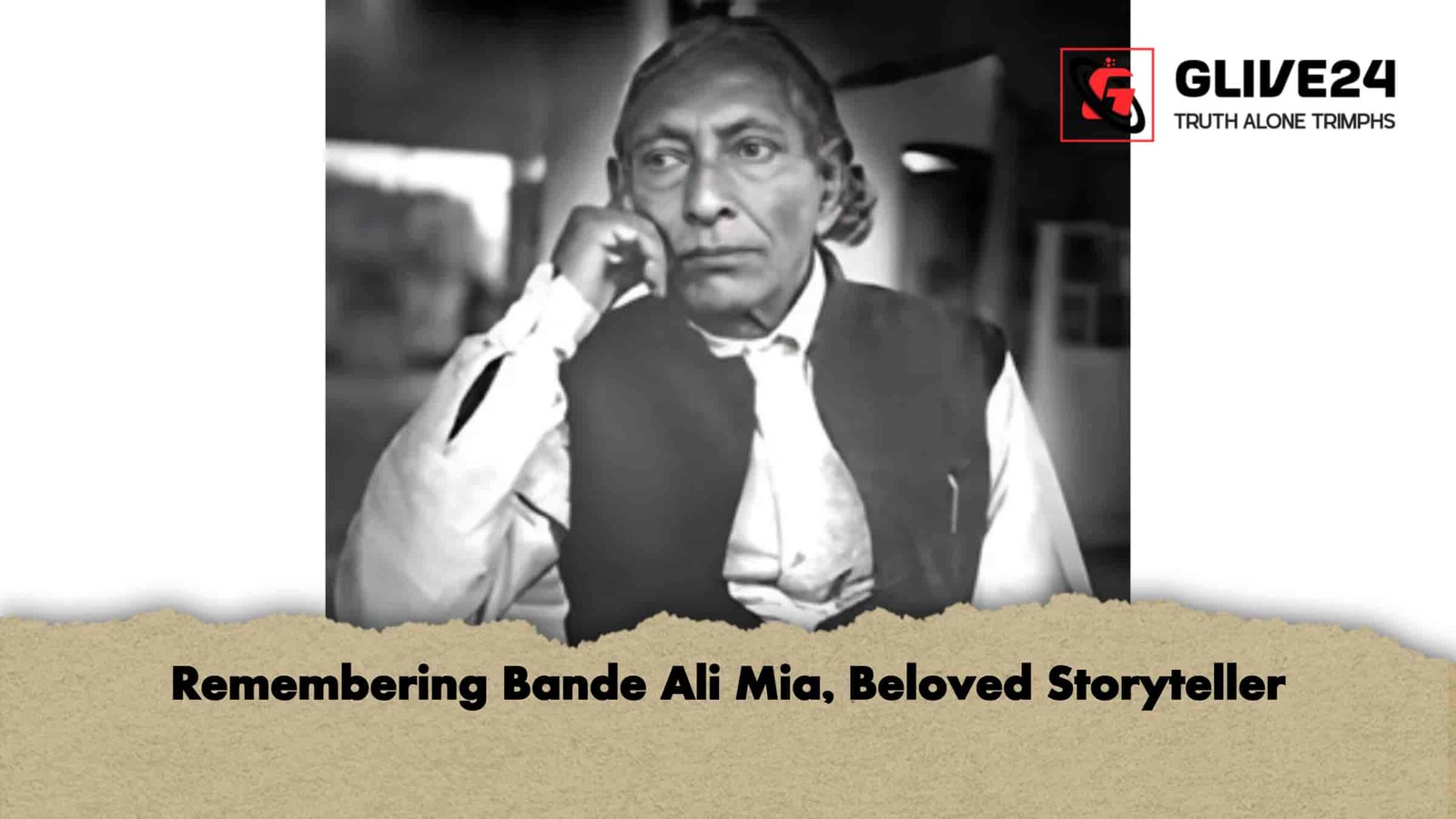
The celebrated lines, “In our little village stand humble homes; together we live, with no one left apart,” encapsulate the essence of rural Bengal—its simplicity, mutual affection, moral clarity, and enduring human warmth. These immortal words were penned by Bande Ali Mia, a writer affectionately remembered across generations as Golpo Dadu, or the grandfather of stories. Few figures in Bengali literature have managed to bridge poetry, storytelling, drama, and the imaginative world of children with such gentle authority and lasting influence.
Bande Ali Mia occupies a singular position in modern Bengali letters. A poet, novelist, short story writer, playwright, journalist, children’s author, and visual artist, his creative range was remarkably broad. Yet his defining strength lay not in rhetorical flourish but in restraint. His language was measured, his tone compassionate, and his moral vision quietly luminous. Ordinary lives—particularly those of children and rural families—formed the emotional core of his work, presented with empathy rather than sentimentality.
Born on 17 January 1906 in Radhanagar village of Pabna district, Bande Ali Mia grew up in modest circumstances. His father, Munshi Umed Ali, held a junior post at the Pabna Judges’ Court. Financial limitations were a constant reality, but the household placed strong emphasis on education and ethical discipline. These early influences shaped the writer’s lifelong commitment to moral clarity, social harmony, and intellectual sincerity.
Academically gifted, he passed his matriculation examination in 1923 from Majumdar Academy in Pabna. He later enrolled at the Calcutta Art Academy, graduating with first-class honours. This formal training in fine arts left a lasting imprint on his literary craft. His prose is notable for its visual precision, careful composition, and evocative imagery, qualities that distinguish his narratives from many of his contemporaries.
Bande Ali Mia began his professional life in journalism, joining the newspaper Islam Darpan in 1925. From 1930 to 1946, he served as a teacher in schools run by the Calcutta Corporation. These years proved formative, allowing his literary output to mature in both scope and depth. Living in pre-Partition Calcutta, he came into contact with Rabindranath Tagore and Kazi Nazrul Islam, whose intellectual presence exerted a subtle yet significant influence on his literary consciousness.
Over his lifetime, Bande Ali Mia published nearly two hundred books across multiple genres. His poems, plays, and lyrical works were also adapted and circulated through gramophone recordings, extending his reach beyond the printed page. After relocating to Dhaka in 1964, he later joined Rajshahi Radio, where his voice and stories found an even wider audience.
In recognition of his literary achievements, he received the Bangla Academy Award and the President’s Award during his lifetime. Posthumously, he was honoured with the Ekushey Padak. Bande Ali Mia passed away on 27 June 1979 at his residence in Kajirhat, Rajshahi. Today, he endures as a defining voice of rural life, a trusted companion of children’s imagination, and a lasting symbol of humane literary beauty.
Key Milestones in Bande Ali Mia’s Life
| Year | Event |
|---|---|
| 1906 | Born in Radhanagar village, Pabna district |
| 1923 | Passed matriculation from Majumdar Academy |
| 1925 | Began career in journalism |
| 1930–1946 | Taught in Calcutta Corporation schools |
| 1962 | Received the Bangla Academy Award |
| 1964 | Moved to Dhaka; later joined Rajshahi Radio |
| 1979 | Passed away in Rajshahi; later awarded the Ekushey Padak |