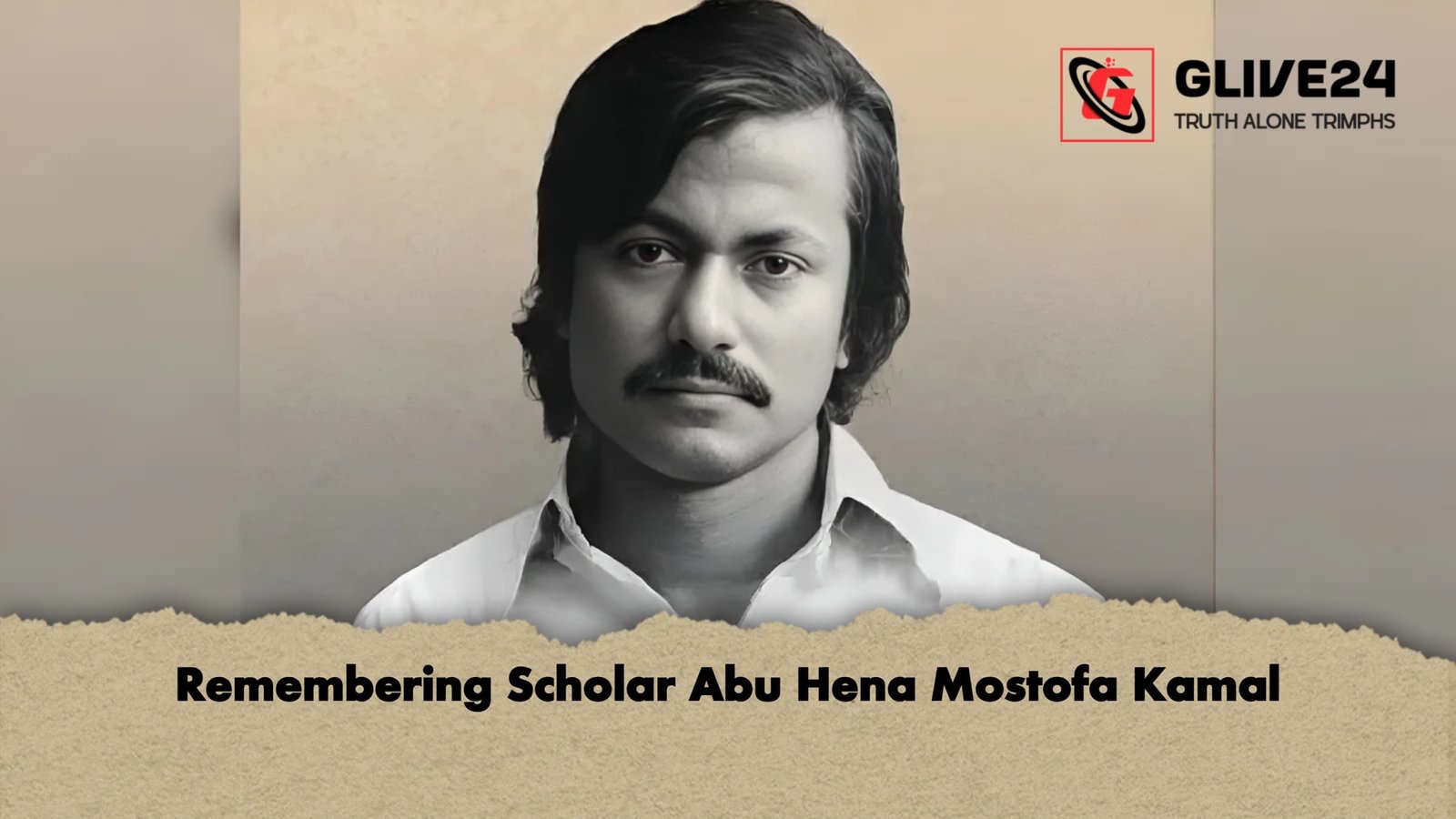
Professor Dr Abu Hena Mostofa Kamal remains one of the most distinguished figures in the fields of Bengali literature, music and education. A scholar of remarkable versatility, he was simultaneously an eminent academic, poet, lyricist, researcher, essayist and captivating public speaker. His creative works enriched the tradition of modern Bengali songs, while his scholarly writings and research contributed significantly to the intellectual development of Bengali literary studies.
Dr Kamal was born on 13 March 1936 in the Gobinda neighbourhood of Pabna town, in present-day Bangladesh. From an early age he demonstrated exceptional academic ability and a strong cultural inclination. He completed his matriculation from Pabna Zilla School in 1952 and later passed the Intermediate examination from Dhaka College in 1954. Pursuing higher education at the University of Dhaka, he enrolled in the Department of Bengali and obtained his Bachelor’s degree with honours in 1958, followed by a Master’s degree in 1959.
During the 1950s, Dhaka was witnessing an important cultural and literary awakening. Dr Kamal emerged as an active member of this vibrant intellectual milieu. Even as a student, he became widely recognised as a passionate advocate of literary and cultural activities. In 1954, together with Mohammad Mahfuzullah, he edited a notable anthology titled Purbo Banglar Kobita (Poetry of East Bengal), which helped introduce emerging poets of the region to a broader readership.
Alongside friends such as Abu Bakar Khan, Anwaruddin Khan and Mohammad Asfaddaula, he played a pivotal role in nurturing a creative circle devoted to modern Bengali music. Many of his lyrics later gained widespread popularity among audiences. One of his most celebrated songs, “Sei Champa Nodir Tire” (On the Banks of the Champa River), sung by Abu Bakar Khan, achieved enduring recognition and remains an iconic piece in the history of Bengali music. Dr Kamal was also associated with Dhaka Radio (Radio Pakistan, Dhaka) as a regular contributor during his early career.
The lyrical beauty of his compositions reflected profound emotional sensitivity, romantic expression and, at times, subtle patriotic sentiments. His mastery of language and ability to weave emotion with poetic elegance gave his works a distinctive literary identity. Beyond writing, he was also admired as a lively television presenter and an engaging commentator who could discuss literature and culture with both depth and humour.
Teaching formed the foundation of his professional life. He began his career as a college lecturer before briefly serving in 1962 as Assistant Director in the Department of Public Relations. In 1963 he joined the Department of Bengali at the University of Dhaka as a lecturer. Two years later, in 1965, he moved to Rajshahi University as a senior lecturer.
In 1966 he received a Commonwealth Scholarship that enabled him to pursue advanced research at the University of London. His doctoral thesis, titled “The Bengali Press and Literary Writing (1818–1831)”, examined the relationship between early Bengali newspapers and literary developments in the nineteenth century. The research remains a valuable scholarly contribution to the study of Bengali literary history and the evolution of the Bengali press.
In September 1973, Dr Kamal joined the University of Chittagong as an Associate Professor in the Department of Bengali. Later, in 1978, he returned to the University of Dhaka as a Professor. Through decades of teaching and research, he inspired countless students and scholars, encouraging a rigorous and analytical approach to literary studies.
He also played an influential role in national cultural institutions. In 1984 he was appointed Director General of the Bangladesh Shilpakala Academy, the country’s principal institution for the promotion of arts and culture. Two years later, in 1986, he became Director General of Bangla Academy, where he contributed to strengthening literary research, publications and cultural initiatives.
The following table summarises key aspects of his life and career:
| Category | Details |
|---|---|
| Full Name | Professor Dr Abu Hena Mostofa Kamal |
| Date of Birth | 13 March 1936 |
| Place of Birth | Pabna, Bangladesh |
| Education | BA (Honours) and MA in Bengali, University of Dhaka |
| Doctorate | University of London (Commonwealth Scholar) |
| Academic Career | Dhaka University, Rajshahi University, Chittagong University |
| Cultural Roles | Director General, Bangladesh Shilpakala Academy; Director General, Bangla Academy |
| Notable Works | Sei Champa Nodir Tire (song), essays such as Shilpir Rupantar and Kotha O Kobita |
Dr Kamal’s prose writings are equally noteworthy. His essays, literary criticism and research articles reveal a profound understanding of literature, combined with analytical clarity and stylistic elegance. His essay collections Shilpir Rupantar (Transformation of the Artist) and Kotha O Kobita (Words and Poetry) remain important contributions to literary criticism in Bangladesh.
Professor Dr Abu Hena Mostofa Kamal passed away on 23 September 1989. Yet his legacy continues to resonate in the cultural and intellectual life of Bangladesh. His songs, poetry, essays and scholarly works still inspire readers, students and researchers alike.
On his birth anniversary, scholars and admirers remember him with deep respect and gratitude. H