
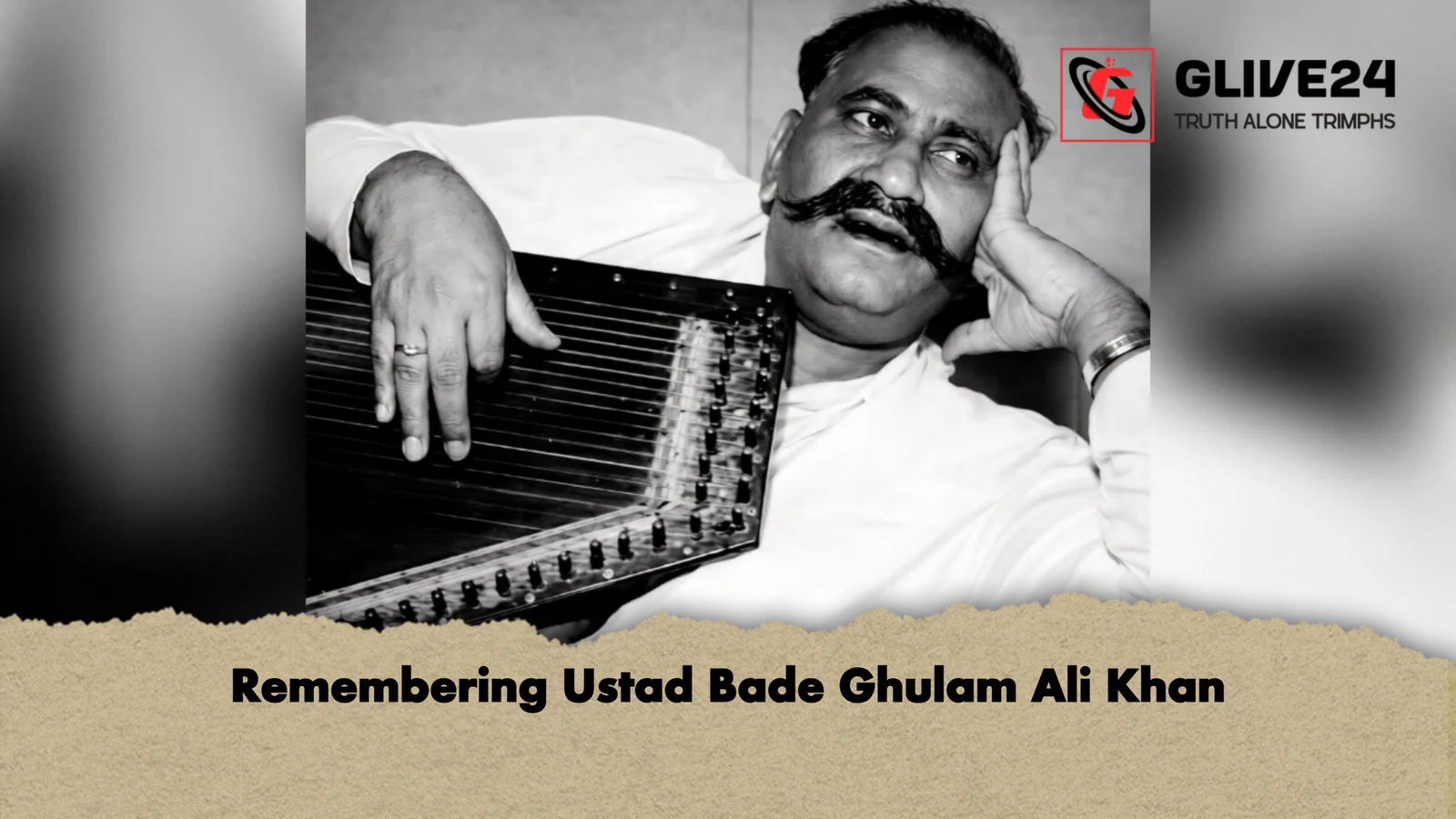
In the closing months of 1947, the Indian subcontinent bore the fresh scars of Partition. Borders had been redrawn, identities reshaped, and lives unsettled. Amid this historical upheaval stood one of the greatest voices in Hindustani classical music—Ustad Bade Ghulam Ali Khan, a maestro whose art transcended political geography and communal categorisation.
Although born into a region that became part of Pakistan after Partition, his identity as a musician was never confined by nationality or religion. He belonged, instead, to the expansive and timeless tradition of classical music. Invited by Radio Pakistan, he continued to perform during this turbulent period, lending his voice to recordings that would later echo across generations. His music carried him from Peshawar to Karachi, where he performed at numerous gatherings, each recital reinforcing his reputation as a towering figure in the khayal and thumri traditions.
Yet, a defining moment in his life came through an unexpected administrative request. Following a performance, he received a formal communication from a programme director requesting a seemingly minor alteration in one of his popular thumri compositions. The objection was to the phrase “Hai Ram”, featured in the evocative line: “Yaad piya ki aaye, hai Ram…”
The suggestion was that the phrase be removed. To the maestro, however, this was not a mere lyrical adjustment but an intrusion into the emotional and cultural integrity of the composition. For him, such expressions were not religious assertions but poetic articulations of longing, devotion, and aesthetic depth embedded in centuries of musical tradition.
His response became legendary for its firmness and clarity. In essence, he rejected the premise that artistic expression could be sanitised or selectively edited to suit external sensitivities. In doing so, he affirmed the autonomy of music as an art form rooted in emotional truth rather than ideological constraint.
Shortly thereafter, he wrote to Dr Rajendra Prasad, the first President of independent India, expressing a profound personal and artistic sentiment: that music built upon the emotions of love, pain, and yearning deserved a space free from sectarian limitations. Within a short span, he made a decisive move, aligning himself with India’s secular cultural landscape and relocating to Kolkata—a city long regarded as a vibrant centre of classical music and artistic freedom.
Key Biographical Overview
| Category | Details |
|---|---|
| Full Name | Ustad Bade Ghulam Ali Khan |
| Date of Birth | 2 April 1902 |
| Date of Death | 23 April 1968 |
| Primary Genres | Khayal, Thumri |
| Musical Tradition | Kirana Gharana |
| Known For | Emotional depth, melodic improvisation, expressive vocal control |
| Major Centres of Work | Lahore, Karachi, Peshawar, Kolkata |
In Kolkata, his artistry found renewed resonance. The city, with its deep-rooted appreciation for classical music, offered him an environment where tradition and experimentation coexisted. His performances were marked by extraordinary control over ragas such as Bhairavi, Darbari Kanada, and Bageshree, each rendered with a rare blend of technical mastery and emotional intensity.
Even today, his legacy continues to inspire listeners and practitioners alike. Alongside contemporaries such as Ustad Faiyaz Khan and Pandit Bhimsen Joshi, he helped define an era in which music was regarded not as entertainment alone, but as a disciplined spiritual pursuit.
Yet, reflections on his legacy often extend beyond biography into cultural commentary. There remains a lingering concern among connoisseurs that commercialisation and superficiality are increasingly encroaching upon classical traditions, diluting the depth once associated with them. In contrast, the world that Ustad Bade Ghulam Ali Khan inhabited was one where music demanded patience, devotion, and emotional sincerity.
From the quiet lanes of childhood memories spent saving modest sums to attend concerts, to the open-air gatherings outside iconic cultural venues in Kolkata, his legacy evokes an era when music was experienced collectively and reverently.
Life Summary
| Milestone | Significance |
|---|---|
| Early Training | Rigorous classical foundation in Kirana tradition |
| Radio Pakistan Era | Established early public recognition |
| Partition Period | Navigated cultural and political transition |
| Move to India | Affirmed commitment to artistic freedom |
| Kolkata Years | Peak creative recognition and legacy consolidation |
Ustad Bade Ghulam Ali Khan remains, therefore, not merely a historical figure but a symbol of artistic integrity. His voice continues to represent a world where music was not bound by division, but elevated by devotion.