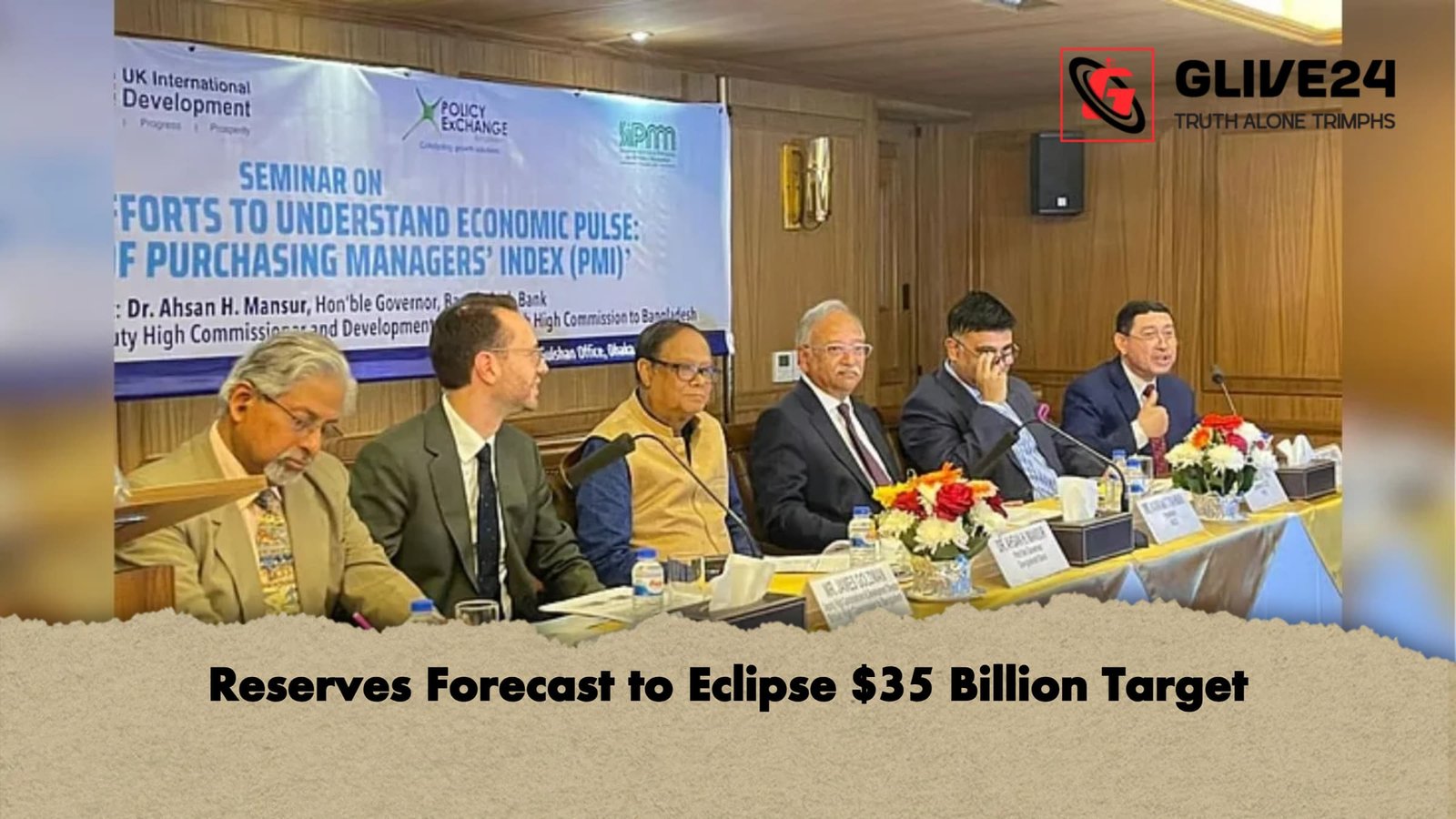
The Governor of the Bangladesh Bank, Ahsan H. Mansur, has issued an optimistic economic forecast, asserting that the nation’s foreign exchange reserves are poised to surge past the $35 billion mark by the close of the current fiscal year. Speaking at a high-level economic seminar in Gulshan on Monday, the Governor emphasised that this recovery is being driven by organic market stabilisation rather than a reliance on external debt.
Table of Contents
Organic Growth Beyond IMF Assistance
Addressing the Metropolitan Chamber of Commerce and Industry (MCCI), Governor Mansur highlighted that the central bank’s strategy of “macroeconomic consolidation” is yielding significant results. Crucially, he noted that the projected $35 billion reserve level is achievable without factoring in the scheduled loan tranches from the International Monetary Fund (IMF).
“Our progress in the Balance of Payments and the external sector has been remarkable,” the Governor remarked. “Meeting this target through our own market dynamics is a sign of true resilience. Any further IMF disbursements would simply be ‘icing on the cake’—welcome, but no longer a necessity for our survival.”
Bangladesh Economic Performance Summary: 2025–26
| Economic Indicator | Current Performance | Fiscal Year Target |
| Forex Reserves | Strengthening via market buys | >$35 Billion |
| Inflation (CPI) | 8% (Stabilising) | <5% (Long-term) |
| Deposit Growth | 11% (December 2025) | 14% |
| Market USD Liquidity | $3.7bn purchased by BB | No intervention required |
| Lending Rates | 11%–12% for prime clients | Further reductions expected |
Monetary Stability and the “Oxygen” of Finance
A pivotal shift in the central bank’s operations has seen it transition from a seller to a buyer of dollars. By making the Taka more attractive, the central bank has successfully purchased $3.7 billion from the open market. This move has not only bolstered reserves but also injected ৳45 billion of liquidity into the banking system.
The Governor also pointed to a healthy recovery in bank deposits, which reached ৳20 trillion in December. He anticipates that as deposit growth climbs to 14%, it will release approximately ৳2 trillion in credit for the private sector. “This liquidity is the oxygen the economy needs to breathe,” he explained, noting that as the credit supply increases, the cost of borrowing will naturally decline.
Global Standards and the “Data Gold Mine”
The event, co-hosted by Policy Exchange Bangladesh, featured insights from James Goldman, the Deputy British High Commissioner. Goldman stressed that for Bangladesh to sustain this momentum, it must move beyond short-term fixes and focus on “better, more transparent regulations” to foster long-term investor trust.
Furthering this point, Dr M. Masrur Reaj of Policy Exchange noted that while government agencies sit on a “gold mine of data,” the lack of timely and regular publication remains a hurdle for investors. He urged for a modernisation of the Bangladesh Bureau of Statistics (BBS) to bring reporting in line with global benchmarks, ensuring that the private sector can make decisions based on real-time economic realities.