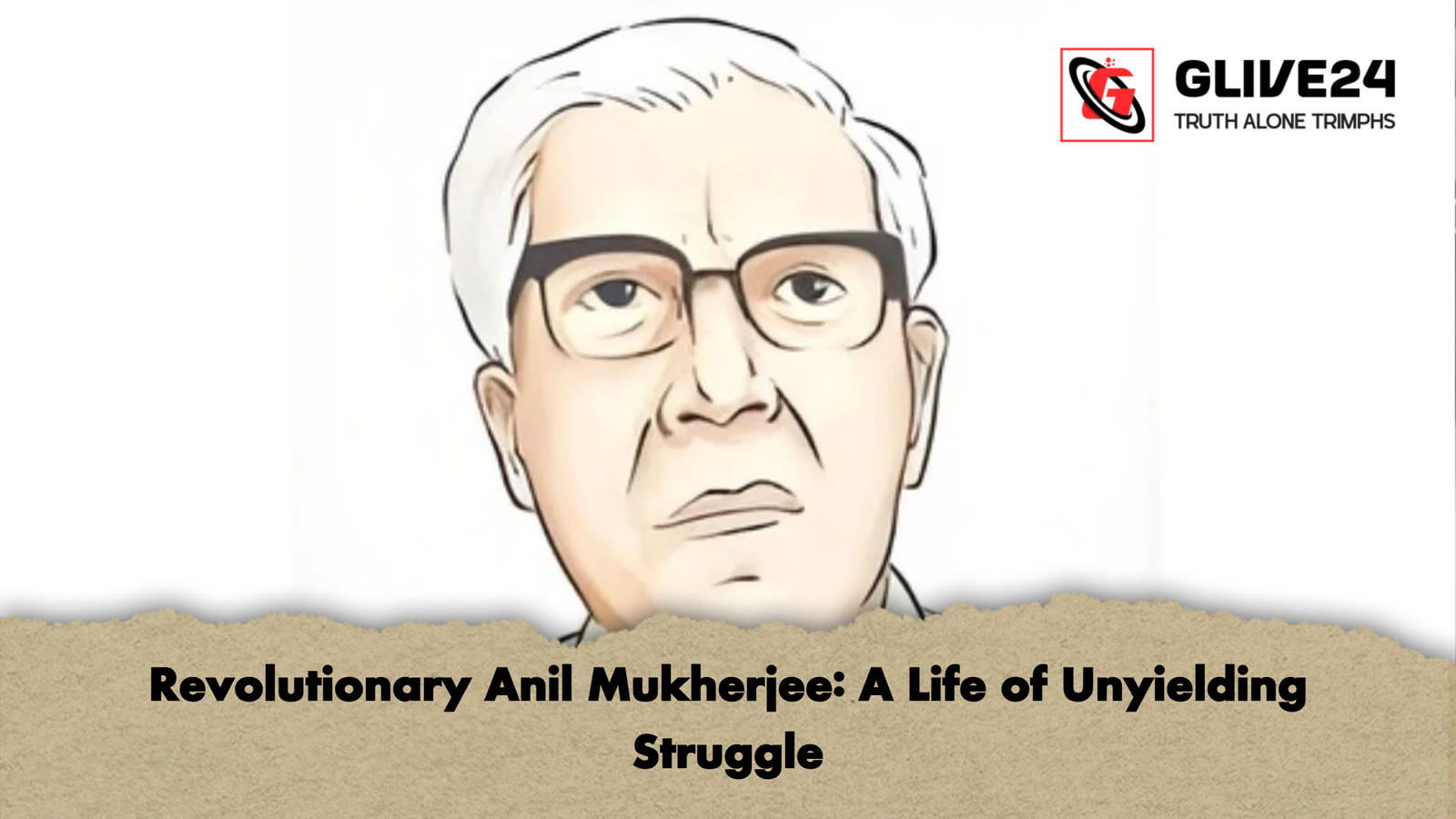
Anil Mukherjee remains an indomitable figure in the revolutionary movements of the Indian subcontinent, a fearless advocate for workers’ rights, and a stalwart of communist thought. Renowned as a revolutionary, organiser, political theorist, and writer, his life was a relentless quest to build a society free from exploitation.
Born on 10 October 1912 in Munshiganj, Mukherjee’s political consciousness emerged during the fervent anti-British movements of the early 20th century. Even as a student, he immersed himself in revolutionary politics, eventually becoming a leading figure in both India’s and later Bangladesh’s communist movements.
In 1930, while pursuing his college education, he was arrested for active participation in acts of civil disobedience. During his incarceration in Midnapore jail, he was accused of involvement in armed revolutionary activities and subsequently exiled by the British authorities to the notorious Cellular Jail in the Andaman Islands. Rather than dampening his resolve, this imprisonment strengthened his revolutionary convictions.
Following his release in 1938, Mukherjee formally joined the Communist Party. He emerged as a prominent organiser of the working class, playing a pivotal role in key labour struggles, including the historic jute workers’ strike in Narayanganj in 1946, where his leadership left a lasting impact.
After the Partition of 1947, his involvement in communist politics in East Pakistan led to eight years of continuous imprisonment. Even after his release, he was compelled to operate clandestinely, a period that extended until Bangladesh’s Liberation War in 1971. During the war, Mukherjee actively contributed as an organiser and motivator for the independence movement. Earlier, he had clandestinely visited Moscow and represented the Communist Party of East Pakistan at 75 international communist congresses, reflecting his stature in the global revolutionary network.
In independent Bangladesh, Mukherjee was elected to the Central Committee of the Bangladesh Communist Party in 1973 and again in 1980. Beyond party politics, he propagated revolutionary ideas through his prolific writing. His notable works include The Role of Socialism, Introduction to the Workers’ Movement, Backdrop of the Struggle for Independent Bangladesh, and The Lost Khoka. These writings continue to serve as invaluable resources for progressive political thought and historical scholarship.
Anil Mukherjee passed away on 7 February 1982. Yet, his ideals, struggle, and writings continue to inspire those committed to the vision of an exploitation-free society.
Key Milestones of Anil Mukherjee’s Life
| Year | Event |
|---|---|
| 1912 | Born in Munshiganj, British India |
| 1930 | Arrested for participation in civil disobedience |
| 1930s | Exiled to Andaman’s Cellular Jail for alleged armed revolutionary activity |
| 1938 | Released from imprisonment; joined the Communist Party formally |
| 1946 | Key organiser in Narayanganj jute workers’ strike |
| 1947–1955 | Imprisoned in East Pakistan for communist activities |
| 1971 | Participated actively in Bangladesh Liberation War |
| 1973 & 1980 | Elected to Central Committee of Bangladesh Communist Party |
| 1982 | Passed away on 7 February |
Anil Mukherjee’s legacy remains a guiding light for those who envision a fair, just, and equitable society.