
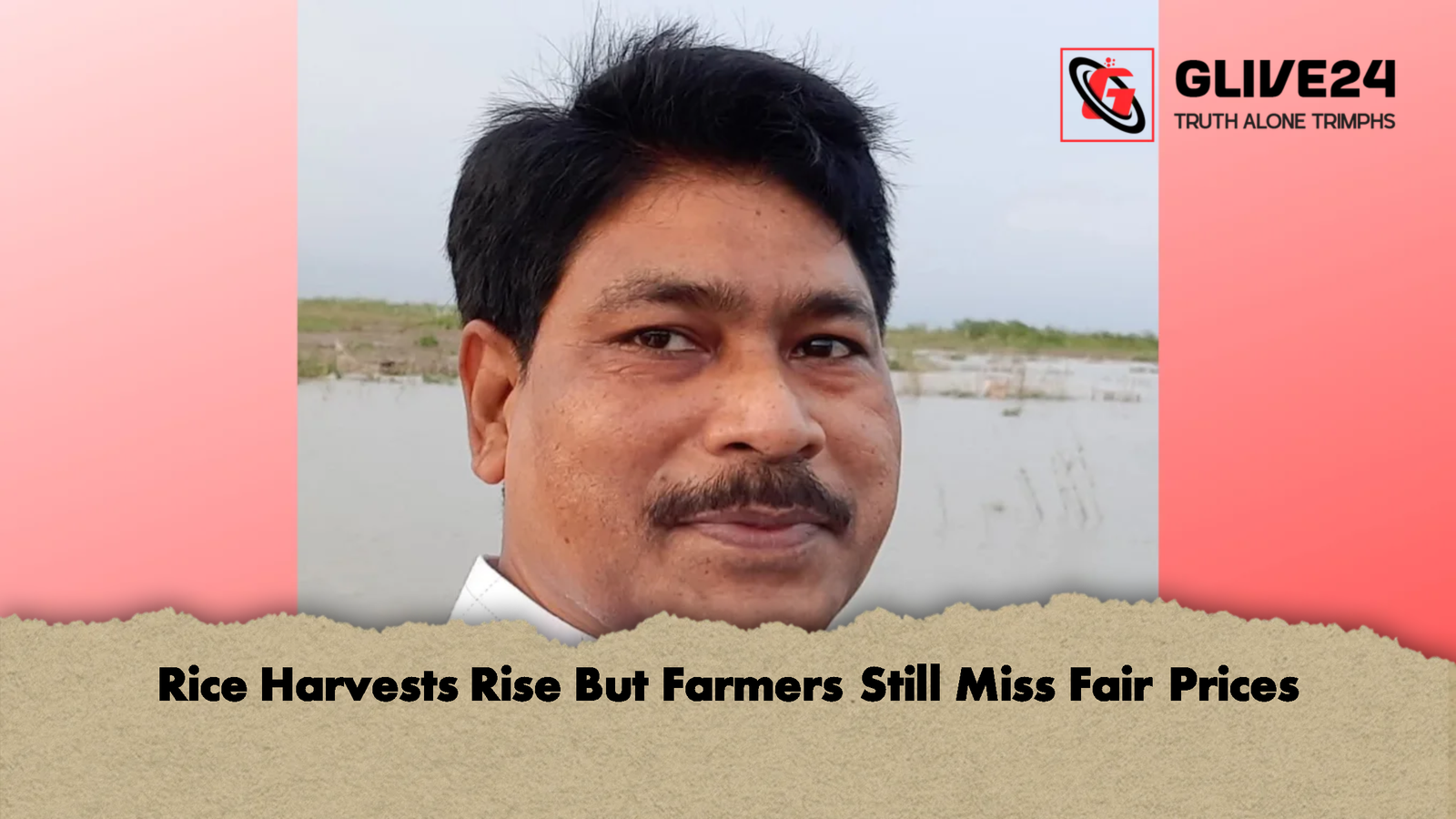
As the morning mist slowly clears over the paddy fields of Bogura, a farmer stands beside his ripened crop—golden, abundant, and hard-earned. Months of labour have culminated in a successful harvest. Yet, despite this apparent success, clouds his expression. His concern is not about yield, but about return. “We grow the rice,” he reflects, “but where does the profit go?”
This simple yet profound question underscores a persistent structural imbalance within Bangladesh’s agricultural economy—one where increased production fails to guarantee fair financial outcomes for farmers.
Table of Contents
Strong Output, Stagnant Income
Bangladesh has emerged as one of the world’s leading rice producers, with annual output ranging between 35 and 40 million tonnes. This achievement forms the backbone of national food security and rural employment. However, the benefits of this productivity have not translated into proportional gains for farmers.
The root of the problem lies not in cultivation, but in systemic inefficiencies:
- Distorted market structures
- Ineffective price-setting mechanisms
- Unequal access to financial resources
From Field to Market: A Fragmented Value Chain
Not all harvested rice reaches the marketplace. After accounting for household consumption, seed retention, and post-harvest losses, only around 50–60% of total production enters commercial circulation. This portion represents the farmer’s primary source of income.
Once in the market, however, farmers lose control over pricing. The supply chain is long and complex:
Farmer → Middleman → Commission agent → Miller → Wholesaler → Retailer
At each stage, value is added—but disproportionately.
- Farmers receive the smallest share of the final price
- Consumers pay the highest
This disparity reflects a deeply entrenched imbalance within the agricultural market.
Information Deficit and Weak Bargaining Position
A significant barrier is the lack of timely and reliable market information. Farmers often remain unaware of prevailing prices and trends, limiting their ability to negotiate effectively. As a result, they function as price takers rather than price setters, accepting whatever rate the market offers.
Seasonal Price Volatility and Distress Selling
One of the most critical challenges is seasonal price fluctuation. During harvest periods:
- Supply increases sharply
- Market prices decline
Later, when supply tightens:
- Prices rise
However, by that time, most farmers have already sold their produce—often under pressure to meet urgent financial needs. This leads to distress selling, where crops are sold below fair value.
Current Price Snapshot
| Category | Price Range (BDT per maund) |
|---|---|
| Market Price | 1,100 – 1,250 |
| Government Price | 1,300 – 1,350 |
| Estimated Loss | 100 – 200 per maund |
For a farmer selling 100 maunds, this equates to a loss of BDT 10,000–12,000—an amount that can significantly affect household stability.
Financial Inequality: A Structural Constraint
Beyond the marketplace, financial disparities deepen the crisis. Data reveals:
- 84% of bank deposits are held in urban areas, compared to just 16% in rural regions
- 92% of loans are disbursed in cities, leaving only 7–8% for rural communities
This imbalance results in:
- Limited access to affordable agricultural credit
- Forced crop sales during emergencies (such as medical or educational expenses)
- Reduced bargaining power in market transactions
Government Initiatives and Digital Access
To address these challenges, the government procures approximately 1.5 to 2 million tonnes of rice annually—representing just 4–6% of total production. In 2019, a digital initiative was introduced through the Krishoker App, enabling farmers to participate directly in procurement processes.
According to the General Economics Division:
- Farmer incomes increased by 24–32%
- Household incomes rose by 10–18%
These findings highlight the transformative potential of direct market access.
Why Progress Remains Uneven
Despite promising results, several challenges limit the initiative’s reach:
- Only 30–40% of farmers are able to participate
- Selection processes are often lottery-based
- Procurement centres are geographically distant
- Digital literacy remains low in rural areas
- Procurement timelines are frequently delayed
Consequently, disparities persist—even among farmers within the same locality.
The Core Issues: Three Structural Gaps
The broader crisis can be summarised into three interconnected challenges:
- Financial inequality – Concentration of credit and investment in urban areas
- Market imbalance – Limited influence of farmers over pricing
- Policy implementation gaps – Restricted reach and inconsistent execution
The Way Forward
Addressing these issues requires targeted and practical reforms:
- Initiating government procurement at the onset of harvest
- Expanding modern storage facilities in rural areas
- Enhancing access to low-interest agricultural credit
- Delivering real-time price information via mobile platforms
- Scaling up e-procurement to ensure universal access
- Strengthening local-level monitoring and transparency
Rethinking Development
Research by the Bangladesh Institute of Development Studies indicates that, in many cases, farmers’ net returns from rice production are so minimal that, when labour costs are included, profits approach zero.
Rice is more than a staple crop—it is central to Bangladesh’s economy, food security, and the livelihoods of millions. In a country where daily sustenance depends heavily on rice, ensuring fair compensation for farmers is not merely an economic necessity but a national imperative.
True development will be realised only when farmers can stand beside their harvests with confidence and say:
“I have received a fair price for my rice.”