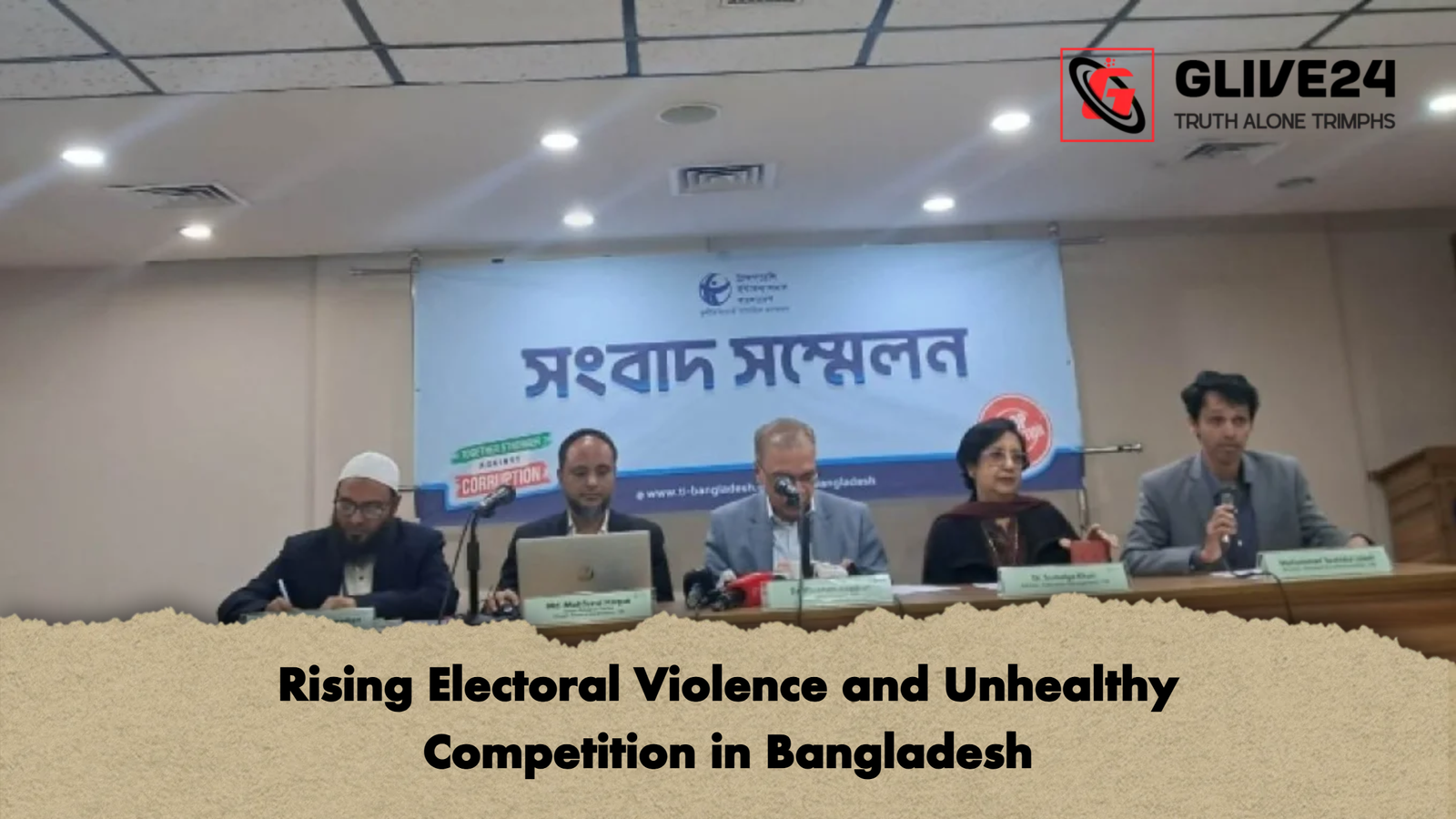
Despite initial signs of relatively healthy competition, conflicts, disputes, unhealthy rivalry, and violence between political parties and alliances in Bangladesh are escalating ahead of the upcoming parliamentary elections and national referendum. This concern was raised by Iftekharuzzaman, Executive Director of Transparency International Bangladesh (TIB), during a press conference held at the organisation’s Dhaka office on Sunday.
The event was organised to release TIB’s latest report, “Referendum and Pre-Election Environment: TIB Observations”, which provides a detailed assessment of the prevailing political climate. Senior Research Officer Md. Mahfuzul Haque presented the report, after which Iftekharuzzaman offered an overview and responded to questions from journalists.
Commenting on the electoral process, Iftekharuzzaman emphasised that both the parliamentary elections and the referendum could be conducted smoothly if all participants adhere to legal and ethical standards. “Political parties and candidates play the most critical role. If they are committed to fairness, a credible election is entirely possible,” he said.
The TIB report highlighted that despite a legal requirement for parties to nominate at least 5% female candidates, no political party has complied. “Jamaat-e-Islami has set a shocking precedent by nominating no women at all. We did not expect Jamaat to meet the quota, but what about those parties from whom we had higher expectations? The largest active party has only 2.7% female candidates. Why?” he questioned. The report also notes the Communist Party of Bangladesh (CPB) has shown similarly poor compliance regarding female representation.
Iftekharuzzaman further identified five key “political capital” elements influencing Bangladeshi elections: money, religion, profession, patriarchy, and majoritarianism. While the Election Commission and law enforcement are responsible for protecting voters—including women and minorities—the ultimate responsibility lies with political parties themselves.
He also expressed concern over continued corruption during the current government’s tenure and the lack of transparency in reporting the assets of caretaker government advisers.
Moreover, he strongly condemned the incident on Saturday night in which journalists were forcibly removed from the Bangladesh Times office, calling it “medieval and unacceptable behaviour that threatens press freedom.”
Key Pre-Election Observations by TIB
| Observation | Summary |
|---|---|
| 1 | Initial signs of fair competition deteriorated as parties continued violent campaign practices. |
| 2 | Election-related violence and anti-election activities by authoritarian forces pose instability risks. |
| 3 | Use of money and religion in campaigns has significantly increased. |
| 4 | Gaps exist in Election Commission’s capacity to ensure free, fair, and peaceful elections. |
| 5 | Violations of codes of conduct both online and offline remain largely unchecked. |
| 6 | Some government officials, including law enforcement, fail to maintain impartiality and integrity. |
| 7 | Political parties exhibit reluctance to cooperate with the Election Commission, undermining fairness. |
TIB’s Observations on the Referendum
The report also identified 11 key issues regarding the referendum campaign, including: government indecision due to political pressures, lack of coordination between the government and the Election Commission, delayed instructions for civil servants, misuse of resources, questionable legal interpretations equating the referendum with elections, and controversies over transparency and accountability in funding. These factors collectively raise concerns over the credibility and impartiality of the referendum process.
The press conference was moderated by TIB’s Outreach and Communication Director, Mohammad Tauhidul Islam. TIB Executive Management Advisor Sumaiya Khair and Research Director Mohammad Badiuzzaman were also present.