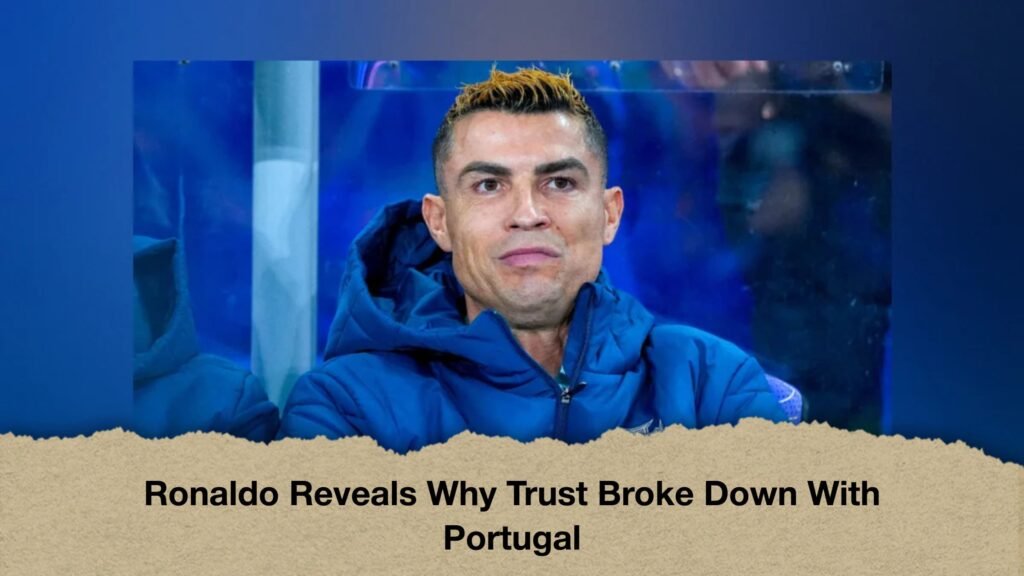
Cristiano Ronaldo has offered a detailed account of the circumstances that led him to leave Portugal’s national-team camp, saying a breakdown in trust and what he described as broken promises ultimately forced his decision.
In a lengthy statement shared on social media, the 41-year-old forward addressed the dispute in detail, accepting responsibility for his own mistakes while also explaining his frustration with the national-team management. He apologised to Portugal’s supporters and his team-mates, but insisted that he should face any punishment deemed appropriate by the Portuguese Football Federation.
Ronaldo said he had promised to explain the situation himself and had therefore decided to speak publicly about the latest episode involving the national team.
He revealed that he had already prepared a message for the Portuguese people to be delivered after the 2026 World Cup. That message, he said, remains in his possession and will only be made public when he genuinely decides to leave the national side.
According to Ronaldo, the president of the Portuguese Football Federation asked him to reconsider his future with the team during the flight back from the United States after the World Cup. The president reportedly stressed that the federation wanted Ronaldo to remain part of the national set-up.
Ronaldo was also consulted about the appointment of the current head coach. He said the federation president had asked for his opinion and, although several other candidates had been considered, Ronaldo believed the eventual appointment was the ideal choice. He therefore welcomed the decision when the coach was formally introduced.
A few days later, the new coach contacted Ronaldo and requested a face-to-face meeting. The meeting took place at the football centre where Ronaldo’s club were holding their pre-season training camp.
Ronaldo said the coach told him that he trusted him and regarded his presence as essential to the national-team project. He was also presented with an immediate plan for the upcoming international fixtures.
Under that plan, Ronaldo was expected to play the first and final matches, with his workload managed through several changes because of his physical condition. The coach also suggested that Ronaldo should not travel with the team for matches in Norway and Denmark. Instead, he would play the first fixture and remain in Portugal before rejoining the squad ahead of the match at the Estádio do Dragão.
Ronaldo rejected the proposal.
He said remaining in Portugal rather than travelling with his team-mates would not set the right example, particularly given his position as captain. He eventually reached an understanding with the coach on the matter, with Al Nassr sporting director Simão Coutinho also involved in the discussions.
Before the training camp began, the coach asked to visit Ronaldo at his home in Lisbon for another conversation. Ronaldo described that meeting as calm and said the principles agreed during their earlier discussions remained intact.
He then played at the Estádio José Alvalade. After being substituted, Ronaldo said he caused no problems and personally handed the captain’s armband to Bruno Fernandes.
At the time, he said, he did not imagine that he might be approaching the final appearances of his international career. His focus was simply on winning for Portugal.
The situation changed during the match in Norway.
At lunchtime on the day of the game, an assistant coach approached Ronaldo and told him that the head coach wanted to speak with him. Ronaldo said he was surprised when the coach asked whether he was prepared to play for 30 minutes.
His original workload plan had been centred on physical recovery and the following match at the Estádio do Dragão, and he had expected not to play in Norway. Nevertheless, he agreed to the request after being told to prepare for a 30-minute appearance.
After half-time, Ronaldo began warming up. He waited as the minutes passed, but was never called upon.
Ronaldo said he believed the coach had failed to keep his word.
After the match, he chose not to greet the supporters. He accepted full responsibility for that decision, describing it as a mistake that should not have happened. He apologised to Portuguese supporters who had attended the match, as well as those who had travelled specifically to see him.
Forty-eight hours later, Ronaldo said he met with the coach and Simão Coutinho for an open and candid discussion about what had happened.
According to Ronaldo, they agreed that the matter could be resolved through a clear explanation from the coach at a press conference. The coach, Ronaldo said, promised to publicly repeat what had been discussed privately.
That explanation would include the fact that Ronaldo had never refused to play, that the training-camp plan had been proposed by the coach himself, and that asking a player of Ronaldo’s stature to warm up without subsequently bringing him onto the pitch had been a mistake.
Ronaldo said the coach ended the meeting by embracing him and assuring him that the issue had been settled. The agreement was that Ronaldo would not play against Denmark but would feature in the match at the Estádio do Dragão.
At the coach’s request, a video meeting involving the coach, Coutinho and Tiago Craveiro was subsequently held to summarise their discussions. Ronaldo said a brief document was then prepared, which he approved before handing it to the coach.
However, he claimed that the subsequent meeting did not reflect the tone or substance of their earlier private conversation.
Ronaldo said he encountered comments and behaviour that he considered aggressive and unreasonable. He also described an attitude that, in his view, was markedly different from the approach shown during their private meeting.
He then outlined eight points contained in the notes he had seen.
The first stated that the coach himself had proposed Ronaldo’s plan for the international season. The second acknowledged Ronaldo’s love for the national team and his considerable influence over Portugal during more than two decades of international football.
The third confirmed that Ronaldo had accepted the coach’s proposed plan. The fourth stated that he had never challenged the coach’s decisions and had behaved as a professional and an example to others.
The fifth point said Ronaldo had not originally been expected to play against Norway, but the coach believed he had recovered sufficiently from the previous match and warned him that he might have to use him. Ronaldo agreed.
The sixth acknowledged that involving a player of the stature of Pelé or Diego Maradona merely in the warm-up, without playing him, had been a mistake.
The seventh made clear that the coach wanted Ronaldo to remain with the national team and valued his contribution. The final point addressed Ronaldo’s failure to greet supporters after the Norway match, describing it as a moment of disappointment rather than evidence that he lacked affection for Portugal.
Ronaldo said the notes contained no acknowledgement that the coach had apologised to him.
For Ronaldo, this was the second occasion on which he believed the coach had failed to honour a promise.
He therefore decided to leave the training camp rather than wait for another commitment that he feared might not be fulfilled. Ronaldo said honesty was fundamental to relationships and that he would rather hear an uncomfortable truth than be given assurances that were later broken.
He also recalled a conversation with the federation president and the coach on the morning of the press conference. Ronaldo said he had told them that if they no longer wanted him in the national team, they simply needed to say so clearly.
He claimed he would have accepted the decision without anger and would still have wished to help create something positive for Portugal.
Instead, he said, both men had answered “no” and assured him that he still had a place in the national team.
Ronaldo stressed that during almost 25 years of his career, he had never interfered with a coach’s technical or tactical decisions. Whether he agreed with them or not, he said he respected them.
But when promises made directly to him were not kept, he felt that his continued presence was no longer appropriate.
The forward also apologised to his national-team colleagues for leaving the camp. He accepted that the decision was his responsibility, even though he believed the circumstances leading to it had seriously damaged his trust in the coach.
Ronaldo said the broken promises had affected him deeply. He eventually concluded that remaining with the squad could do more harm than good, prompting him to pack his belongings and leave.
He also called on the Portuguese Football Federation to assess his actions and punish him if necessary.
Ronaldo insisted that any punishment should not be reduced because he is the captain. In his view, being one of the team’s most prominent players does not place him above the rules.
He acknowledged that he had already apologised, but accepted that every action carries consequences and that the same standards should apply to everyone in football.
The possibility of a farewell match was also addressed in his statement. Ronaldo said he had heard suggestions that he deserved a proper send-off and that the federation was prepared to provide such an opportunity.
However, he made clear that when he thinks about Portugal, his first thought is competition rather than ceremonial farewells.
Ronaldo recalled remaining with the national team after learning of his father’s death. At the time, he was at an international training camp and decided to stay until the following day’s match had been completed.
For him, that decision represented the importance he has always attached to playing for his country.
He therefore left open the possibility of continuing his international career.
If he remains physically fit, continues playing and scoring for his club, and completes any suspension imposed on him, Ronaldo said he will be ready to return and compete for Portugal once again.
Despite the extraordinary circumstances surrounding his departure, his message was clear: he does not regard his relationship with the national team as necessarily over. For Ronaldo, the dispute was ultimately about trust, honesty and keeping one’s word.
And, as he stressed in his statement, if he believes he can still contribute, he remains prepared to fight and win for Portugal.