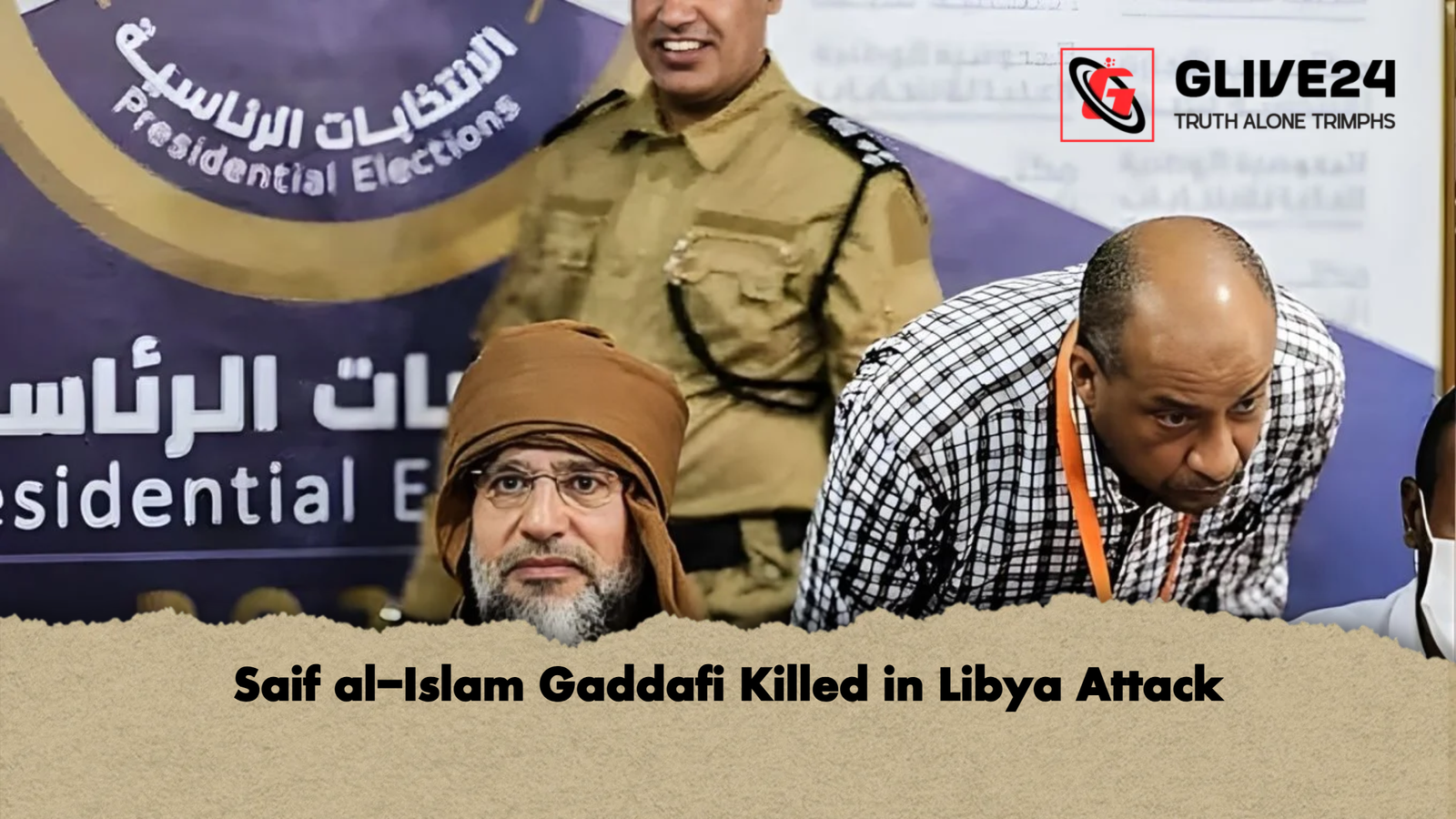
The death of Saif al-Islam Gaddafi, son of Libya’s former ruler Muammar Gaddafi, has sent shockwaves across the country, reigniting tensions in an already volatile political landscape. He was killed in a targeted armed assault at his residence in the mountainous town of Zintan, located approximately 136 kilometres south-west of the capital, Tripoli. He was 53 years old. The attack has once again highlighted Libya’s enduring power struggles and the pervasive influence of militias amid ongoing instability.
According to sources close to the Gaddafi family, four armed assailants entered Saif al-Islam’s home on Tuesday evening. They reportedly first disabled the security cameras to prevent any footage of the attack. The assailants then confronted him in his garden, shooting him at close range. Although he was rushed to hospital in critical condition, he succumbed to his injuries late at night. The attackers fled the scene immediately, and their identities remain unknown.
A close associate described the incident unequivocally as an “assassination.” Saif al-Islam’s political adviser, Abdullah Osman, confirmed the death via social media, offering condolences in religious terms. Reactions have begun to pour in from Libya’s various political factions and tribal leaders, though official details regarding the investigation’s progress remain limited.
Saif al-Islam’s life was marked by dramatic rises and falls. Once considered a potential successor to his father, he served as a key policy maker and international interlocutor under the Gaddafi regime. He played a pivotal role in Libya’s renunciation of weapons of mass destruction, the settlement of the Lockerbie bombing compensation, and improving relations with Western nations. Educated at the London School of Economics and fluent in English, he was well-recognised on the international stage.
During the 2011 uprising, he remained loyal to his father, taking a hardline stance against the rebels. Following the fall of the Gaddafi regime, he was captured by militias in Zintan after attempting to flee, spending six years in detention. Sentenced to death for war crimes in 2015, he was released under a general amnesty in 2017. He later spent several years in political obscurity before attempting to run in the 2021 presidential elections, a bid that was blocked by legal challenges and political opposition.
Analysts argue that Saif al-Islam’s death is not merely a personal tragedy; it reflects Libya’s fractured political system, the dominance of militias, and the country’s incomplete judicial processes. His assassination introduces further uncertainty into Libya’s already complex political future.
Key Milestones in Saif al-Islam Gaddafi’s Life
| Year | Event |
|---|---|
| 1972 | Born |
| 2000s | Significant role in Gaddafi government policy-making |
| 2011 | Uprising, father’s fall, and imprisonment |
| 2015 | Sentenced to death for war crimes |
| 2017 | Released under general amnesty |
| 2021 | Attempted presidential candidacy |
| 2026 | Killed in armed attack in Zintan |
The investigation into this assassination and its potential ramifications for Libya’s political trajectory remain under close scrutiny both domestically and internationally.