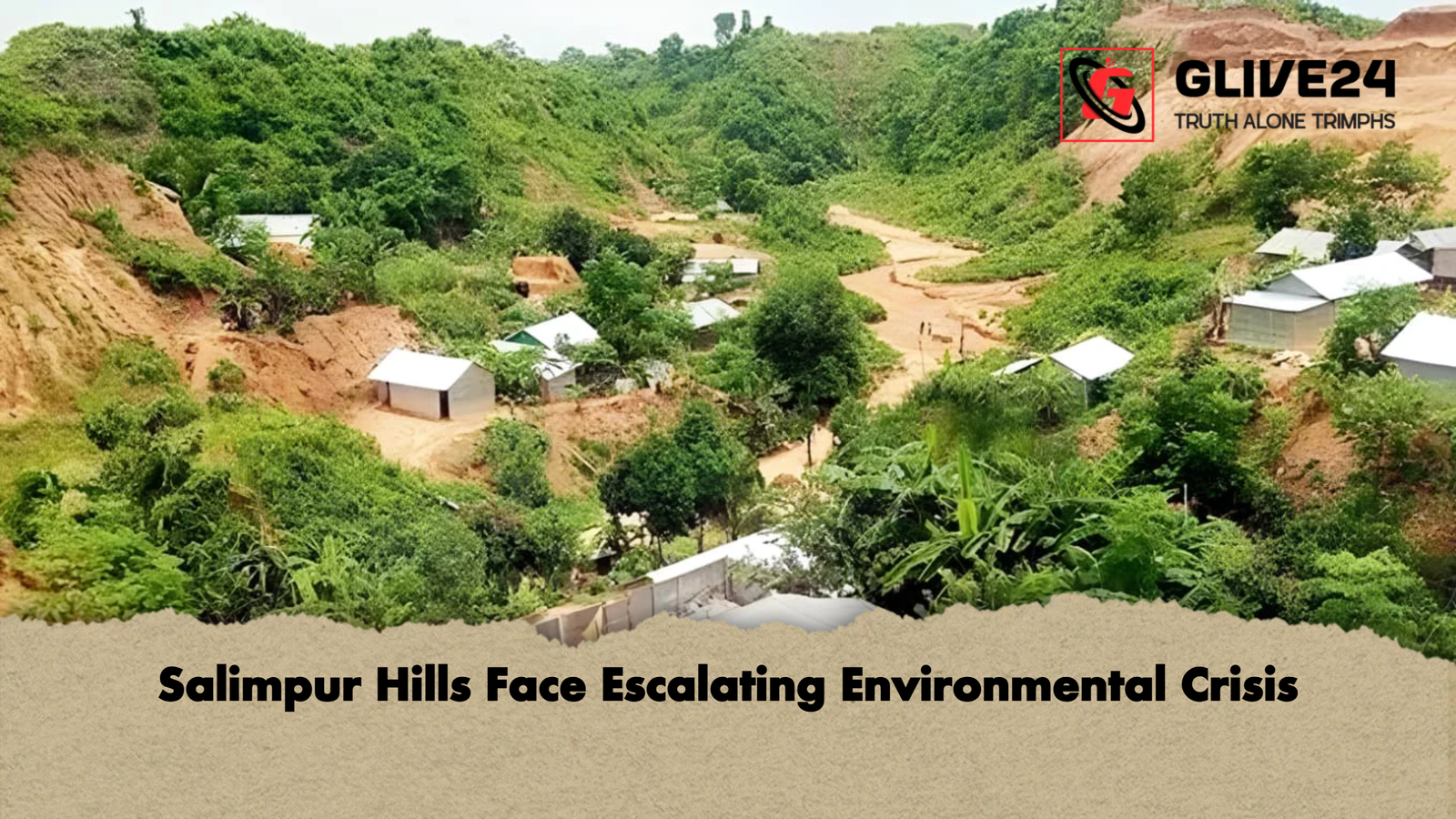
The rugged hills of Jangal Salimpur in Sitakunda, adjacent to the port city of Chattogram, are facing a severe environmental and social crisis. Once a forested area, decades of unregulated hill cutting, informal settlements, and criminal land trade have left the terrain almost entirely stripped, fragmented into residential plots, and increasingly unsafe for both residents and enforcement authorities.
Table of Contents
Geography and Settlement Overview
Located approximately two kilometres west of Bayezid Bostami and opposite the Asian University for Women along the Bayezid–Faujdarhat link road, Jangal Salimpur covers 3,100 acres. Administratively part of Sitakunda Upazila, it functions as a near extension of Chattogram city’s urban fringe. The area is divided into two main sections: the Chinnomul area and Alinagar, both heavily encroached upon by informal settlements and commercial activity.
| Feature | Description |
|---|---|
| Total Area | 3,100 acres |
| Location | Sitakunda Upazila, Chattogram |
| Main Sections | Chinnomul area, Alinagar |
| Estimated Residents | Tens of thousands of low-income settlers |
| Primary Activity | Hill cutting, informal plot trade |
The hills now host a labyrinth of narrow pathways, makeshift roads, electricity poles, markets, schools, and residential buildings. Many plots are encased by brick walls, prepared for sale, while others occupy steep slopes previously covered with trees.
Origins and Criminal Networks
Local accounts suggest that hill encroachment began in the 1990s under Ali Akkas, a notorious criminal who initiated large-scale hill cutting to establish settlements for low-income families. He reportedly created an armed group to maintain control and prevent outsiders from entering. After Akkas was killed in a gunfight with law enforcement, his associates divided the area into factions, continuing the illegal land trade and forming local associations representing thousands of plot buyers.
Security Risks and Restricted Access
Access to the hills, particularly Alinagar, is tightly controlled. Visitors often require permission, and local residents escort them through checkpoints. Previous law enforcement operations have faced violent resistance; notably, a Rapid Action Battalion officer was killed during a recent mission. A joint operation on Monday by army, police, border guards, and paramilitary units encountered roadblocks, damaged culverts, and barricaded routes, highlighting ongoing challenges in enforcing the law.
Environmental Impact
Experts warn that ongoing hill cutting is causing severe ecological degradation. Stripped slopes are prone to erosion and landslides, while unplanned settlements exacerbate environmental vulnerability.
| Environmental Issue | Impact |
|---|---|
| Uncontrolled hill cutting | Loss of landscape and biodiversity |
| Removal of vegetation | Increased landslide and erosion risk |
| Informal construction | Unplanned urban expansion |
| Weak law enforcement | Continued illegal land development |
Officials caution that without intervention, remaining hills could vanish entirely.
Development Plans and Governance Challenges
Government authorities have previously considered establishing a new central prison, a model mosque, and other public facilities in the area. However, informal occupation has repeatedly stalled such initiatives. Senior officials emphasise the need to reassert administrative control, implement planned development, and ensure relocation options for displaced residents.
The crisis at Jangal Salimpur underscores the complex interplay of poverty, urbanisation, environmental degradation, and weak governance. Without prompt action, the hills surrounding Chattogram risk being permanently lost to unregulated settlement and ecological destruction.