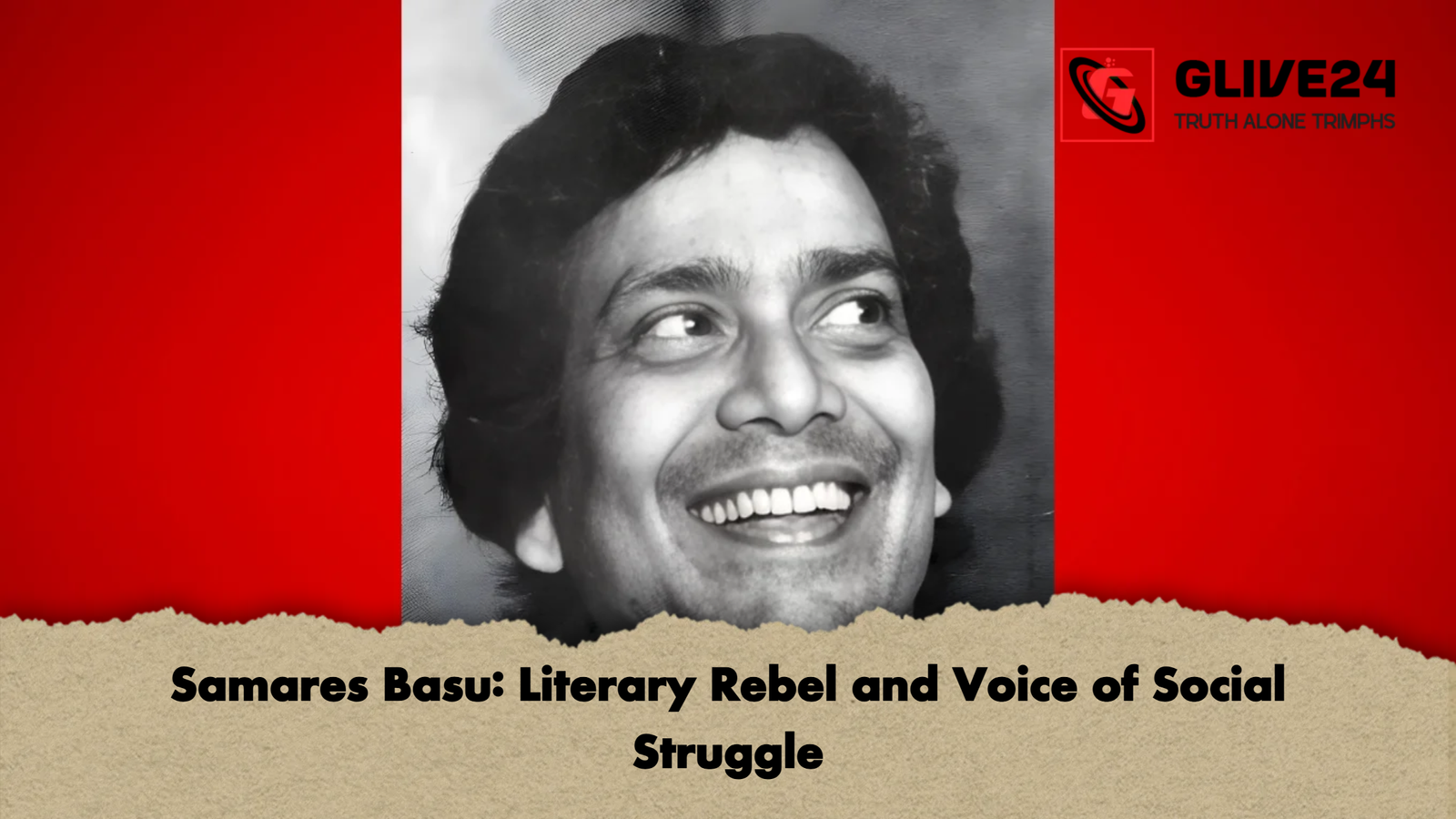
Samares Basu remains one of the most remarkable and boundary-breaking writers in Bengali literature. His writings are deeply infused with lived experience, social awareness, engagement in labour politics, extensive travel, and a profound understanding of human emotion, giving them a unique depth and realism. Between 1943 and 1949, he was employed at the Ishapore Rifle Factory. During this period, he became actively involved in the trade union movement and joined the Communist Party of India. His political activities led to his imprisonment in 1949–50, yet this period of confinement proved to be a blessing for Bengali literature. Within the silence and darkness of prison, he composed his first novel, Uttaranga. After his release, writing became the principal means of his livelihood and the foundation of his creative life.
Samares Basu was born on 11 December 1924 in Kolkata. His early years were spent in Bikrampur, in present-day Bangladesh, and his adolescence in the narrow lanes of Naihati. The struggles of poverty, hardship, and close proximity to the working class profoundly shaped his consciousness. The boy who once roamed the streets selling eggs with a basket on his head grew up to become an immortal storyteller whose narratives continue to resonate across generations.
He was a master of experience-driven storytelling, capturing the lives of labourers, the inner workings of political movements, sexuality, and the complex tensions of society through a bold and artistically accomplished voice. He wrote under two pseudonyms, Kalkut and Bhramar. Under the name Kalkut, he authored many celebrated novels, including Amrita Kumbher Sandhane, Kothay Pabo Tare, Amrita Biser Patre, Mon Meramoter Ashay, and Tushar-Shringer Padataale. These novels explore human sorrow, suffering, and the search for truth through a distinctive and compelling literary style. Within the fiery intensity of ‘Kalkut’, he poured his very essence into the narratives, producing works that are stark, raw, yet profoundly human. In 1980, he was awarded the Sahitya Akademi Award for his writings under this pseudonym.
His contributions to children’s literature are equally enduring. Gogol, the inquisitive, adventurous, and mystery-loving boy he created, remains a beloved figure for Bengali readers. Samares Basu’s literary output was prodigious, comprising more than 200 short stories and over 100 novels. Across this vast body of work, nearly every genre of Bengali literature was revitalised and presented in a new dimension.
On 12 March 1988, Bengali literature lost one of its greatest luminaries. Yet Samares Basu’s writings remain alive in the hearts of readers. Through the sweat of labourers, the dust of travellers, human emotion, and the intense truths of life, he continues to live on. His literary legacy endures as an immortal treasure of Bengali literature, inspiring readers and writers alike.