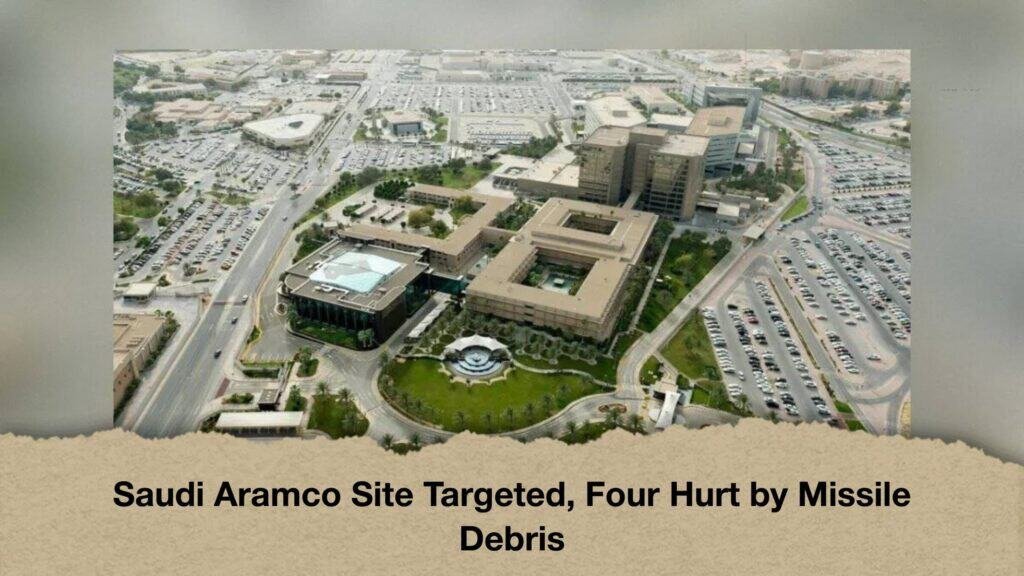
An attack on an administrative building belonging to Saudi Arabia’s state-owned oil giant Aramco in the eastern city of Dhahran triggered a limited fire, while debris from two intercepted cruise missiles injured four people, including a child, in the capital, Riyadh. At least 15 homes were also damaged, according to Saudi civil defence authorities.
The incidents, confirmed by Saudi officials on Wednesday, come amid a series of attacks targeting the kingdom’s airports and energy infrastructure, raising fresh concerns over security across the Gulf region.
An official from Saudi Arabia’s Energy Ministry said the attack on Aramco’s administrative building took place on Tuesday evening in Dhahran. The incident caused a limited fire, but no fatalities were reported.
Authorities have not released further details about the extent of the damage or whether the incident affected the building’s operations.
In Riyadh, air defence systems intercepted two cruise missiles. Debris from the missiles fell in residential areas, injuring two women, one man and a child, the Saudi Civil Defence authority said.
At least 15 homes sustained damage. Details about the injured people’s conditions and the full extent of the property damage were not immediately available.
Deadly Airport Attack Precedes Saudi Retaliation
The latest incidents follow an attack on Riyadh International Airport on Saturday that reportedly killed 13 people and led to a suspension of flight operations. The incident has been described in the report as the deadliest attack on Saudi territory since 2015.
In response to the recent attacks on airports and energy facilities, the Saudi-led military coalition launched air strikes on oil installations and other infrastructure in Yemen on Tuesday. The strikes targeted locations in the capital, Sanaa, as well as Dhamar and Saada provinces.
Coalition spokesman Turki Al-Maliki said in a statement posted on social media platform X that the operation targeted infrastructure used by the Houthi rebels to strengthen their military capabilities, as well as facilities considered a threat to security in the Red Sea and international waterways.
Large explosions were reported in Sanaa during the air strikes. Concerns about a possible fuel shortage also prompted residents to form long queues at petrol stations across the city.
However, a comprehensive assessment of the damage caused by the coalition’s operation was not immediately available.
Saudi Arabia Issues Firm Warning on Maritime Security
At a cabinet meeting chaired by Crown Prince Mohammed bin Salman, Saudi Arabia reiterated its commitment to protecting national security and safeguarding freedom of navigation in the Red Sea and the Bab al-Mandab Strait.
The government warned that it would not allow threats to undermine the kingdom’s security or restrict maritime movement through the strategically important waterways.
The Red Sea is a major route for international trade and energy shipments. The Bab al-Mandab Strait connects the Red Sea with the Gulf of Aden, making it an important passage for commercial vessels travelling between Europe, Asia and other global markets.
Disruptions to shipping through the region could affect international trade, increase transportation costs and create uncertainty in energy markets.
Saudi Arabia’s conflict with Yemen’s Houthi movement has continued for years. The confrontation intensified in 2015, when a Saudi-led coalition intervened in Yemen’s civil war. Since then, missile and drone attacks, border clashes and strikes against critical infrastructure have remained major security concerns.
The latest incidents have also prompted international concern. France and several other countries have issued travel advisories urging their citizens to avoid airports in Riyadh, Jeddah and Dammam amid the deteriorating security situation.
The attacks in Dhahran and Riyadh, alongside the Saudi-led coalition’s strikes in Yemen, have heightened tensions across the region. The growing risks to energy facilities, residential areas and international shipping routes could have consequences beyond the immediate conflict, particularly for regional stability, commercial transport and global energy supplies.
The full extent of the damage and the potential for further escalation remain unclear.