
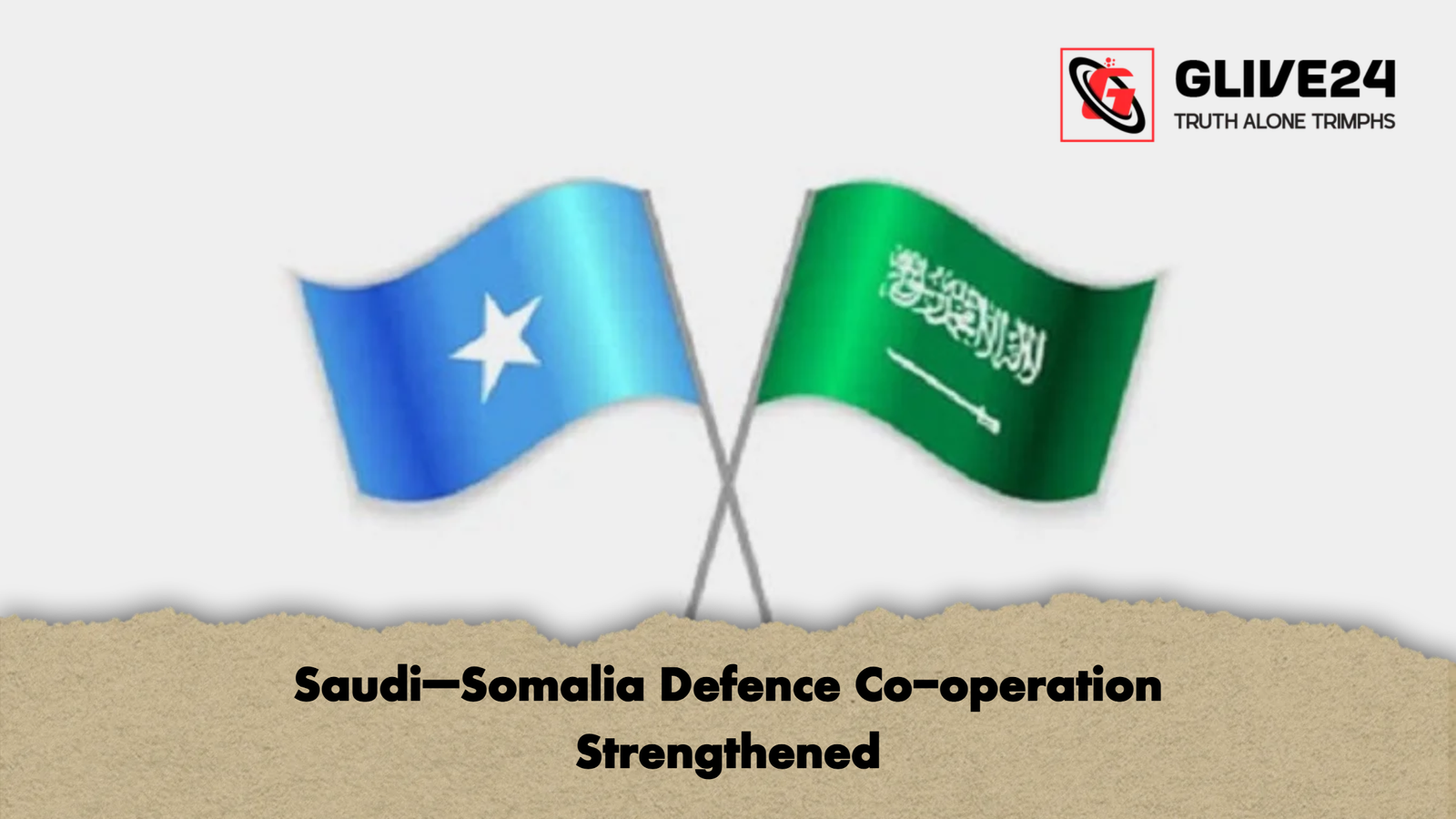
Somalia and Saudi Arabia have formally signed a defence and military co-operation agreement, marking a significant step in the deepening of ties between the two nations. The announcement was made on Monday by Somalia’s Ministry of Defence, which described the accord as a framework for enhanced collaboration across a range of strategic and security fields.
The Memorandum of Understanding (MoU) was signed in Riyadh by Somalia’s Minister of Defence, Ahmed Moallim Fiqi, and his Saudi counterpart, Prince Khalid bin Salman. According to the official statement, the agreement is intended to strengthen bilateral defence relations and expand co-operation in areas of mutual interest, including training, intelligence-sharing, and maritime security.
Somali media reports suggest that the partnership carries broader geopolitical significance. It is widely viewed as part of a concerted effort to bolster regional stability in the Horn of Africa and enhance security along the Red Sea corridor — one of the world’s most strategically vital maritime routes. The Red Sea facilitates a substantial portion of global trade, linking Europe and Asia via the Suez Canal, and has in recent years witnessed heightened security challenges, including piracy, armed insurgency and regional rivalries.
Key Areas of Co-operation
While full details of the MoU have not been publicly disclosed, officials have indicated that the agreement encompasses the following areas:
| Area of Co-operation | Expected Scope of Engagement |
|---|---|
| Military Training | Joint exercises, officer training, and capacity-building programmes |
| Intelligence Sharing | Counter-terrorism co-ordination and information exchange |
| Maritime Security | Protection of Red Sea shipping lanes and anti-piracy operations |
| Defence Technology | Provision of advanced equipment and surveillance systems |
| Airspace Protection | Strengthening radar systems and aerial defence capabilities |
The agreement comes at a time of shifting political dynamics in the region. Following Israel’s recognition of Somaliland — a self-declared independent region within Somalia — diplomatic alignments in the Horn of Africa have grown increasingly complex. Analysts believe that the evolving situation has encouraged Mogadishu to consolidate ties with key regional actors, including Saudi Arabia, in order to safeguard its territorial integrity and reinforce its diplomatic position.
For Saudi Arabia, engagement with Somalia aligns with its broader strategic interests in the Red Sea basin. Riyadh has in recent years expanded its political, economic and security footprint across East Africa, driven in part by concerns over maritime trade security and regional instability. Co-operation with Somalia, which possesses one of the longest coastlines in Africa, is considered particularly significant in this context.
Somalia, meanwhile, continues to face security threats from extremist groups such as Al-Shabaab. Strengthening defence capabilities through access to modern military equipment and advanced technical assistance remains a priority for the Somali government. Officials have indicated that partnerships with allies will be crucial in modernising the country’s armed forces and improving border and airspace surveillance systems.
Observers note that, if effectively implemented, the Saudi–Somalia defence agreement could contribute not only to bilateral relations but also to wider efforts aimed at stabilising a strategically sensitive region. The pact may signal the beginning of a more structured and sustained security partnership between Riyadh and Mogadishu, with implications extending beyond the Horn of Africa.