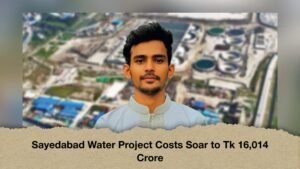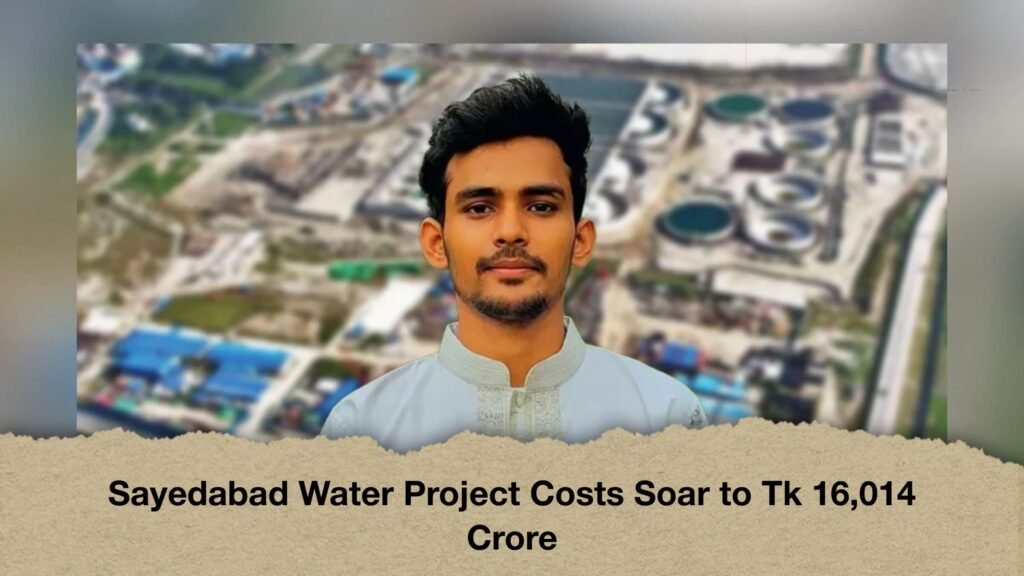
The cost of the third phase of the Dhaka Water Supply and Sewerage Authority’s (WASA) Sayedabad Water Treatment Plant project has risen sharply, prompting questions over the justification for the increase and the process through which the revisions were approved.
The project was initially approved at a cost of Tk 4,597 crore. Its estimated expenditure was later raised to Tk 7,518 crore in the first revision. Under a second revision, the cost climbed dramatically to Tk 16,014 crore.
This means the estimated cost has increased by around Tk 11,417 crore from the original approval. The scale of the increase has drawn particular attention because the project’s physical progress was reportedly below 10 per cent when the major cost revision was made.
Cost revisions are not unusual in large infrastructure projects. Changes in design, land requirements, construction materials, foreign exchange rates, additional works and delays can all affect the final expenditure. However, the timing and scale of the increase in the Sayedabad project have raised questions about whether the revised estimate was adequately justified.
Comparison raises further questions
The cost becomes more difficult to explain when the project is compared with another major water treatment scheme, the Gandharbpur Water Treatment Plant project.
The Gandharbpur project has an estimated cost of around Tk 10,974 crore. According to the information available in the original report, it has a higher water treatment capacity than the Sayedabad project and also involves a longer pipeline network. Yet its estimated cost remains substantially below the Tk 16,014 crore projected for the second revised Sayedabad project.
The comparison has prompted questions over the factors behind the sharp rise in Sayedabad’s estimated expenditure. Among the issues requiring clarification are the scope of work covered by the revised estimate, the basis for the additional expenditure and whether the increase was supported by adequate technical and financial assessments.
The low level of physical progress at the time of the cost revision has also become a central issue. A significant increase in expenditure before substantial work had been completed requires a clear explanation, particularly in a large public-sector infrastructure project involving thousands of crores of taka.
Asif Mahmood was in charge during revision
Asif Mahmood Sajib Bhuiyan was serving as adviser to the Local Government Ministry when the cost of the third phase of the Sayedabad project was substantially increased.
Allegations have been raised that improper benefits were involved in the process of increasing the project’s estimated cost during his tenure. However, the allegations have not been established as fact.
Whether any irregularity, corruption or abuse of authority occurred in connection with the revisions will have to be determined through investigation. The mere presence of an allegation does not establish wrongdoing, and any conclusion would require examination of the relevant project documents, approvals and decision-making process.
ACC scrutiny may focus on the project
The Anti-Corruption Commission (ACC) has begun examining various allegations of corruption, irregularities and abuse of authority against former interim government adviser Asif Mahmood Sajib Bhuiyan. The reported increase in the cost of the Sayedabad water treatment project could also come under scrutiny as part of that process.
An ACC official involved in the inquiry was quoted by Kalbela as saying that various allegations concerning corruption, irregularities and abuse of authority had been submitted to the commission against the former adviser.
According to the official, the ACC has decided to investigate the allegations and has already formed a team for the inquiry. Further legal action, if warranted, would depend on the findings of that investigation.
The Sayedabad project therefore presents several issues for investigators to examine: how the original estimate of Tk 4,597 crore rose to Tk 16,014 crore; why such a substantial revision was considered necessary when physical progress was below 10 per cent; and whether the additional expenditure was supported by proper technical and financial justification.
Investigators may also need to establish whether any improper financial benefit or other irregularity was connected to the cost escalation.
For now, the allegations remain subject to investigation. The key question is not simply why the project became more expensive, but whether the successive revisions followed established procedures and were based on legitimate project requirements.