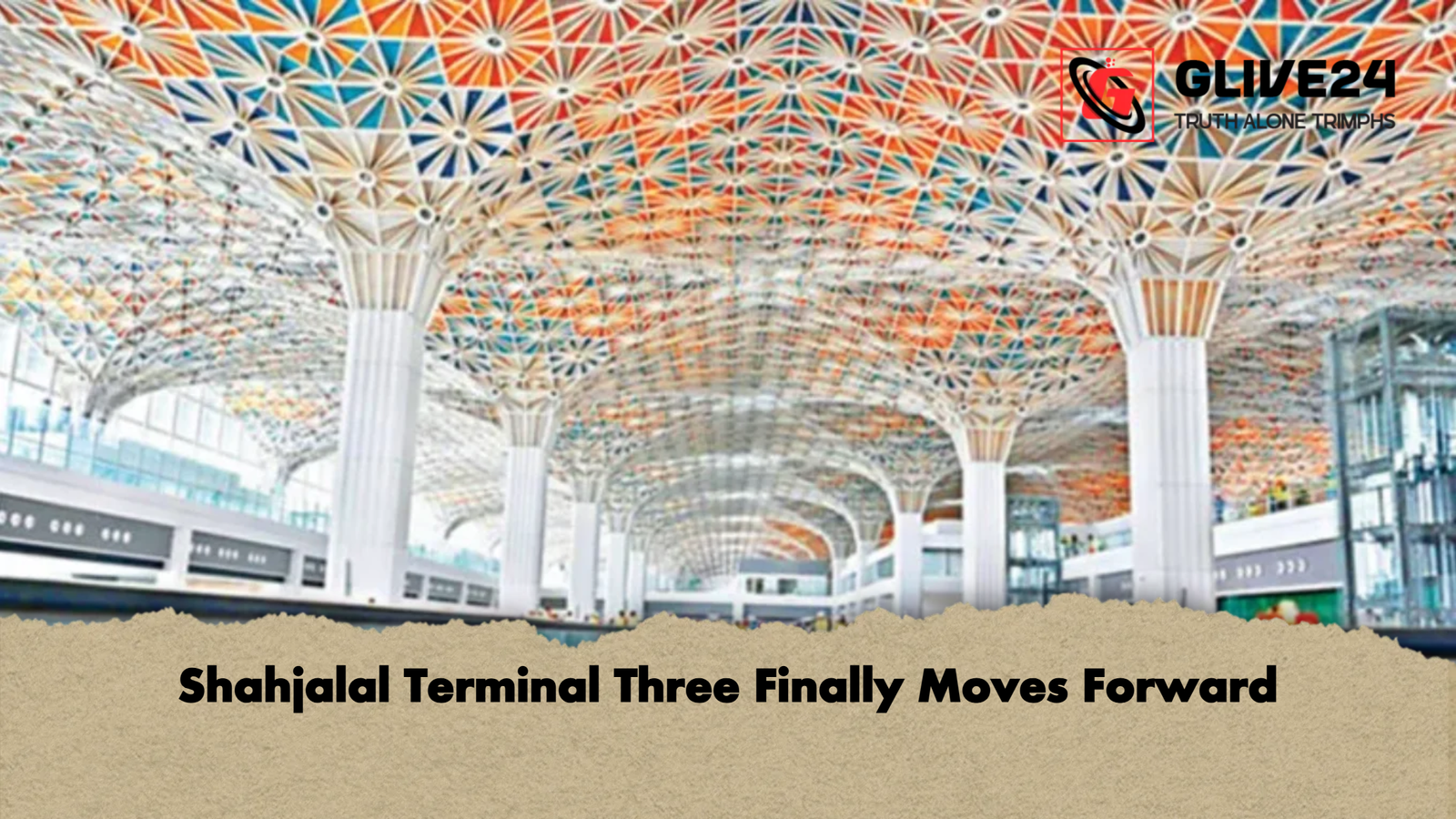
Dhaka’s Hazrat Shahjalal International Airport has been awaiting the operational launch of its third terminal for nearly three years. Despite being constructed at a massive cost, the facility remained largely unused due to complex management and operational disagreements. However, recent developments indicate that these issues are beginning to be resolved, with a Japanese technical delegation scheduled to visit Dhaka on 11 March to discuss the terminal’s future operations.
Air Commodore Abu Saeed Mehbub Khan, Member (Planning & Administration) of the Civil Aviation Authority of Bangladesh (CAAB), confirmed the visit. He emphasised that accelerating the terminal’s opening will be a top priority during the discussions.
A senior official at the Ministry of Foreign Affairs, speaking on condition of anonymity, stated that Japan has already received the green light to operate the terminal. However, negotiations will revisit previously proposed passenger service fees, which, if implemented, would have increased both travellers’ costs and government expenditure. The current government is reportedly looking to replicate the Hambantota Port model from Sri Lanka, wherein Japan would manage the terminal for a defined period and recover its loan, minimising the financial burden on Bangladesh.
Earlier plans under the Awami League government involved awarding a government-to-government (G2G) management contract to Japan. Following the July 2023 political upheaval, the interim administration scrapped this arrangement and opted for a public-private partnership (PPP) model. Despite multiple rounds of meetings and shifting decisions, the terminal has yet to become fully operational.
The Japanese delegation will include the Assistant Minister for Land, Infrastructure, Transport and Tourism, and Rico Nakayama, Director-General for International Aviation. A high-ranking Bangladeshi official indicated that the three proposals previously submitted by Japan were unrealistic, a view shared by the International Finance Corporation (IFC), appointed as an advisor to the project.
In December last year, Sumitomo Corporation of Japan proposed raising the embarkation fee for international travellers from 500 BDT (~4 USD) to 12 USD, while taking no financial responsibility for terminal operations or maintenance—terms deemed unacceptable by CAAB.
The project, valued at BDT 21,300 crore, has seen the government contribute approximately BDT 5,000 crore, with the remainder financed by the Japan International Cooperation Agency (JICA). Covering 230,000 square metres, the terminal features 115 check-in counters, 66 departure immigration desks, 59 arrival immigration desks, and three VIP desks. Once fully operational, annual passenger handling capacity is expected to rise from 8 million to 24 million, and cargo handling capacity will double to 1 million tonnes.
| Feature | Specification |
|---|---|
| Terminal Area | 230,000 sqm |
| Check-in Counters | 115 |
| Departure Immigration Desks | 66 |
| Arrival Immigration Desks | 59 |
| VIP Desks | 3 |
| Current Passenger Capacity | 8 million/year |
| Projected Capacity | 24 million/year |
| Current Cargo Capacity | 500,000 tonnes/year |
| Projected Cargo Capacity | 1,000,000 tonnes/year |
The terminal was soft-launched on 7 October 2023 but remained largely inactive due to operator and staffing shortages. Disputes with the foreign consortium “Aviation Dhaka Consortium” over payment obligations led to an international arbitration ruling ordering CAAB to pay approximately BDT 1,650 crore. The consortium includes Mitsubishi Corporation, Fujita Corporation, and Samsung C&T.
Additionally, the project has faced corruption allegations, with the Anti-Corruption Commission investigating the alleged embezzlement of roughly BDT 4,000 crore. Design flaws have also compromised ceiling structures and limited mobile network coverage, though urgent measures are now underway to address these deficiencies.