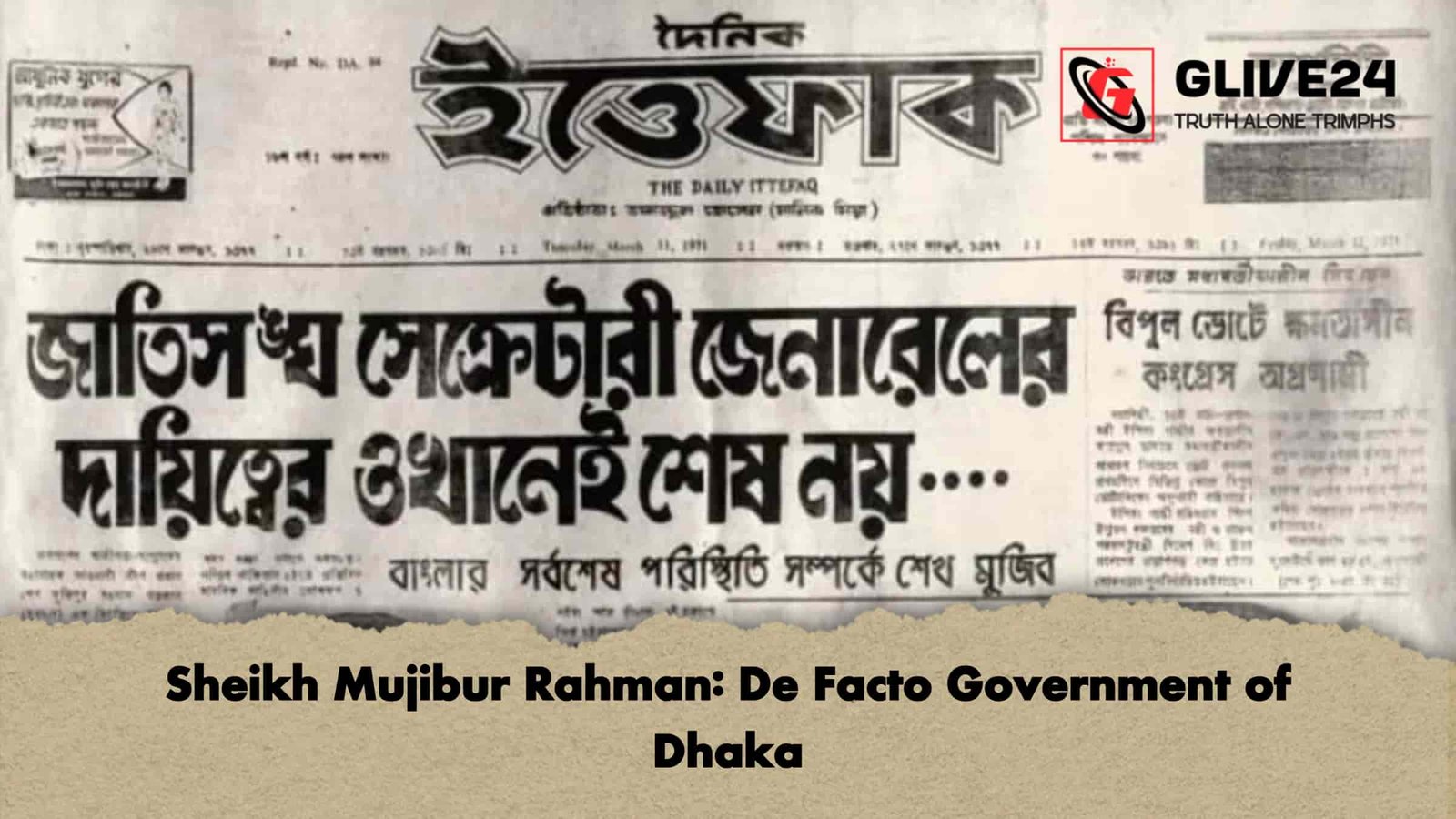
On 11 March 1971, people across East Bengal continued the non-cooperation movement under the decisive leadership of Sheikh Mujibur Rahman. By this time, the authority of the Pakistani administration in East Bengal had become virtually non-existent. Judges of the High Court, secretaries of public administration, and employees of both government and semi-government institutions actively boycotted offices and joined the non-cooperation movement, signalling the collapse of central authority.
That day, the Secretariat, the Chief Secretary’s residence, and the Chief Justice’s residence, along with other government and semi-government buildings, flew the flag of an independent Bengal. Across every district, Sheikh Mujibur’s leadership became politically, administratively, and socially recognised. His authority effectively guided the people, establishing him as the focal point of governance in Dhaka.
Several important political and diplomatic meetings also took place on the same day. Professor Mozaffar Ahmad, President of the East Bengal branch of the National Awami Party (Wali faction), M. Khurshid, President of the Awami League’s Punjab branch, Pir Saifuddin, special envoy of Mamataz Daultana of the Council Muslim League, and the UN’s Assistant Resident Representative in Dhaka held separate discussions with Sheikh Mujibur at his Dhanmondi residence. During these meetings, he expressed concern over the military build-up by Pakistani forces.
In Tangail, a public gathering at Bindubashini High School witnessed National Awami Party leader Maulana Abdul Hamid Khan Bhasani declaring his support for the independence movement. He urged the people to follow Sheikh Mujibur’s guidance and unite in the struggle for freedom. Meanwhile, the Chairman of the People’s Party, Zulfikar Ali Bhutto, sent a message from Karachi calling for collective action to prevent national destruction. At a press conference, Air Marshal (Retd.) Asghar Khan emphasised that power must be immediately handed to the majority party, stating, “Sheikh Mujibur is effectively the government of Dhaka.”
On 10 March, a vessel carrying military arms anchored at Chittagong Port, prompting the ‘Shadhin Bangla Sangram Parishad’ to issue warnings to the public. The Dhaka University Teachers’ Association held a meeting endorsing the liberation struggle. Renowned artist Murtaja Basir withdrew from a government-sponsored exhibition in protest, calling upon fellow artists to follow suit.
The key political and social events of 11 March are summarised below:
| Location / Institution | Activity / Event | Leadership / Influence |
|---|---|---|
| Secretariat and government buildings | Office boycotts, flag hoisting | Government officials and secretaries following Sheikh Mujibur |
| Dhanmondi residence | Meetings and diplomatic discussions | Sheikh Mujibur Rahman |
| Tangail, Bindubashini High School | Public gathering | NAP leader Maulana Bhasani endorsing independence |
| Karachi | Messages and public unity campaigns | Zulfikar Ali Bhutto, Air Marshal Asghar Khan |
| Chittagong Port | Anchoring of military arms | Shadhin Bangla Sangram Parishad warning public |
| Dhaka University | Teachers’ association meeting | Support for the liberation movement |
The events of 11 March 1971 clearly demonstrate that Sheikh Mujibur Rahman was, in practice, the de facto head of government in Dhaka. Every civil servant, judge, and secretary adhered to his directives, while the populace rallied behind him, moving collectively towards the goal of national independence.
Sources: Documents of Bangladesh Liberation Struggle, Liberation War Museum.