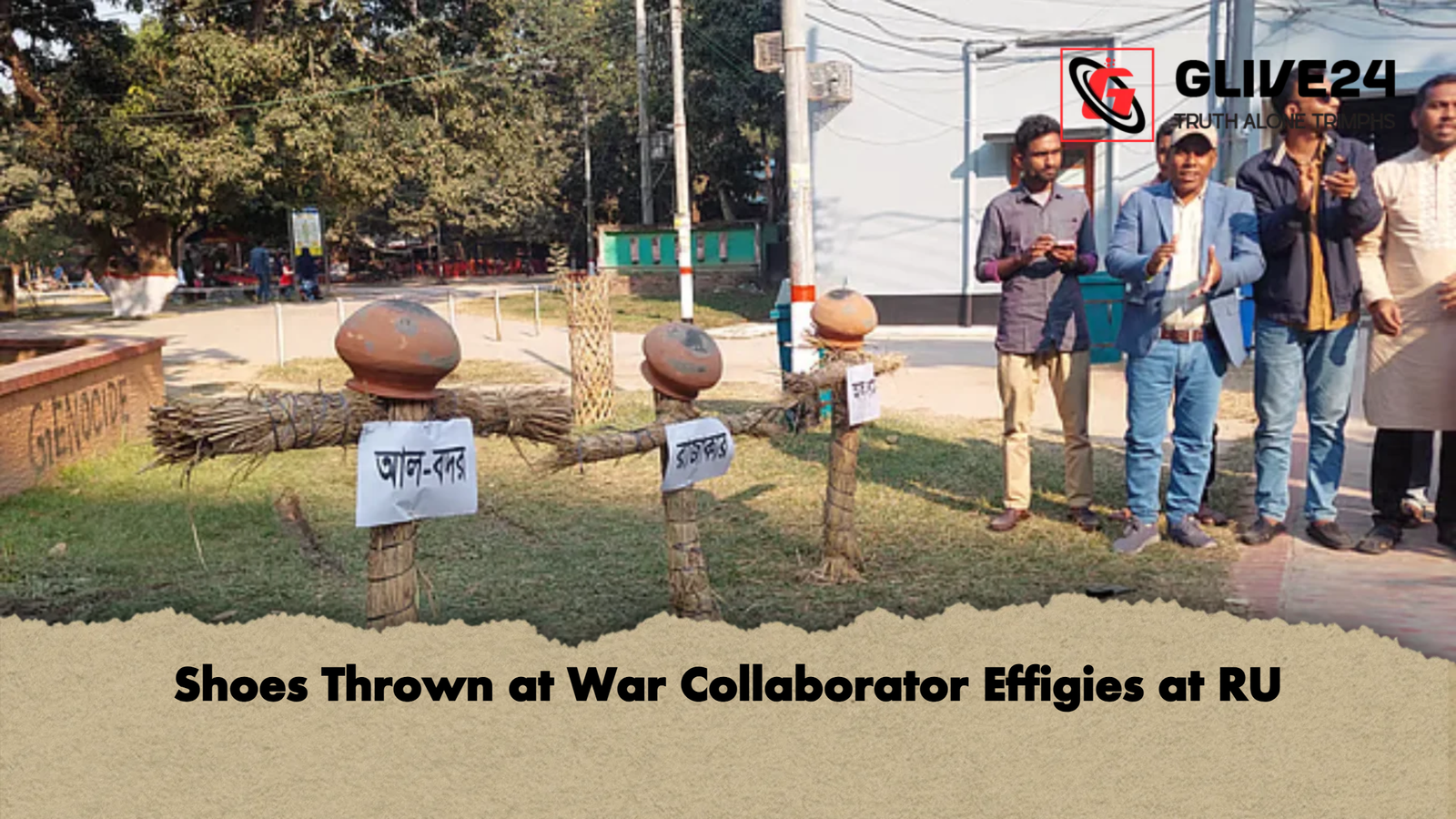
Marking Bangladesh’s Victory Day, students at Rajshahi University staged a symbolic and emotionally charged protest by throwing shoes at effigies representing Rajakar, Al-Badr, and Al-Shams, the auxiliary forces accused of collaborating with the Pakistani military during the Liberation War of 1971. The programme was organised by the University Unit of Chhatra Dal and took place on Tuesday afternoon at the Shaheed Intellectuals Memorial premises on campus.
The protest featured three makeshift structures, crafted from bamboo and straw, each topped with an earthen pot. These pots were clearly labelled with the names Rajakar, Al-Badr, and Al-Shams. Students were invited to throw shoes at the symbolic effigies, and those who successfully hit the targets were reportedly rewarded, adding a performative and participatory element to the demonstration.
Speakers at the programme said the initiative was intended as a symbolic expression of hatred and resistance against forces that aided the Pakistani army in committing mass atrocities during the Liberation War. They recalled that, with the assistance of these collaborators, the occupying forces killed millions of people, subjected countless women to sexual violence, and attempted to crush the Bengali struggle for independence.
Addressing the gathering, Sultan Ahmed (Rahi), President of the University Unit Chhatra Dal, said that Rajakar, Al-Badr, and Al-Shams represent one of the darkest and most shameful chapters in the nation’s history. He added that the shoe-throwing programme was also meant to condemn contemporary political ideologies that, in his words, still fail to respect Bangladesh’s sovereignty and continue to harbour sympathies towards Pakistan.
The organisation’s Organising Secretary, Mahmudul Mithu, echoed the sentiment, stating that although many of the collaborators of 1971 are no longer alive, their ideological successors remain active in various anti-national activities. According to him, the programme served as a warning that the younger generation has neither forgotten nor forgiven the crimes committed during the war.
Other student leaders present at the event included General Secretary Sardar Zahurul Islam, Senior Vice-President Shakilur Rahman (Sohag), and Vice-President Jannatun Naim (Tuhina). The atmosphere at the memorial was solemn yet charged, as students chanted slogans reaffirming the spirit of the Liberation War and pledging allegiance to its ideals.
While the programme drew attention for its dramatic symbolism, it also sparked discussion on university campuses and social media about the role of political expression in commemorating national history. Supporters described the act as a legitimate form of protest and remembrance, while critics questioned whether such methods align with academic decorum. Regardless, the event underscored the enduring emotional resonance of 1971 within Bangladesh’s political and cultural landscape.
Event Overview :
| Aspect | Details |
| Occasion | Victory Day (16 December) |
| Location | Shaheed Intellectuals Memorial, Rajshahi University |
| Organiser | University Unit Chhatra Dal |
| Protest Method | Shoe-throwing at symbolic effigies |
| Effigies Represented | Rajakar, Al-Badr, Al-Shams |
| Materials Used | Bamboo, straw, earthen pots |
| Key Message | Condemnation of 1971 collaborators and their ideology |