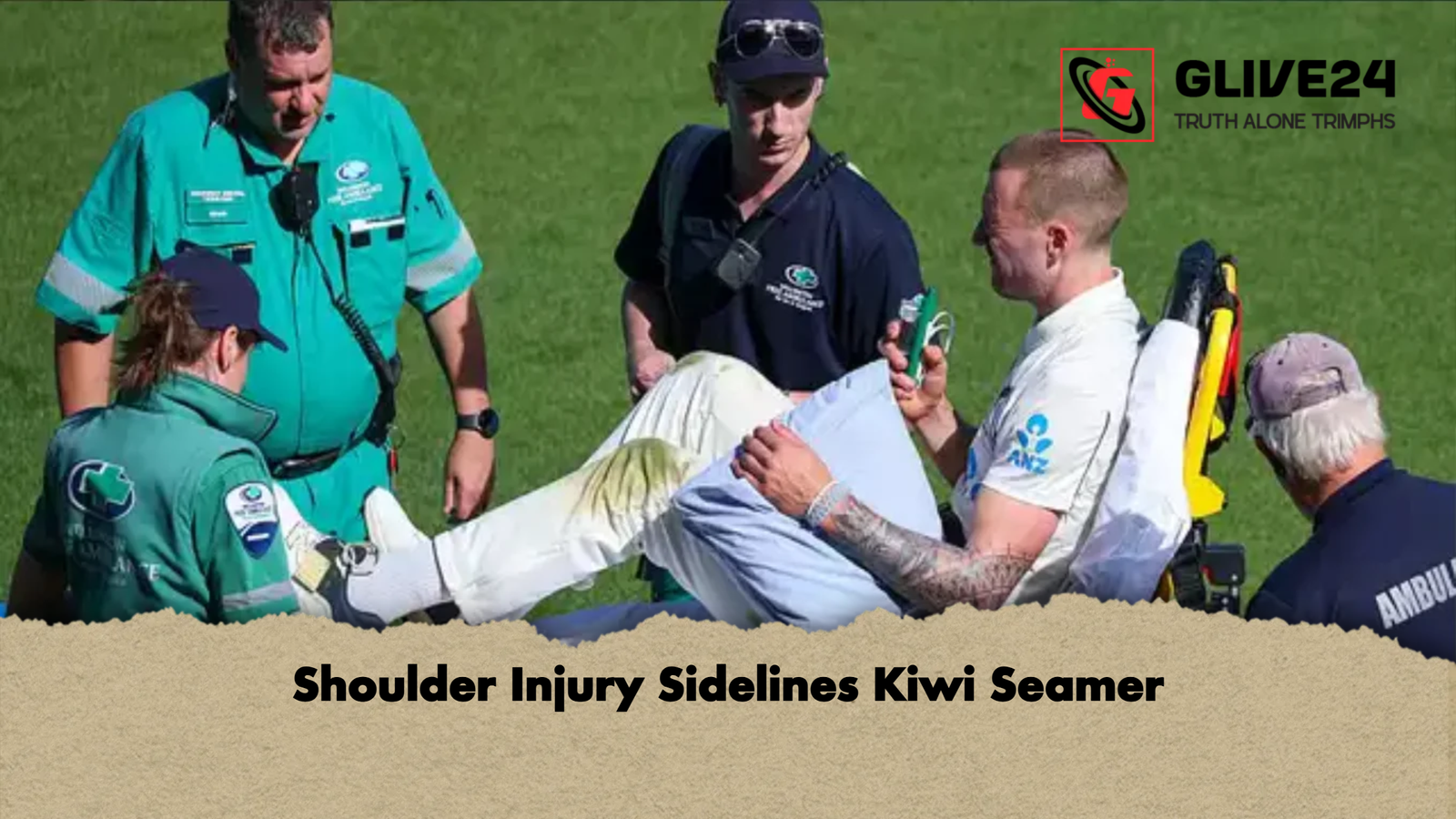
Blair Tickner’s highly anticipated comeback to Test cricket ended in heartbreak on the opening day of New Zealand’s second Test against the West Indies, as the pace bowler suffered a suspected shoulder dislocation while fielding. The incident occurred at the Basin Reserve, forcing Tickner to be stretchered off in front of a concerned home crowd.
Tickner had returned to the Test arena after nearly a year away, and his initial performance had been nothing short of sensational. Claiming four crucial wickets for just 32 runs, he had torn through the visitors’ top order, seemingly putting New Zealand in control. Yet, the afternoon’s narrative shifted dramatically in the 67th over when Tickner, diving at fine leg to prevent a boundary, appeared to injure his shoulder severely. Teammates and medical staff immediately attended to him, while fans stood in stunned silence before applauding the departing player.
His departure adds further strain to an already depleted seam attack. Tickner was brought in after Matt Henry and Nathan Smith were ruled out, making him the third frontline pacer to exit the series due to injury. This leaves New Zealand with a combination of Jacob Duffy, Zak Foulkes, and debutant Michael Rae, a trio with limited Test experience, to shoulder the responsibility of leading the pace attack.
Before the injury, Tickner had been at the forefront of New Zealand’s bowling, taking LBWs of Brandon King and Kavem Hodge, dismissing Shai Hope with a short-pitched delivery, and uprooting Roston Chase’s leg stump. Remarkably, part-timers Glenn Phillips and Kane Williamson, with 31 and 30 Test wickets respectively, are now the team’s leading wicket-takers—a testament to the unprecedented situation facing the Black Caps.
Historically, it is rare for New Zealand to field a pace attack with so little Test experience. The last time this happened was in Kingston in 2012, when Boult, Southee, and Wagner debuted together. Despite dismissing West Indies for just 205 in their first innings, New Zealand must now navigate the Test with a skeletal seam attack, recalling the challenges faced in Christchurch, where the visitors managed a remarkable draw.
Tickner’s injury serves as a stark warning about the fragility of fast bowlers and casts uncertainty over New Zealand’s prospects in the series, with selectors now facing a difficult task in managing a depleted pace attack.