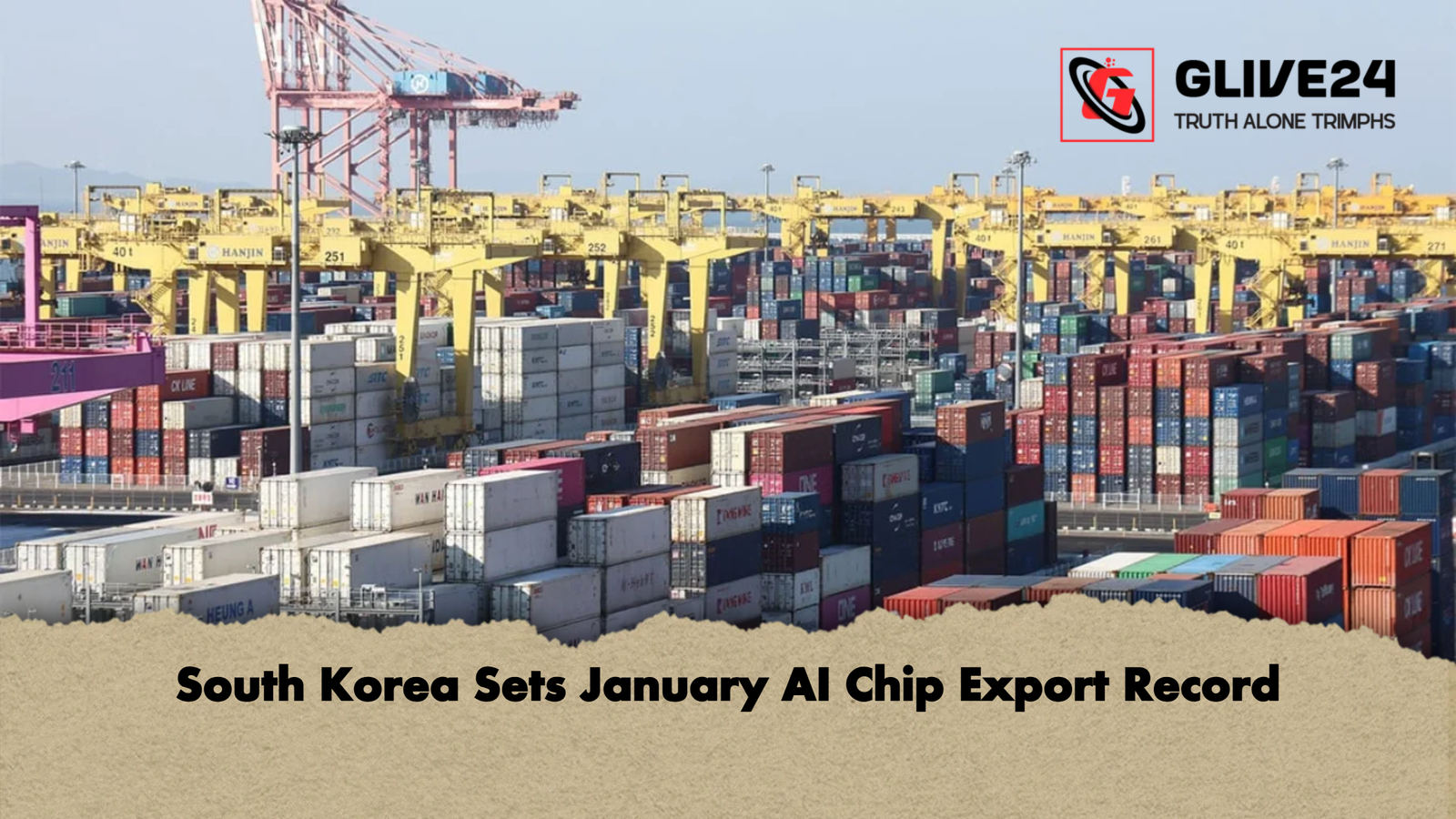
South Korea achieved its highest ever exports in the month of January, according to government data released on Sunday. Analysts attribute this historic surge primarily to the growing global demand for artificial intelligence (AI), which relies heavily on South Korean-manufactured semiconductors.
The Ministry of Trade, Industry and Energy stated that exports in January reached a record $65.8 billion, marking a 33.9 per cent increase compared to the same month last year. For the first time in history, the country’s exports in January have surpassed the $60 billion threshold.
As a world-leading producer of memory chips, South Korean products have become indispensable for AI infrastructure. Technology giants Samsung and SK Hynix also reported record profits for the October–December quarter, underscoring the strength of the nation’s semiconductor industry.
The ministry reported that semiconductor exports alone amounted to $20.5 billion, representing a 102.7 per cent year-on-year increase. While impressive, this is the second-highest monthly figure on record, following December, when the country exported $20.8 billion worth of chips.
In addition to semiconductors, South Korea’s automobile exports showed robust growth. Driven by strong global demand for hybrid and electric vehicles, exports in this sector rose 21.7 per cent, reaching $6 billion in January.
| Export Category | January 2026 Value (Billion USD) | Year-on-Year Growth (%) |
|---|---|---|
| Total Exports | 65.8 | 33.9 |
| Semiconductors | 20.5 | 102.7 |
| Automobiles | 6.0 | 21.7 |
However, South Korea faces fresh challenges in its trade relations with the United States. Earlier this week, US President Donald Trump announced plans to raise tariffs on South Korean products from 15 per cent to 25 per cent, creating uncertainty in Seoul. The South Korean government blamed the US Congress for failing to approve their trade agreement, which had been signed in October last year.
Under the agreement, South Korea had committed to increased US investment, in return for a reduction of tariffs from 25 per cent to 15 per cent. Seoul’s presidential office insisted in November that congressional approval was not required, arguing that the pact is a memorandum of understanding rather than a legally binding document.
Despite these geopolitical and trade-related challenges, South Korea’s record exports highlight the country’s critical role in the global AI and automotive sectors, and its continued prominence as a technology and industrial powerhouse. Analysts suggest that maintaining momentum will depend on both sustaining semiconductor innovation and navigating evolving international trade dynamics.