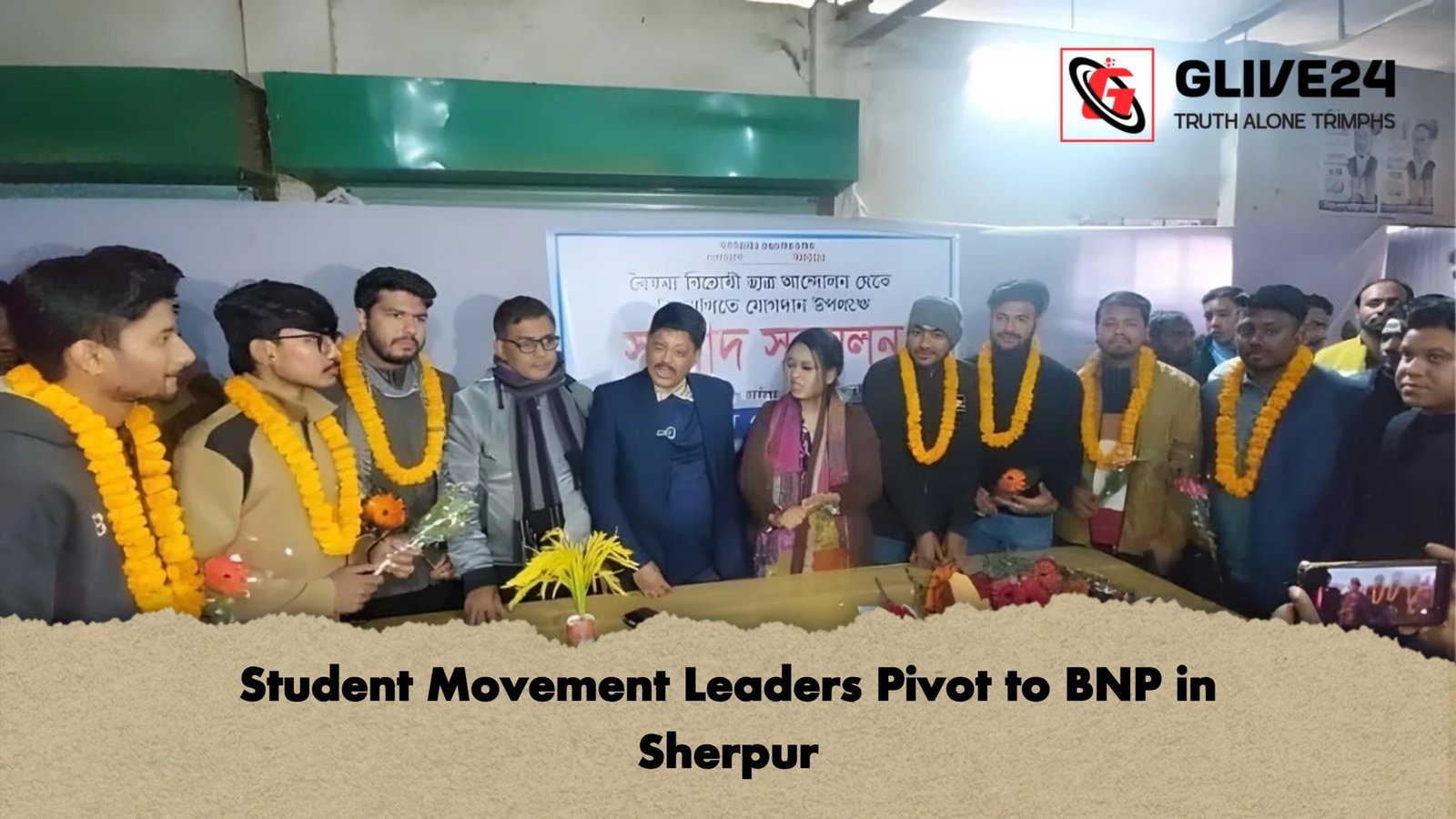
In a significant realignment of local political forces, more than 300 activists and coordinators from the Anti-Discrimination Student Movement formally joined the Bangladesh Nationalist Party (BNP) on Tuesday. The mass induction ceremony was held during a press conference at the district BNP headquarters in Raghunath Bazar, Sherpur, marking a major transition for the youth leaders who spearheaded the recent national uprising.
The decision to join one of the country’s primary political platforms indicates a strategic shift by the student vanguard, moving from street-level advocacy to the halls of established partisan politics.
A Celebratory Reception for Youth Leaders
The new members were greeted with a festive reception, where they were presented with floral bouquets by senior district party officials. The welcoming committee was led by Dr Sansila Jebrin Priyanka, Joint Convener of the Sherpur District BNP and the party’s parliamentary candidate for the Sherpur-1 seat, along with Hazrat Ali, the Convener of the Sadar Upazila BNP.
Dr Priyanka lauded the students’ decision, characterising the influx of youth as a “vital infusion of revolutionary energy” that would strengthen the party’s pursuit of a democratic and discrimination-free Bangladesh.
Profile of the New BNP Cohort
The scale of this political shift is underscored by the high-profile nature of the individuals involved. The group includes the core leadership that organised the district-wide protests during the anti-discrimination campaign.
Prominent Student Leaders Entering the BNP:
| Movement Designation | Name of Leader |
| Chief Coordinator & Spokesperson | Farhan Fuad Tuhin |
| District Coordinator | Al Mamun Sarkar |
| Senior Organiser & Coordinator | Arafat Rahman Talukdar |
| Senior Joint Member Secretary | Md Monibul Islam |
| Joint Member Secretary | Shahriar Nafis |
| Joint Member Secretary | Md Rahat |
| Sadar Upazila Joint Convener | Md Ashikur Rahman |
| Active Organiser | Nahim Ahmed Niloy |
Strategic Realignment for Future Governance
In addition to the senior coordinators, the contingent comprised over 300 active workers from various educational institutions across Sherpur. Addressing the media, the student leaders explained that their choice was driven by a desire to translate the spirit of the “July Mass Uprising” into institutional reforms through a party capable of national governance.
The mass joining has significantly altered the local political landscape. While the BNP views this as a major victory in securing the support of the younger generation, political analysts are observing how this move might influence the independent identity of the student movement elsewhere. For the Sherpur BNP, however, the addition of hundreds of battle-hardened organisers provides a powerful grassroots advantage ahead of future electoral cycles.