
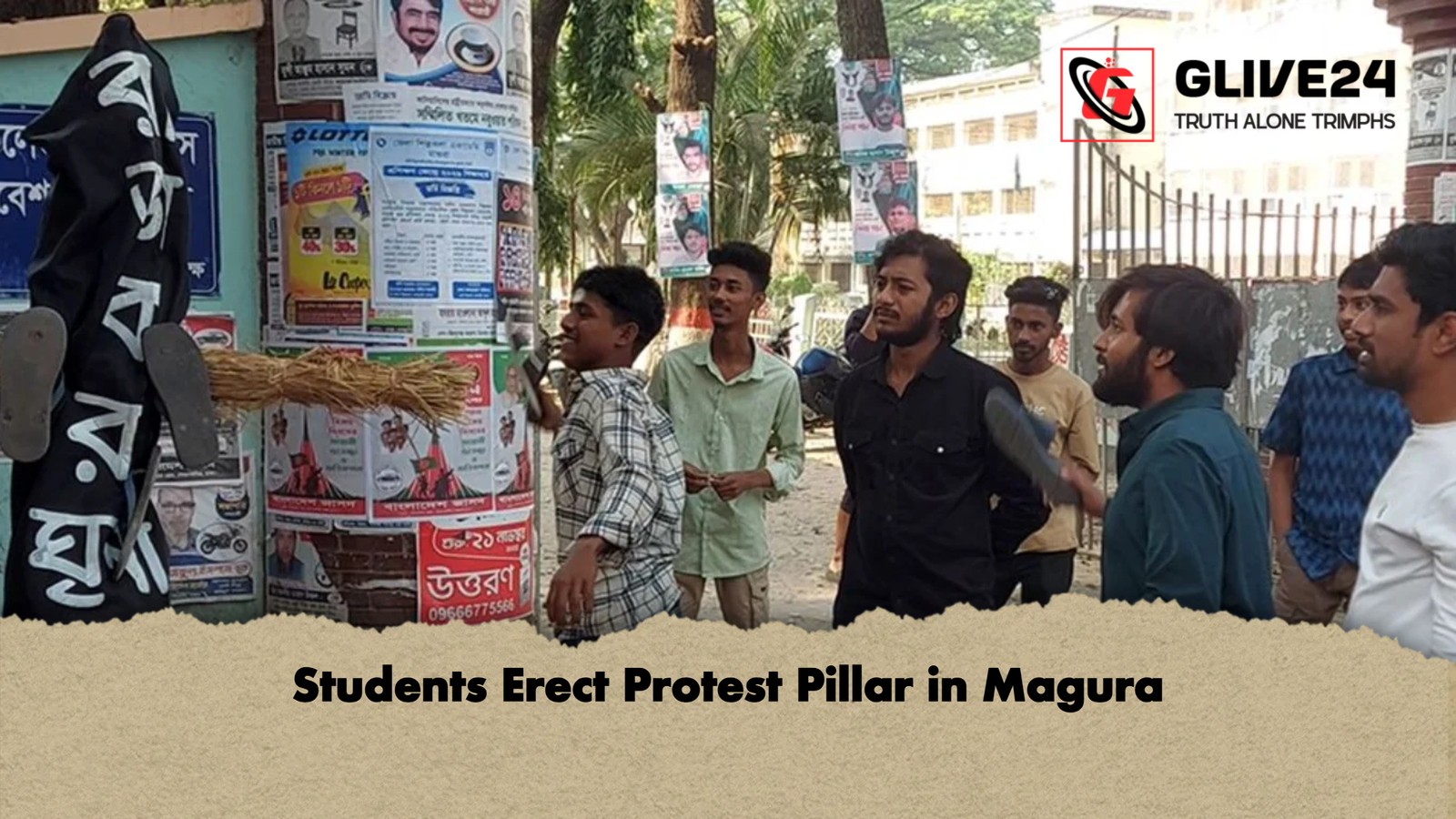
In a powerful and unconventional expression of civic awareness, students in Magura have mounted a symbolic protest against anti-liberation forces, aligning their actions with the celebrations of Bangladesh’s 54th Victory Day anniversary. On Wednesday morning, general students of Magura Government Huseyn Shaheed Suhrawardy College erected a temporary structure, referred to by them as a “Razakar pillar”, at the college’s main entrance. Almost immediately, the installation became the centre of a day-long programme marked by visible acts of rejection, remembrance, and historical reflection, drawing significant attention from across the district.
From the early hours, hundreds of students gathered in an orderly manner, lining up to throw sandals at the symbolic pillar. Others hurled bricks, stones, and debris, while some expressed their contempt through gestures intended to convey deep moral outrage. These acts were meant to symbolically denounce the Razakar, Al-Badr, and Al-Shams forces that collaborated with the Pakistani military during the Liberation War of 1971. The protest quickly extended beyond the student body, as passers-by, parents, and local residents paused to observe and, in many cases, joined in solidarity with the students’ stance.
Observers and local commentators remarked that the demonstration transcended the nature of an ordinary protest. Instead, it emerged as a potent message from a generation born after independence, asserting that betrayal of the nation remains an unforgivable crime and that the collective memory of wartime atrocities continues to inform the country’s moral framework. Members of Magura’s civil society praised the initiative as timely, bold, and socially resonant, particularly during Victory Month, when the ideals of independence and sacrifice are most vividly recalled.
Throughout the day, students were joined by labourers, professionals, and other members of the public, many of whom participated spontaneously. Several attendees described the event as a form of social resistance against any attempt to distort, diminish, or rewrite the history of the Liberation War. According to the organisers, the principal objective of the programme was to preserve the spirit of the Liberation War within the hearts of future generations and to foster enduring awareness against ideologies perceived as hostile to national sovereignty.
One of the organisers, college student Zulfiqar Ali, explained to reporters that the symbolic pillar was intended to represent the collective hatred towards those who betrayed their own people in 1971 despite being nurtured by the land. He stated that the message was unequivocal: traitors have no place of honour in Bangladesh, only rejection and condemnation.
Another student, Atik Faisal Saif, noted that although his generation did not witness the events of 1971 firsthand, the documented brutality and suffering recorded in history demand continued vigilance. He warned that defeated forces still seek to undermine the nation’s progress under different guises.
Student Iman Mollah added that those responsible for atrocities against women and the mass killing of civilians deserve lifelong condemnation. He expressed hope that similar symbolic initiatives would spread to educational institutions nationwide.
The protest has since gained widespread traction on social media, with many describing it as a symbolic battle in which moral outrage, rather than weapons, served as the instrument of resistance. Students have pledged to continue such awareness-driven activities throughout Victory Month to ensure that young people remain informed about the true history of the Liberation War and alert to any forces working against the nation’s independence.