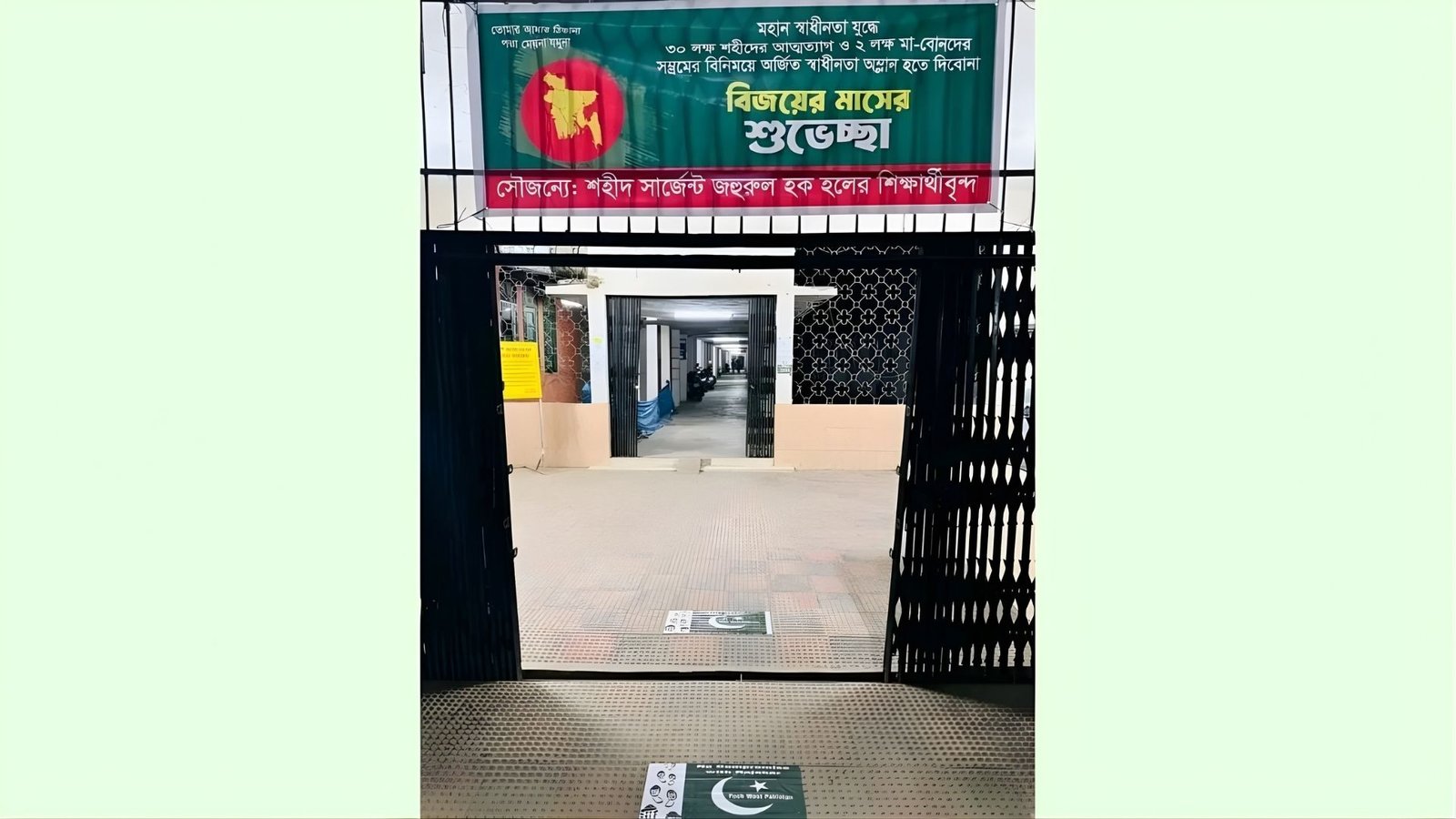
A symbolic protest unfolded at the University of Dhaka as students drew representations of the Pakistani flag at the entrances of three residential halls and then walked over them to express outrage against the historic atrocities committed during the Liberation War. The symbolic flags bore the bold inscription: “No Compromise with Razakars,” emphasising a strong message against collaborators of the Pakistani occupation forces in 1971.
The demonstrations took place on Monday afternoon at Ziaur Rahman Hall and Bijoy Ekattor Hall. A similar act was carried out the previous night at Sergeant Zahurul Haque Hall. Earlier, on Saturday night, students were also seen walking over a Pakistani flag placed on the ground in front of the historic Dhaka University Central Students’ Union (DUCSU) building. Photos and videos of the protests later circulated widely on Facebook, drawing significant public attention. However, by the following day, the symbolic flags placed in front of the halls were no longer visible.
For the students who took part, the protest was far more than a symbolic gesture—it was a reaffirmation of historical memory and national dignity at the beginning of Victory Day month. December remains a deeply significant period for the people of Bangladesh, reminding them of the sacrifices and martyrdom that led to the nation’s independence.
Karib Chowdhury, a student of the Department of Mass Communication and Journalism, articulated the sentiment behind the protest. He said that the initiative was an expression of profound gratitude to the valiant freedom fighters whose sacrifices made it possible for Bangladesh to emerge as a sovereign nation. According to him, walking over the symbolic flag was a reminder of the brutality inflicted by the Pakistani military junta and their local collaborators.
He added that the protest was a condemnation of the Pakistani occupation forces, as well as their auxiliary groups—Razakars, Al-Badr, and Al-Shams—who were responsible for widespread torture, atrocities against women, and the killing of freedom fighters and intellectuals. Karib emphasised that the students’ demonstration stemmed from a sense of responsibility towards history and a moral commitment to humanity.
“This protest, this anger—all of it comes from our duty to our history and our pledge to uphold human values,” Karib stated. “From the campus of Dhaka University, we want to send a message that the price of freedom must never be forgotten and that future generations must remain resolute against injustice.”
The protest reflects a growing awareness among the younger generation about the atrocities of 1971 and the importance of resisting any move to distort or undermine the nation’s liberation history. Students at Dhaka University, historically at the forefront of major national movements, once again invoked their role as guardians of collective memory.
As discussions continue both online and across campus, the protest has sparked debate about symbolic acts, freedom of expression, and the role of universities in shaping national consciousness. Above all, the demonstration stands as a reminder of Bangladesh’s painful but heroic history and the enduring commitment of its youth to safeguard the spirit of liberation.