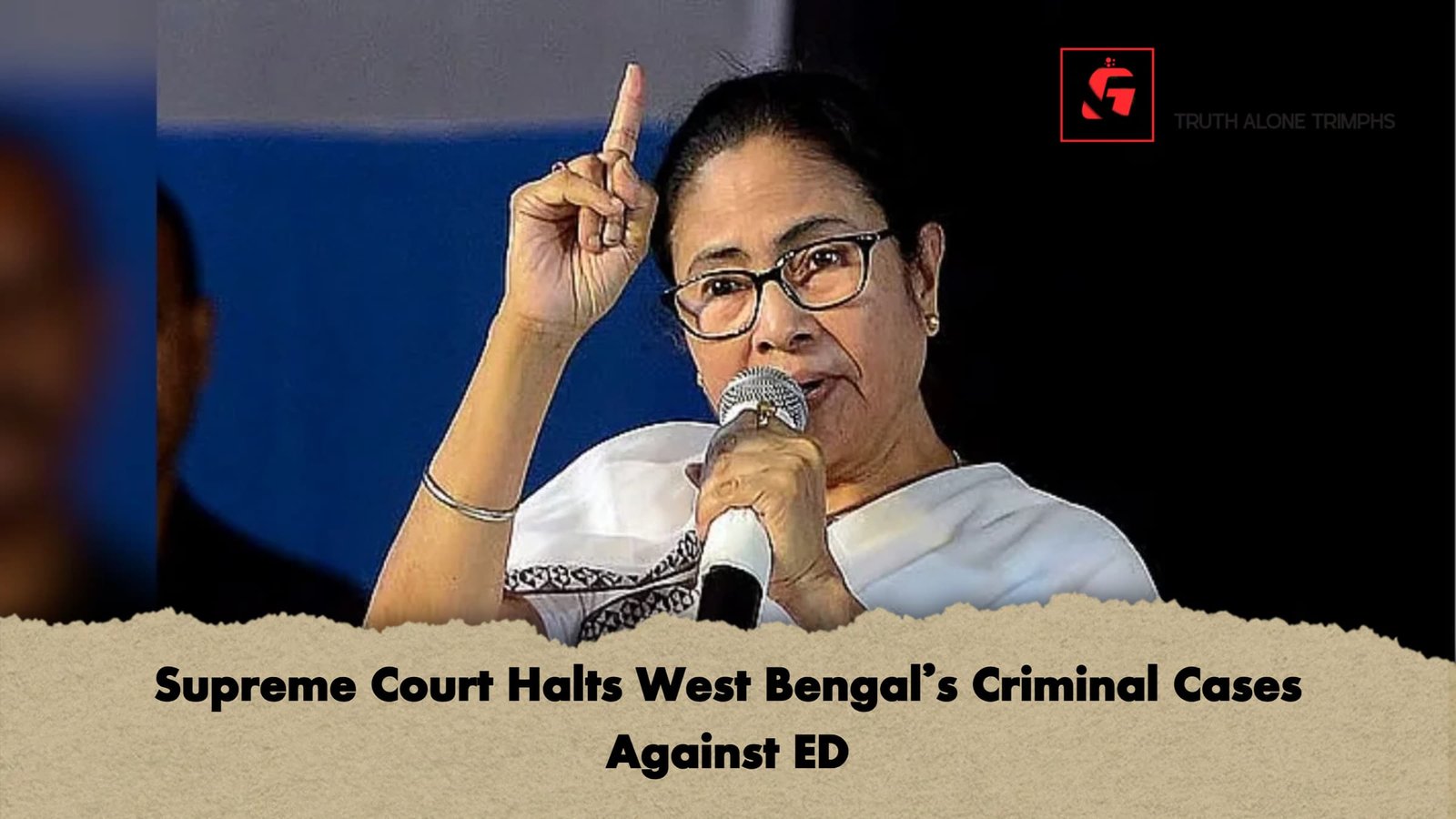
The legal battle between the Enforcement Directorate (ED) and the West Bengal government has reached the highest levels of the Indian judiciary. On Thursday, 15 January 2026, the Supreme Court of India issued an interim stay on four First Information Reports (FIRs) filed by the state police against federal ED officers. This judicial freeze comes amid a fierce jurisdictional dispute regarding recent raids on political consultancy firm I-PAC.
The Division Bench, consisting of Justice Prakash Chandra Mishra and Justice Vipul M. Pancholi, has directed both the federal agency and the state administration to file affidavits clarifying their positions. The next hearing has been scheduled for 3 February, effectively pausing all state-led criminal proceedings against the ED until that date.
The Catalyst: The I-PAC Raids
The conflict erupted on 8 January when ED officials conducted simultaneous searches at the Loudon Street residence of I-PAC head Pratik Jain and the firm’s headquarters in Salt Lake, Sector V. The agency alleges that these raids were part of a wider investigation into a multi-million-rupee coal smuggling racket. Specifically, federal investigators claim that “black money” from illegal coal operations was funnelled to I-PAC via “hawala” (informal money transfer) channels.
In a swift retaliatory move, the West Bengal government registered four separate cases at two Kolkata police stations, accusing the ED of procedural misconduct and the unauthorised seizure of sensitive documents.
Allegations of Constitutional Overreach
The Supreme Court proceedings revealed a startling set of counter-accusations. The ED’s legal team argued that the state’s legal action was an attempt to intimidate federal officers. Most notably, the agency alleged that Chief Minister Mamata Banerjee personally intervened during the raid.
According to the ED, the Chief Minister arrived at the site accompanied by the Director General of Police, Rajeev Kumar, and the Kolkata Police Commissioner, Manoj Verma. The agency claims this high-level presence was used to facilitate the removal of crucial evidence before a formal seizure list could be finalised. Consequently, the ED has requested that any investigation into its officers be transferred to the Central Bureau of Investigation (CBI) and conducted outside of West Bengal to ensure impartiality.
Key Points of Contention:
| Issue | Enforcement Directorate (ED) Allegation | West Bengal Government Defence |
| Search Conduct | Lawful investigation into “coal-smuggling” funds. | Politically motivated raid without prior notice. |
| Evidence | Alleges police helped “remove” vital documents. | Claims ED siphoned off private “election strategy” papers. |
| Police Involvement | State police used to obstruct federal duties. | Police acted on complaints of ED “heavy-handedness.” |
| Judicial Relief | Seeks transfer of cases to the CBI. | Demands state sovereignty in law enforcement. |
A Deepening Political Schism
The West Bengal government maintains that the ED is being used as a political tool by the central government to destabilise the Trinamool Congress (TMC). The Chief Minister has vociferously argued that the seizure of documents from I-PAC—a firm central to her party’s electoral planning—is an illegal attempt to gain access to confidential campaign strategies.
The Supreme Court’s decision to stay the FIRs provides a temporary shield for the federal officers involved. However, the underlying coal smuggling probe continues to expand, with the ED insisting that constitutional office-holders cannot use their positions to interfere with federal crime scenes.