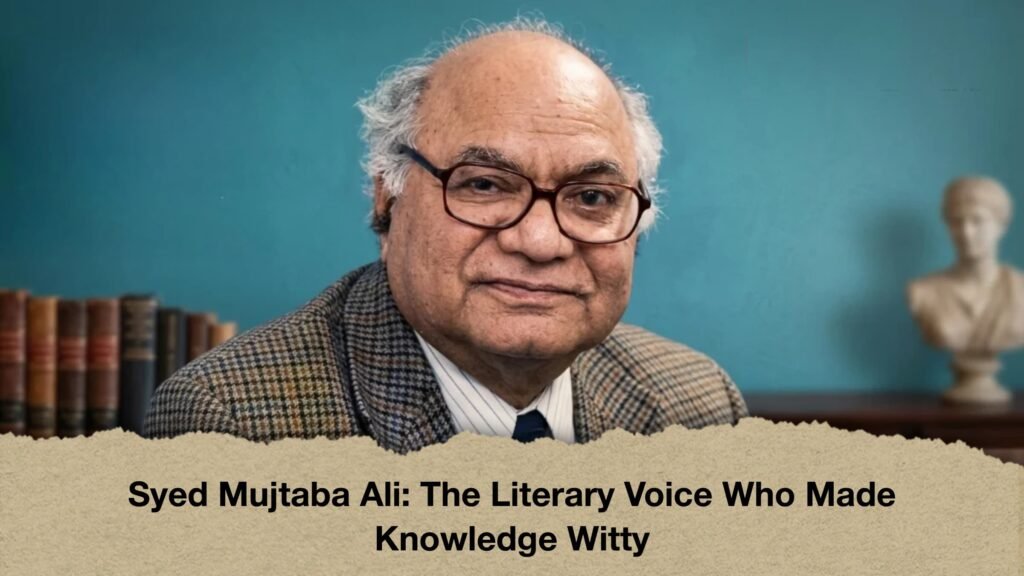
“Buying books never makes anyone bankrupt.” Few lines capture Syed Mujtaba Ali’s lifelong devotion to books and knowledge as vividly as this one. In Bengali literature, however, he cannot be defined simply as a writer. He was a scholar, linguist, traveller, humorist and keen observer of life whose work brought together erudition, wit, cultural curiosity and a profound understanding of people.
13 September marks his birth anniversary. On this day, readers remember one of the most distinctive literary figures in modern Bengali literature, whose writing continues to entertain, inform and encourage readers to look at the world from a broader perspective.
Early life and upbringing
Syed Mujtaba Ali was born on 13 September 1904 in Karimganj, then part of the Sylhet district. His father, Syed Sikandar Ali, was a government official, while his mother was Syed Ayatul Mannan Khatun. He was the third of four children.
From an early age, Ali showed an exceptional interest in knowledge and languages. His later travels across different countries and his exposure to diverse cultures and traditions broadened his intellectual horizons considerably. He gradually emerged as a truly cosmopolitan Bengali thinker whose outlook extended far beyond geographical boundaries.
A life devoted to learning
During his studies at Santiniketan, Ali came into contact with Rabindranath Tagore’s ideals of universal humanity and the institution’s multicultural educational environment. His intellectual journey later took him to Europe and the Middle East for higher studies.
At the universities of Berlin and Bonn in Germany, he conducted research in comparative theology and received a Doctor of Philosophy degree in 1932. He also studied Islamic theology at Al-Azhar University in Egypt.
His command of languages was remarkable. Alongside Bengali and English, he had a strong knowledge of Sanskrit, Arabic, Persian, Urdu, Hindi, Gujarati, French, German and Italian, among others. For Ali, language was more than a means of communication. It was a way of entering different cultures and understanding the civilisations that shaped them.
A remarkably varied career
His professional life was as diverse as his literary interests. He began his career as a lecturer in French and English at the Agricultural Science College in Kabul. He later worked at Baroda College, Bogura Azizul Haque College, the University of Calcutta, the Indian Council for Cultural Relations and All India Radio.
He eventually joined Visva-Bharati as a Reader in the Department of Islamic History and retired from there.
His wide-ranging professional experiences brought him into contact with different educational, cultural and social environments. These experiences also enriched the perspective that later became one of the defining characteristics of his writing.
‘Deshe-Bideshe’ and a new literary horizon
Syed Mujtaba Ali’s arrival in Bengali literature brought a distinctive new voice. His celebrated travelogue Deshe-Bideshe made him widely popular. Based on his experiences in Kabul, the book presents Afghan society, people, culture, politics and everyday life with remarkable vitality.
Yet the work is far more than a conventional travel account. Through his observations and storytelling, Ali turned an unfamiliar country into a place that Bengali readers could approach through its people and their lives. Characters such as Abdur Rahman, Professor Benoit, Ahmed Ali, Khudabakhsh, Bogdanoff and Moin-us-Sultan remain memorable to generations of readers.
One of the greatest strengths of Ali’s writing was his ability to make unfamiliar places feel familiar and strangers seem remarkably close to the reader.
Humour with a deeper purpose
Ali is widely remembered as a master of Bengali humorous writing, but his humour was never merely intended to provoke laughter. Behind the jokes lay observations about life; behind the satire was often an uncomfortable truth; and beneath the wit was a genuine affection for humanity.
Works such as Panchatantra, Mayurkanthi, Chacha-Kahini, Tuni Mem, Dhupchhaya and Bhoboghure O Anyanya demonstrate his distinctive command of humour and language.
His humour could be gentle or sharp, playful or satirical. At times, an apparently simple joke would lead the reader towards a deeper reflection on human nature and everyday life. That ability to make readers laugh while quietly encouraging them to think became one of the hallmarks of his literary style.
Novels, stories and other works
His literary contribution extended well beyond humorous writing. He wrote novels, short stories, essays and travel literature. Among his notable novels are Abishwasya, Shabnam, Shahriyar and Tulanahina.
Shabnam, set against the backdrop of Afghan society, presents a poignant story of love and human relationships. His storytelling ability is also evident in works such as Chacha-Kahini, Rasgolla, Tirthahina, Padatika and Rakshasi.
His other books, including Jale-Dangay and Purba-Pakistaner Rashtra Bhasha, reflect his intellectual depth, command of language and awareness of society.
A Bengali with a universal outlook
Perhaps one of the most significant aspects of Syed Mujtaba Ali’s identity as a writer was his liberal, non-communal and universal humanist outlook.
He possessed deep knowledge of religion, but did not embrace religious narrowness. His curiosity led him to engage with Eastern and Western traditions, India and Europe, Islam and other religious and cultural heritages with an open and questioning mind.
As a result, his literature cannot be confined to a single geographical or cultural space. Afghanistan, Germany, India and Europe all appear in his work, yet the central subject remains the human being.
When scholarship became entertaining
Ali’s extraordinary learning became almost legendary. His interests and knowledge extended from the Gita and Sanskrit literature to Islamic theology and European philosophy. Yet his scholarship rarely made his writing feel heavy or inaccessible.
Instead, he presented knowledge through an easy, lively and witty style. A reader could begin with what appeared to be a simple story and gradually find themselves encountering ideas from a much wider intellectual world.
That quality explains why Ali cannot be adequately described merely as a humourist. He was one of Bengali literature’s most intellectually agile and engaging storytellers.
Why he became a legend
According to the essence of literary critic Syed Manzurul Islam’s assessment, Syed Mujtaba Ali had already become a legendary figure during his lifetime.
His distinctive quality was not simply that he wrote stories; it was the sense that he was telling them directly to the reader. His characters often feel like people one might have encountered in ordinary life, while his humour echoes the laughter, contradictions and experiences of human existence.
His language was witty, polished and richly influenced by his exposure to different cultures. His literature, meanwhile, remained grounded in a deep faith in humanity. These qualities helped establish a literary identity that has endured long after his death.
Words that continue to resonate
Several of Ali’s observations remain widely remembered, including the lines: “Acquiring knowledge is greater than acquiring wealth” and “Buying books never makes anyone bankrupt.”
Another much-quoted reflection expresses his enduring faith in the value of books and knowledge. It contrasts the temporary nature of food, drink and human life with the lasting vitality of a good book.
These words are more than memorable quotations. They offer a glimpse into the values that shaped Ali’s intellectual and literary life.
Recognition and honours
For his outstanding contribution to Bengali literature, Syed Mujtaba Ali received several honours, including the Ananda Puraskar. He was also awarded the Ekushey Padak posthumously for his literary contribution.
For a writer, however, formal awards are only one measure of achievement. Ali’s enduring readership may be his most significant legacy. Generation after generation has continued to read his books, laugh at his wit, reflect on his observations and discover unfamiliar worlds through his writing.
A literary legacy that remains alive
Syed Mujtaba Ali died on 11 February 1974. Yet his literary presence did not disappear with his death.
He continues to live through the Kabul of Deshe-Bideshe, the humour of Chacha-Kahini, the emotional world of Shabnam and the sharp intelligence of his humorous writings. His works remain part of the reading experience of countless Bengali readers.
Ali looked at the world through many windows, encountering different countries, languages, traditions and people. Yet his literary journey repeatedly returned to one central subject: humanity.
He made readers laugh, but he also made them think. He took them on journeys across unfamiliar places while bringing them closer to the complexities of human life. He shared knowledge without burdening his readers with it, and drew upon diverse cultural traditions without losing his distinctive Bengali voice.
His literary contribution therefore extends beyond the individual books he wrote. He demonstrated how scholarship could become accessible, how humour could carry serious ideas and how familiarity with the wider world could enrich Bengali literature.
As long as Bengali remains a living language, as long as readers continue to turn the pages of books, and as long as literature can make people laugh while encouraging them to reconsider life, Syed Mujtaba Ali’s work will retain its place in the cultural memory of Bengali readers.
On his birth anniversary, this remarkable storyteller and literary legend is remembered with deep respect and affection.