
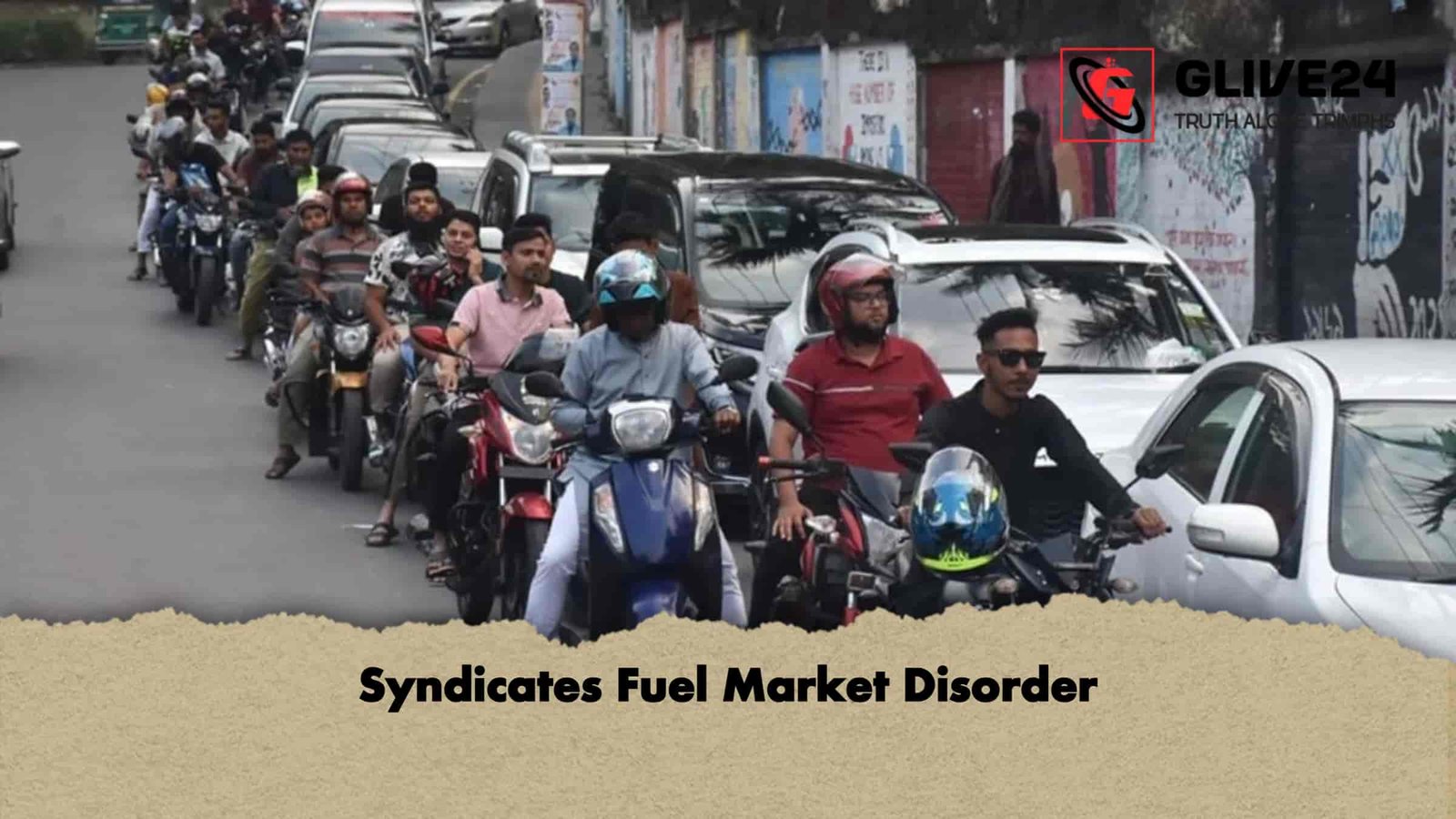
Khulna’s fuel market has descended into disorder, leaving ordinary motorists facing long queues and growing frustration, despite there being no significant reduction in overall fuel supply. Investigations indicate that the crisis is not caused by scarcity, but by organised manipulation carried out by a well-coordinated motorcycle syndicate.
A visit to several petrol stations across the city on Sunday revealed a troubling situation. Although fuel sales were scheduled to begin at 11 a.m., queues had already formed before dawn, stretching for kilometres. A substantial proportion of those waiting were not genuine motorists, but professional “fuel collectors” operating as part of an organised network.
These individuals repeatedly purchased small quantities of petrol or octane—typically worth around 300 taka—before transferring the fuel into large containers and rejoining queues. In some cases, they returned to the same station after changing their appearance, while others moved between different stations to avoid detection. The collected fuel was later sold in informal markets at inflated prices, often 100 to 150 taka per litre above the official rate.
This practice has created a distorted market. While petrol stations appear to be running dry, fuel remains readily available in backstreet markets at significantly higher prices. Fear of shortages has also prompted genuine motorists to queue multiple times, further intensifying pressure on supply.
Some filling stations have attempted to introduce control measures. One station implemented a system of marking motorcycle tyres with paint after refuelling to prevent repeat purchases. However, syndicate members quickly adapted by visiting other stations or altering identifying features, rendering such measures largely ineffective.
Authorities have uncovered further irregularities. There are allegations that certain operators, despite having sufficient stock, have refused service to ordinary customers while diverting fuel to black market channels. Enforcement agencies have already taken action in several cases, issuing fines for under-measurement and unlawful sales. In one instance, fuel collected under the pretext of official use was intercepted while being sold illegally at inflated prices.
According to data from regional depots in Khulna, overall fuel supply has remained broadly stable compared to the previous year. However, artificially inflated demand—driven by hoarding and repeated purchases—has created the illusion of scarcity.
| Indicator | Current Situation |
|---|---|
| Fuel supply | Largely stable |
| Genuine demand | Moderate |
| Artificial demand | Significantly inflated |
| Black market price rise | 100–150 taka per litre |
| Primary causes | Syndicates, hoarding, repeat purchases |
Industry representatives argue that the crisis reflects systemic mismanagement rather than a genuine shortage. They have proposed introducing a digital rationing system linking each vehicle’s registration number to a central database. Under such a system, fuel purchases would be restricted to fixed intervals, preventing multiple transactions within a short period.
Experts believe that mandatory verification of vehicle registration and driving licences at the point of sale, combined with digital monitoring, could significantly reduce black market activity. Without swift and coordinated intervention, however, ordinary citizens are likely to continue bearing the burden of a crisis driven not by scarcity, but by exploitation.