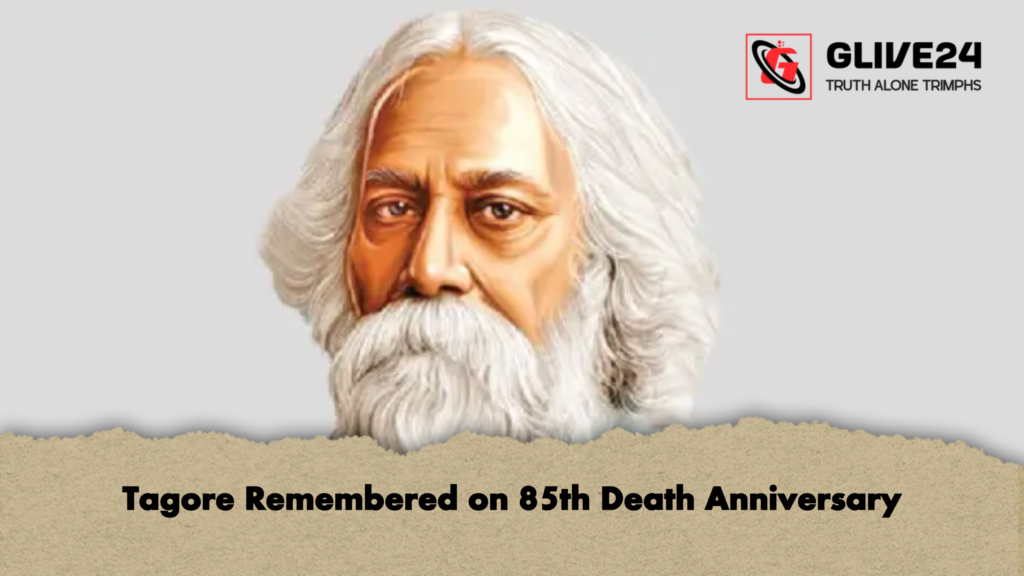
Bangladesh is observing the 85th death anniversary of Nobel laureate poet, writer, composer and philosopher Rabindranath Tagore on Thursday, 6 August, with a range of cultural programmes and commemorative events. People across the country are paying tribute to the legendary figure whose contributions transformed Bengali literature, music, art and intellectual thought.
Rabindranath Tagore breathed his last on 7 August 1941 at the ancestral Tagore residence in Jorasanko, Kolkata, at the age of 80. In Bangladesh, his death anniversary is observed every year on 22 Shravan according to the Bengali calendar. This year, the date coincides with 6 August, prompting cultural organisations, educational institutions and media outlets to arrange special programmes in remembrance of his life and legacy.
Born on 7 May 1861 (25 Baishakh 1268 in the Bengali calendar) into the influential Tagore family of Jorasanko, Kolkata, Tagore was the youngest among the surviving children of Debendranath Tagore and Sarada Devi. Growing up in an environment rich in literature, music, philosophy and social reform, he developed an early passion for creative expression. His exposure to both Indian traditions and global literary movements played a significant role in shaping his unique artistic vision.
Over a creative journey spanning nearly seven decades, Tagore enriched Bengali culture through an extraordinary body of work that included poetry, songs, novels, short stories, plays, essays and paintings. His writings explored themes such as human dignity, freedom of thought, love for nature, social awareness and the complex emotions of human life.
Tagore composed more than 2,000 songs, which later formed the foundation of the distinct musical tradition known as Rabindra Sangeet. These songs remain deeply connected with Bengali identity and continue to be performed across generations. His celebrated literary works include Gitanjali, Gora, The Home and the World, The Last Poem, The Wreck and The Post Office, among many others.
Tagore’s international recognition reached a historic milestone in 1913 when he was awarded the Nobel Prize in Literature for his acclaimed poetry collection Gitanjali. He became the first Asian writer to receive the prestigious honour, bringing global attention to Bengali literature and Indian cultural traditions. His works have since been translated into numerous languages, allowing readers worldwide to engage with his ideas and artistic philosophy.
His influence also extends to national identity and cultural heritage. Two of his compositions later became national anthems: “Amar Sonar Bangla” was adopted as the national anthem of Bangladesh, while “Jana Gana Mana” became the national anthem of India. These works continue to symbolise the enduring power of his creativity and vision.
Marking the anniversary, government and private organisations in Bangladesh have arranged various commemorative events. Television channels are broadcasting special programmes featuring Rabindra Sangeet, poetry recitations, discussions, documentaries and analyses of his life and works. Cultural institutions are also organising seminars and performances to highlight different aspects of his remarkable contribution.
Cultural figures and scholars say Tagore’s philosophy remains relevant even decades after his passing. His messages of humanity, equality, compassion and the pursuit of beauty continue to inspire people around the world. His writings reflect universal emotions and values that transcend geographical and historical boundaries.
Eighty-five years after his death, Rabindranath Tagore remains an inseparable part of Bengali thought, culture and identity. His creations are not merely reflections of a particular era but timeless expressions of human experience, imagination and moral consciousness.