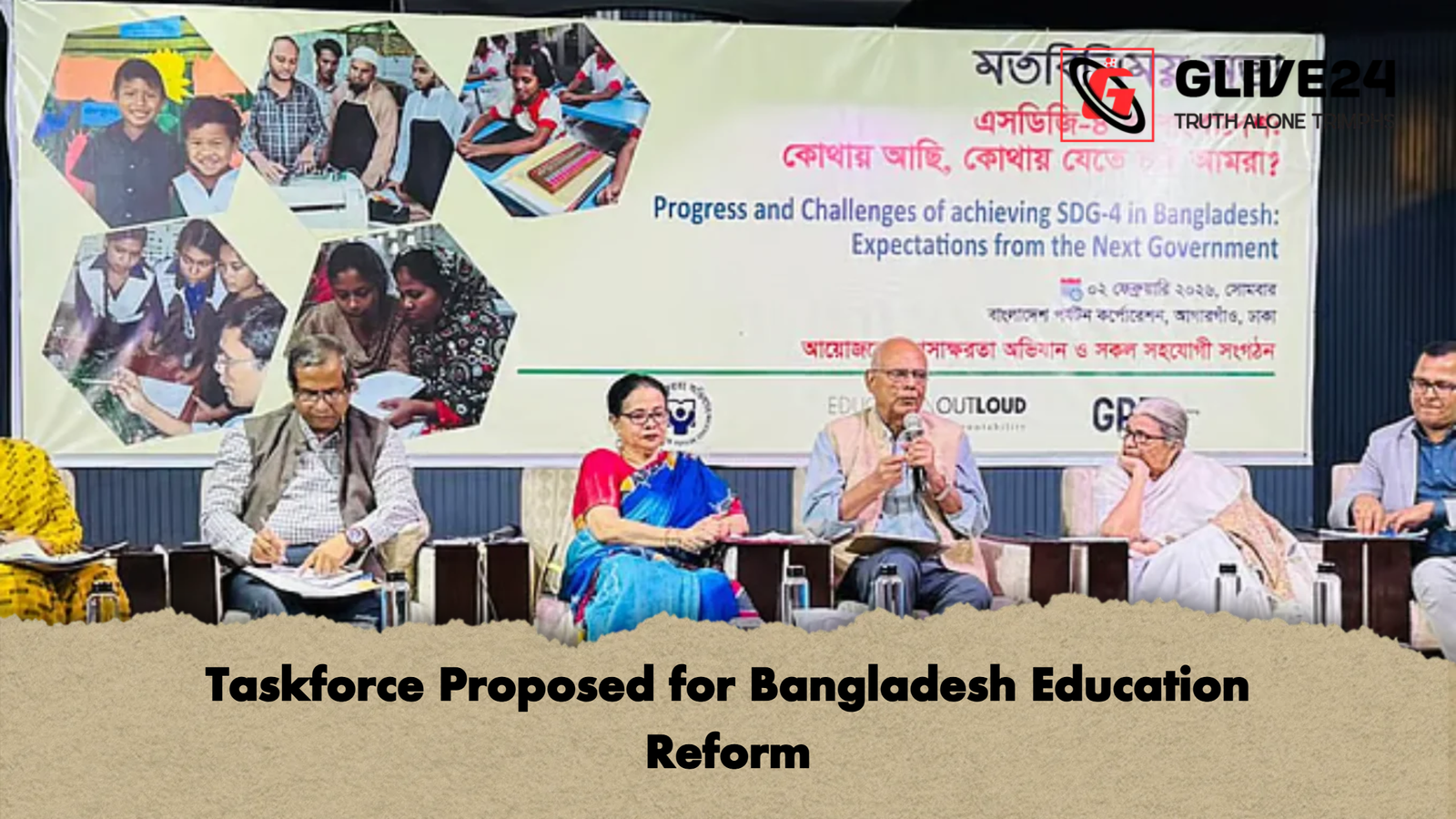
Ahead of the forthcoming national elections, the civil society coalition Ganashakkhorota Abhijan has outlined a set of urgent recommendations to the incoming government to advance the country’s education sector. The organisation called for the immediate establishment of a dedicated education taskforce to develop a comprehensive five-year plan, the allocation of 20 per cent of the national budget or 4–6 per cent of GDP to education, the provision of at least BDT 500 per month in student stipends, and the consolidation of all pre-tertiary and higher education under a single ministry. The proposals emphasise short-term, medium-term, and long-term strategies to systematically improve the sector.
The recommendations were presented during an event held today at Agargaon, Dhaka, titled “SDG-4 and Bangladesh: Where We Are, Where We Aim to Go”, which reviewed the current state of education in the country in the context of Sustainable Development Goal 4 (SDG-4). The programme highlighted both achievements and challenges in implementing education policies.
The session, moderated by Rasheda K. Chowdhury, Executive Director of Ganashakkhorota Abhijan, featured Professor Manzur Ahmad, Chair of the Advisory Committee on Primary, Non-Formal, and Secondary Education and Professor Emeritus at BRAC University, as the keynote speaker. Professor Ahmad stressed the importance of forming a taskforce of experienced and dedicated professionals to guide education policy. “There is a justified need for a permanent education commission,” he said. “The taskforce, once operational, could evolve into this permanent commission. The sector must be viewed holistically, with decentralised administration and universal access to education up to the secondary level.” He also criticised successive governments for neglecting educational reforms and noted that nearly a year had passed since his committee submitted recommendations without any significant implementation.
Abdur Rauf, Programme Manager at Ganashakkhorota Abhijan, presented a detailed evaluation of SDG-4 indicators, highlighting current challenges:
| Indicator | 2023 | 2024 | Observation |
|---|---|---|---|
| Primary school dropout rate | 13.15% | 16.25% | Rising trend |
| Secondary school dropout rate | 34.50% | 35.40% | Slight increase |
Rauf noted that while certain positive trends exist in literacy and enrolment, high dropout rates at both primary and secondary levels remain a major concern. He emphasised the need for enhanced stipends, improved school infrastructure, and systematic policy interventions to address these challenges.
Additional speakers included Khandakar Golam Moazzem, Research Director at the Centre for Policy Dialogue; Fauzia Moslem, President of Bangladesh Mahila Parishad; Mohammad Golam Kibria, Co-Chair of Education Local Consultative; expatriate physician Nahreen Ahmed; and Ganashakkhorota Abhijan Deputy Director Tapan Kumar Das. Representatives from various districts, including students and civil society organisations, also contributed their perspectives and recommendations for strengthening the sector.
The coalition concluded by urging the incoming government to adopt a structured, long-term, and comprehensive approach to education reform, ensuring adequate funding, equitable access, and quality improvement across all levels.