
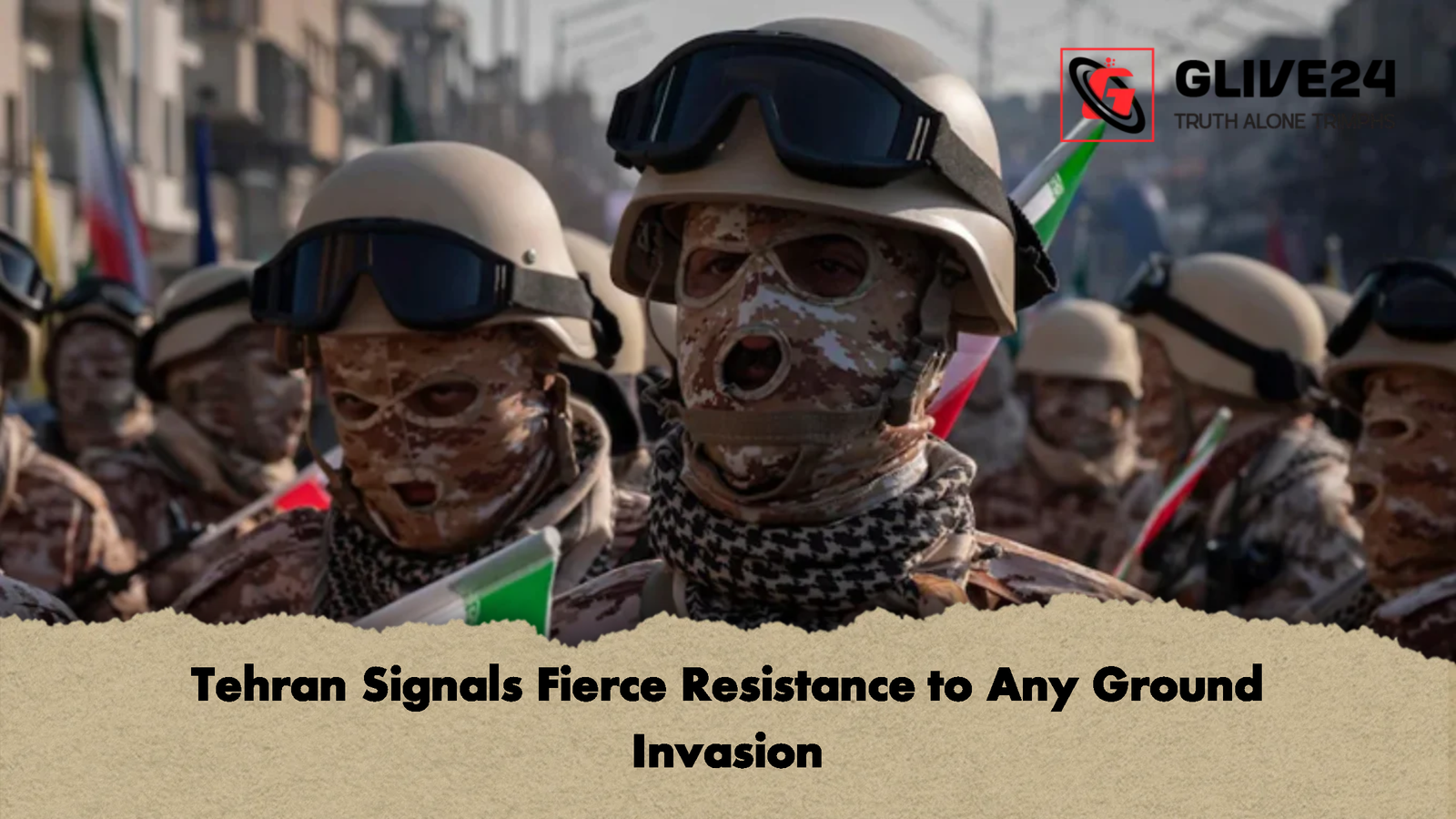
Iran has issued a forceful warning that any United States-led ground offensive would encounter sustained, highly organised resistance, potentially drawing American forces into a prolonged and costly conflict against a deeply entrenched military system designed explicitly to defend Iranian sovereignty at all costs.
According to reporting referenced by The Telegraph, the strategic risks facing Washington would escalate significantly if any future US administration attempted to seize or disable Iran’s stockpile of enriched uranium. Such an operation would likely require direct entry into Iranian territory and coordinated strikes on multiple heavily fortified nuclear facilities—an undertaking widely regarded by defence analysts as exceptionally complex and hazardous.
Former US Navy Admiral James Stavridis has suggested that such a mission could rank among the largest special forces operations ever conceived, given the dispersion, concealment, and layered protection of Iran’s nuclear infrastructure.
Table of Contents
Geographic Constraints and Strategic Depth
Military analysts note that Iran’s strategic facilities are often situated far from conventional US military staging areas in the Gulf region, with some locations estimated to lie roughly 600 miles from key American naval or air bases. This creates significant operational challenges in terms of supply lines, real-time coordination, and sustained military pressure.
Iran’s terrain further complicates any potential incursion. The western region is dominated by the Zagros mountain range, a vast and rugged natural barrier that restricts ground movement and provides significant defensive advantage. This geography is widely considered a central pillar of Iran’s broader national defence strategy.
Multi-Layered Defensive System
Iran’s military doctrine is built around a structured, multi-tiered air defence and ground resistance system designed to offset the technological superiority of potential adversaries through depth, redundancy, and dispersion.
| Layer | Capability |
|---|---|
| Long-range defence | Integrated radar and missile systems targeting incoming aircraft and missiles |
| Medium-range defence | Mobile units engaging fighter jets, drones, and cruise missiles |
| Short-range defence | Man-portable air defence systems (MANPADS) for low-altitude threats |
| Core command structure | Islamic Revolutionary Guard Corps (IRGC) |
| Auxiliary forces | Basij militia and volunteer formations |
| Claimed mobilisation capacity | Up to 1,000,000 personnel |
| Key terrain advantage | Zagros mountain defensive network |
The Islamic Revolutionary Guard Corps (IRGC) plays a central role in coordinating these systems, drawing on decades of operational experience shaped by the Iran–Iraq War and subsequent regional confrontations.
Leadership Rhetoric and Military Warning
Former Iranian Vice President Ishaq Jahangiri has issued particularly severe warnings regarding any attempt at a ground invasion, stating that even capturing a small portion of Iranian territory would come at an extreme human cost. He described such a scenario as one that would plunge invading forces into what he termed a “sea of blood”, reflecting Tehran’s declared intent to resist occupation through sustained warfare.
Nuclear Material Security Challenges
A further complication in any potential military operation involves Iran’s enriched uranium stockpile, estimated in the report at around 450 kilograms. This material is believed to exist in multiple forms—gas, metallic, and powdered—and may be dispersed across several highly secured facilities.
Some portions are thought to be stored deep underground, while others could be located in damaged or partially destroyed infrastructure. Recovering and transporting such material would require highly specialised containment systems, radiation protection measures, and precise operational coordination under hostile conditions.
Regional Escalation Risks
Iran has warned that any ground invasion could trigger a broader regional conflict. Potential retaliatory measures reportedly include attacks on US military installations across the Middle East, disruption of Gulf energy infrastructure, and the closure or obstruction of key maritime chokepoints such as the Strait of Hormuz and the Bab al-Mandab Strait.
Such developments would have immediate and severe consequences for global energy markets and international shipping, potentially destabilising supply chains far beyond the region.
Historical Context and Operational Complexity
Analysts frequently draw comparisons with earlier US operations in Iran, particularly the failed 1980 hostage rescue mission in Tehran, which highlighted the difficulties of conducting complex military operations in hostile terrain with limited intelligence and coordination.
However, modern conflict scenarios would be significantly larger in scale and involve advanced technologies, including precision airpower, satellite intelligence, cyber capabilities, and integrated multi-domain warfare systems.
A Highly Unstable Strategic Balance
Taken together, Iran’s geography, layered defence architecture, and large mobilisation capacity create a highly challenging operational environment for any invading force. While military planners continue to assess feasibility and deterrence strategies, analysts broadly agree that any ground operation would carry extraordinary risks and uncertain outcomes.
In this context, Iran’s posture—combined with its stated willingness to escalate across the wider region—ensures that any direct confrontation would carry severe consequences not only for the immediate belligerents but also for global security and economic stability.