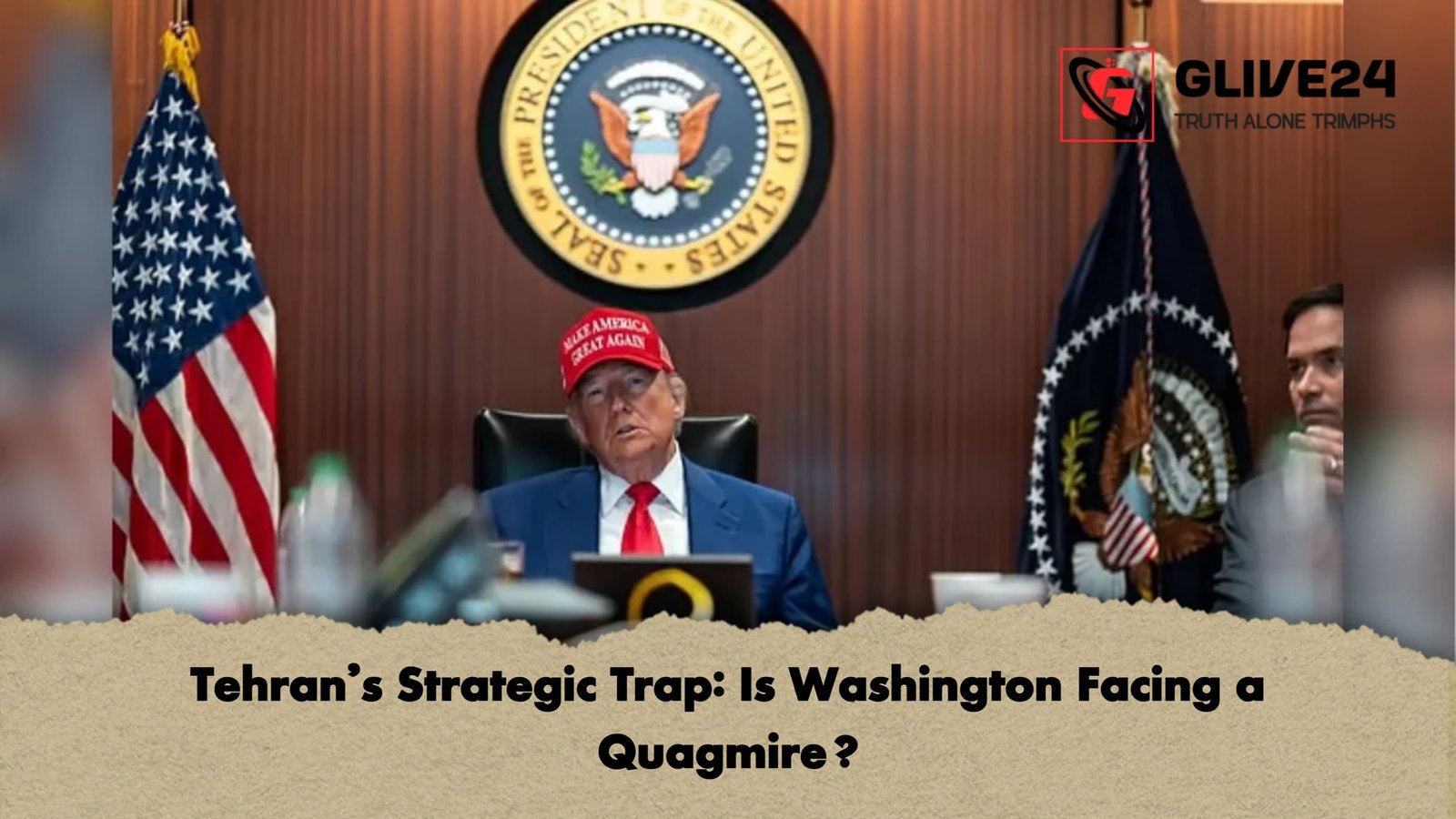
The joint military offensive launched by the United States and Israel against the Islamic Republic was initially framed as a swift, surgical campaign designed to catalyse immediate regime change. On paper, this objective persists; however, escalating rhetoric from Washington suggests a sober recalibration is underway. As the conflict enters its second week, the anticipated domestic collapse of the Iranian state has failed to materialise. Instead, the “Shock and Awe” phase has given way to a sophisticated Iranian strategy of “cost-distribution” that threatens to ensnare the West in a protracted regional nightmare.
Table of Contents
The Failure of Initial Assumptions
The Anglo-American assumption that decapitating Iran’s senior leadership—including reports regarding the Supreme Leader—would trigger a populist uprising has proven premature. Far from crumbling, the Iranian administrative and military apparatus has demonstrated remarkable resilience. Tehran has moved beyond mere survival, launching effective counter-strikes against US assets and ignoring diplomatic overtures from regional intermediaries.
This strategic intransigence is not merely ideological; it is calculated. Tehran believes that any ceasefire without a fundamental change in the regional security architecture would simply grant the West time to prepare a more lethal follow-up.
Casualties and Strategic Shift: A Comparative Overview
| Feature | Initial US/Israeli Projection | Current Reality (Day 6+) |
| Duration | Short-term, “Surgical” | Likely “Endless” / Multi-month |
| Iranian State | Immediate Collapse | Stable Command & Control |
| US Focus | Regime Change | Ballistic Missile Neutralisation |
| Global Markets | Managed Volatility | Skyrocketing Oil/LNG Prices |
| Primary Tactic | Decapitation Strikes | Regional Attrition & Proxy War |
The Pentagon’s Changing Tune
The shift in Washington is palpable. General Dan Kane, Chairman of the Joint Chiefs of Staff, recently warned of “excessive loss of life,” a grim departure from earlier optimistic briefings. While Defence Secretary Pete Hegseth insists “this is not Iraq,” his very need to deny the comparison suggests that the spectre of a “forever war” is now a mainstream concern.
Secretary of State Marco Rubio has further broadened the mission’s scope. Having acknowledged that Washington anticipated Iranian retaliation against US bases, he now asserts that the US must remain until Iran’s ballistic missile capabilities are “completely eradicated.” This expansion of goals often signals a lack of a clear exit strategy—a hallmark of strategic traps.
Tehran’s “Cost-Distribution” Doctrine
Iran’s new tactical playbook eschews rare, massive strikes on Israel in favour of a dispersed, long-term campaign designed to exhaust Western air defences. By targeting US bases in Qatar, the UAE, and Kuwait, Iran is testing the durability of Washington’s security umbrella.
Reports indicate that the UAE and Qatar are rapidly depleting their stocks of interceptor missiles and have urgently requested American replenishment. This puts the US in a logistical bind: how to defend its allies without stripping its own global reserves. Furthermore, the threat to the Strait of Hormuz has sent energy markets into a tailspin. With Saudi refineries and Qatari LNG plants halting operations, the economic cost of the war is being felt in every household in the West.
The “Proxy” Gamble and Internal Stability
Desperate to regain the initiative, Washington appears to be pivoting toward the “internal instability” model long advocated by Israeli hawks. Reports of President Trump’s telephone conversations with Kurdish insurgent leaders suggest an attempt to weaponise ethnic minorities—including Azeris, Kurds, and Balochis—against Tehran.
However, Iranian security officials have dismissed this as a “pipe dream.” Tehran has already launched preemptive strikes against Kurdish camps near Erbil, Iraq, to disrupt any burgeoning proxy ground force.
The Global Stakes
The Iranian crisis has become a litmus test for American endurance. If Tehran successfully sustains this level of resistance for several more months, it exposes a critical vulnerability in the US military posture. The overarching question now facing the Pentagon is not just about Iran; it is about the global precedent. If China were to adopt a similar “cost-distribution” strategy in the Pacific, would Washington possess the economic and political capital to respond?
In this light, the sands of the Middle East have become more than a battlefield; they are a laboratory for a new era of exhausted hegemony.