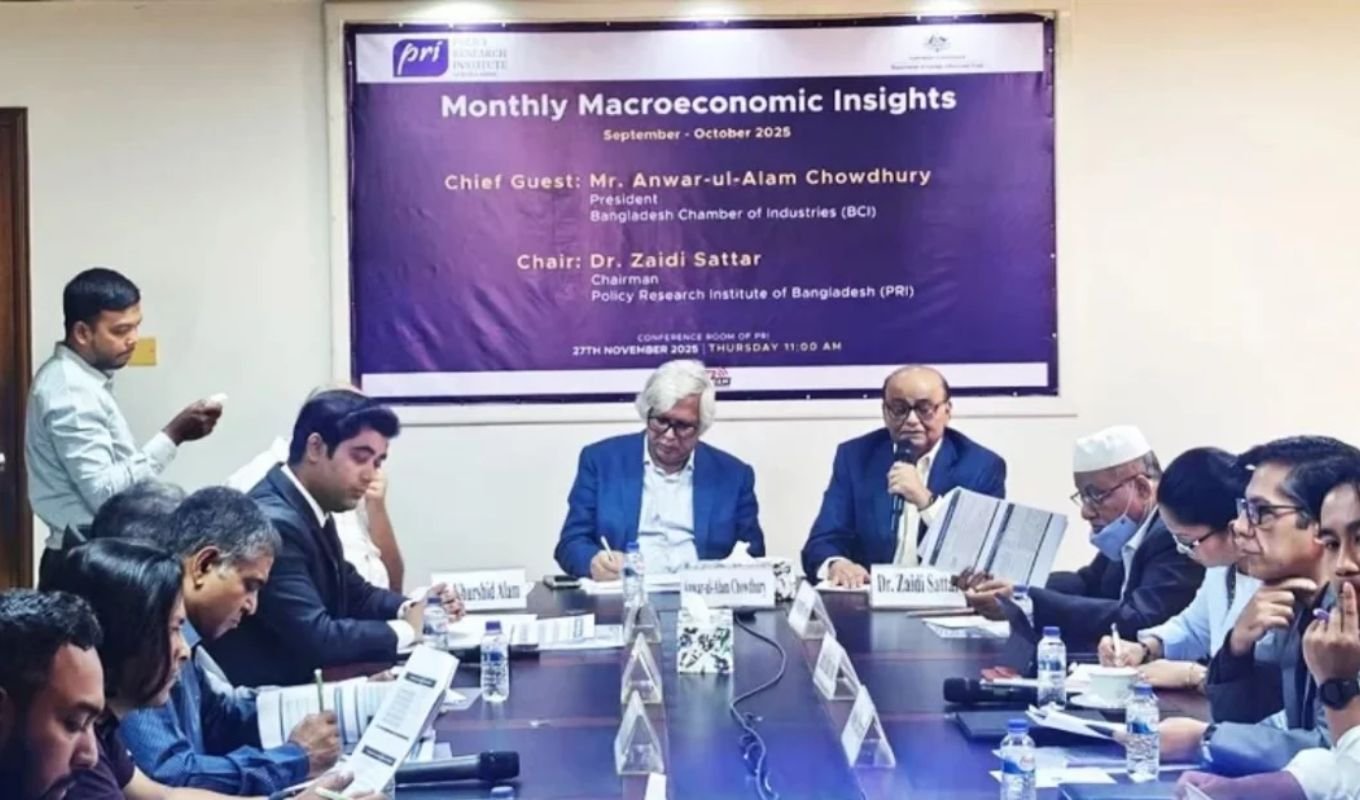
The President of the Bangladesh Chamber of Industries (BCI), Anwar-ul Alam Chowdhury Pervez, has stated that the country’s economy is suffering from severe “bleeding.” Speaking as the chief guest at a monthly economic review session held at the Policy Research Institute (PRI) office in Banani on Thursday, he remarked that despite repeated warnings from the business community, the government remains indifferent and fails to prioritise their concerns. He pointed out that credit flow to the private sector has diminished significantly, and those currently seeking loans are doing so primarily to repay existing debts to avoid being classified as defaulters. As a former president of BGMEA, he alleged that while the economic distress is palpable, the authorities are showing a distinct lack of attention.
The seminar, which analysed the economic situation of September and October, was presided over by PRI Chairman Dr Zaidi Sattar, with the keynote paper presented by Chief Economist Dr Ashikur Rahman. Anwar-ul Alam further noted that since 2022, production has been severely hampered due to energy shortages. Despite several price hikes for fuel and energy, the government has failed to ensure adequate supply, leading to the closure of nearly 50 per cent of small-scale enterprises. Many displaced workers from these industries have migrated to Dhaka to drive auto-rickshaws, pushing the capital’s population to an estimated 35 million. Regarding non-performing loans (NPLs), he highlighted that while the IMF expressed concern when the rate was 17 per cent, it has now surged past 35 per cent. He criticised the decision to reduce the loan rescheduling period, predicting it will further escalate the NPL crisis.
In the keynote address, Dr Ashikur Rahman warned that the financial sector is currently burdened by approximately 6.4 trillion BDT in outstanding loans, creating deep economic pressure. When considering restructured and rescheduled loans, the total volume of risky assets in the banking sector could reach 9.5 trillion BDT. This creates a “toxic cycle” where banks maintain high interest rates, leading to reduced investment, higher inflation, and weakened growth. PRI Chairman Dr Zaidi Sattar expressed concern over the rising Real Effective Exchange Rate (REER) index and suggested that easing import restrictions would be a pragmatic step to support exporters. Other experts in the panel discussion, including former NBR Chairman Dr Nasiruddin Ahmed, emphasised the need for skill-based education and a tax policy formulated by politicians and businesses rather than bureaucrats.
GLIVE/TSN