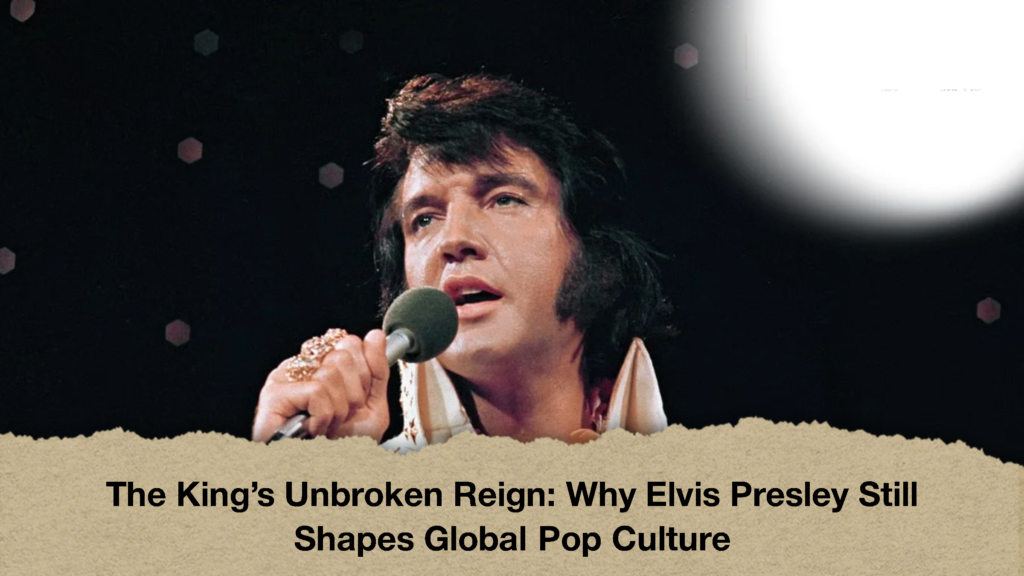
Nearly half a century after his untimely death, the name Elvis Presley requires no qualification. On 16 August 1977, the entertainment world lost its most magnetic performer when Presley passed away at his Graceland estate in Memphis, Tennessee, at the age of just 42. Forty-nine years on, he remains universally acclaimed as “The King”. This title denotes far more than mere commercial popularity; it reflects a radical movement that fundamentally altered music, fashion, television, performance art, and modern celebrity culture.
When Presley died in 1977, rock and roll was no longer a novelty. Iconic acts such as The Beatles, The Rolling Stones, Bob Dylan, and Jimi Hendrix had already expanded the sonic boundaries of popular music. Yet Presley maintained a distinct, foundational place in history. He was not merely the breakout face of a new genre; he demonstrated how a recording artist could unify sound, fashion, movement, and mass media into a singular artistic force.
Humble Origins and the Sun Records Breakthrough
Born Elvis Aaron Presley on 8 January 1935 in Tupelo, Mississippi, the young singer grew up in impoverished circumstances deeply steeped in gospel, blues, and country music. After relocating with his family to Memphis, his musical horizons broadened further. He absorbed the raw emotion of Black blues and rhythm and blues artists alongside white country and gospel performers.
In 1954, while working as a truck driver, Presley walked into Sun Records to record a modest demo. Producer Sam Phillips recognised something extraordinary in the young singer. During a session pause, Presley began improvising Arthur Crudup’s blues track ‘That’s All Right’. The resulting recording captured the blueprint of his future success. By fusing traditional country and blues with an electric, youthful tempo, Presley created an explosive sound that brought Black-influenced musical genres directly to mainstream audiences. His contract was transferred to RCA Victor in late 1955, and by early 1956, the release of ‘Heartbreak Hotel’ launched him into national stardom, selling over one million copies in record time.
A Musical Revolution Across Genres
Labeling Presley purely as a rock and roll artist understates his remarkable versatility. While tracks like ‘Hound Dog’, ‘Jailhouse Rock’, and ‘Blue Suede Shoes’ sparked a youth revolution, he proved equally adept at romantic ballads, country music, and religious gospel. Hits such as ‘Suspicious Minds’, ‘Can’t Help Falling in Love’, ‘Love Me Tender’, and ‘Are You Lonesome Tonight?’ showcased his exceptional vocal range and emotional depth. Over his career, he earned three Grammy Awards, all of which were awarded for his gospel recordings.
Presley’s musical foundation relied heavily on the groundwork laid by Black artists such as Arthur “Big Boy” Crudup, Big Mama Thornton, Sister Rosetta Tharpe, and B.B. King. Operating within a deeply segregated 1950s America, his rise sparked an enduring debate regarding appropriation and credit. While critics highlight the economic disparities between white mainstream stars and the original Black creators, historians note that Presley consistently voiced profound respect for his influences, using his platform to champion their contributions.
Stage Presence, Style, and the Power of Television
Presley’s physical performance was just as revolutionary as his studio recordings. His rhythmic hip movements, fluid body language, and expressive facial mechanics scandalised conservative mid-century society. Television executives initially attempted to censor his movements by filming him only from the waist up, yet public curiosity only intensified. He redefined live performance, establishing the visual standards for modern pop concerts and music videos.
His wardrobe further reinforced his iconic status. From the tailored pink-and-black jackets and pompadour hairstyle of the 1950s to the flamboyant, jewelled jumpsuits and high collars of his 1970s Las Vegas residency, Presley transformed stage fashion into a statement of identity.
Recognising the power of television early in his career, Presley used the medium to project his image directly into millions of homes. His major televised milestones included the acclaimed ’68 Comeback Special, which reinvigorated his musical career after years in Hollywood, and the historic 1973 broadcast Aloha from Hawaii Via Satellite. Watched live across the globe, the Hawaii concert represented a pioneering moment in global satellite broadcasting long before the advent of modern live-streaming technology.
An Enduring Legacy Beyond the Stage
Alongside his music career, Presley starred in 31 feature films and two concert documentaries. Though many of his Hollywood vehicles relied on predictable romantic formulas that underutilised his acting potential, they cemented his status as a formidable box-office draw.
Following years of gruelling tour schedules, escalating health issues, and reliance on prescription medication, Presley died at Graceland in 1977. His home was subsequently listed on the National Register of Historic Places and turned into a museum attracting hundreds of thousands of international visitors annually. With global record sales estimated to exceed one billion units, Presley’s commercial reach remains unmatched.
Nearly five decades after his death, new generations continue to discover his catalogue and visual style through cinematic biopics, digital remasters, and annual commemorations. Elvis Presley remains a titan of modern entertainment—a cultural figure whose influence continues to shape the landscape of global pop culture.