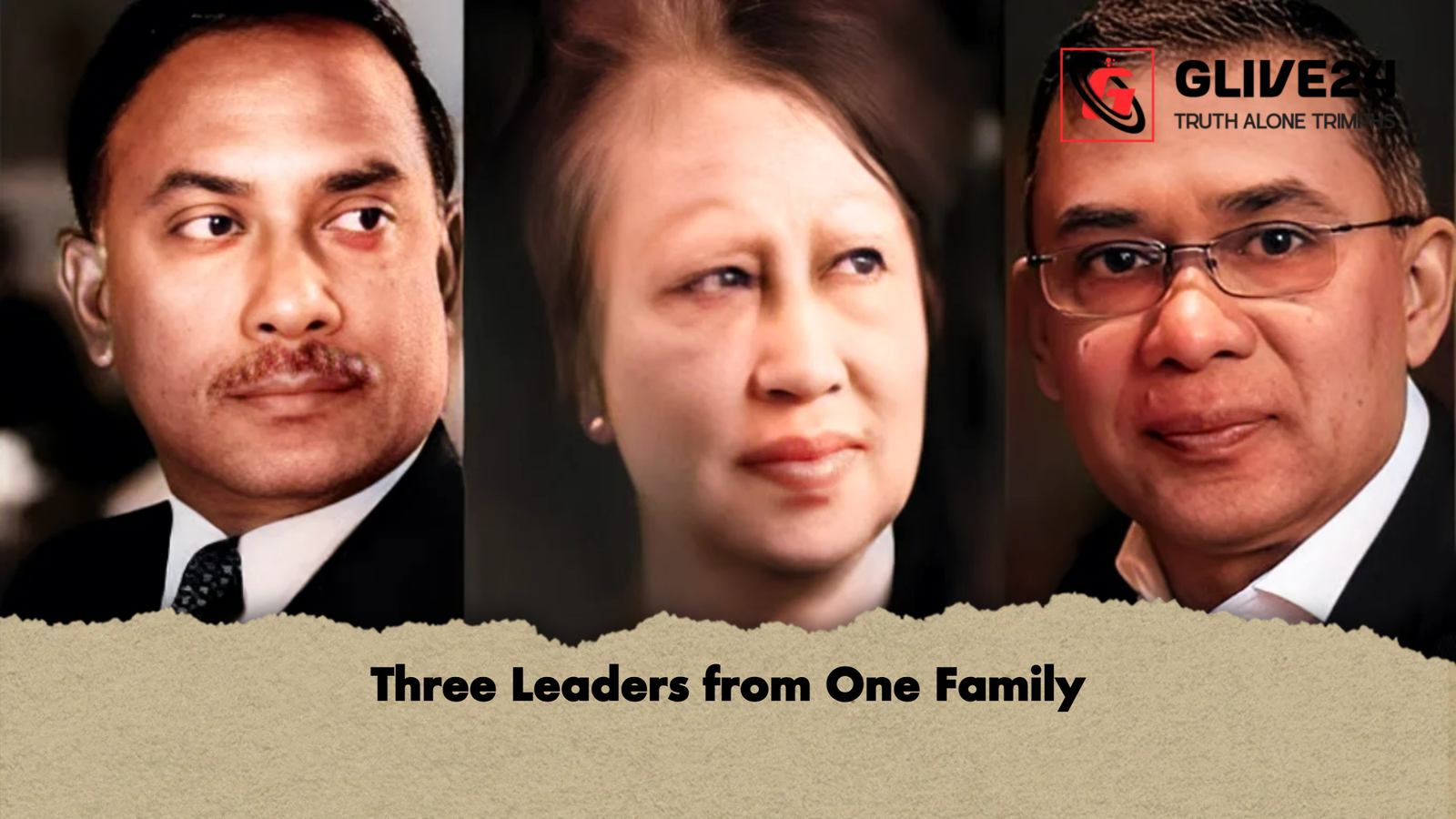
Bangladesh is poised to witness a rare political milestone. Following a decisive parliamentary victory by the Bangladesh Nationalist Party (BNP), party chairman Tarique Rahman is expected to assume office as Prime Minister. Should this transition proceed as anticipated, the Zia family will enter an exclusive global club: political dynasties in which three members have served as either head of state or head of government.
The legacy began with Ziaur Rahman, who emerged as a central political figure in the turbulent aftermath of Bangladesh’s 1975 upheavals. Having risen through the ranks of the military, he assumed the presidency in 1977. In 1978, he founded the BNP, shaping Bangladesh’s centre-right political tradition. His tenure was cut short in 1981 when he was assassinated in Chittagong.
His widow, Khaleda Zia, entered politics amid national uncertainty. She became Prime Minister in 1991, the first woman to hold the office in Bangladesh, and went on to serve three separate terms. Under her leadership, the BNP consolidated itself as a principal political force. Her death on 30 December marked the end of an era. Now, with Tarique Rahman’s anticipated premiership, the family’s political narrative advances into a third generation.
While political families are not uncommon, instances in which three relatives have each held supreme executive authority remain exceptional in modern republican systems. The following survey highlights comparable examples across continents.
Table of Contents
Bangladesh: The Zia Family
| Name | Position | Years in Office |
|---|---|---|
| Ziaur Rahman | President | 1977–1981 |
| Khaleda Zia | Prime Minister | 1991–1996; 1996; 2001–2006 |
| Tarique Rahman | Prime Minister (anticipated) | From 2026 |
The Zia family’s influence spans both presidential and parliamentary systems, reflecting Bangladesh’s constitutional evolution.
India: The Nehru–Gandhi Lineage
India’s independence in 1947 brought Jawaharlal Nehru to power as the nation’s first Prime Minister. A principal architect of India’s parliamentary democracy and a champion of non-alignment during the Cold War, Nehru shaped the republic’s formative decades.
His daughter, Indira Gandhi, served two extended terms (1966–1977 and 1980–1984). Her premiership was marked by decisive leadership during the 1971 Bangladesh Liberation War and controversy during the 1975–1977 Emergency. She was assassinated in 1984.
Her son, Rajiv Gandhi, became Prime Minister at age 40—the youngest in India’s history. Though his tenure was comparatively brief (1984–1989), he presided over economic and technological reforms. He was assassinated in 1991.
| Family | Country | Members | Highest Office |
|---|---|---|---|
| Nehru–Gandhi | India | 3 | Prime Minister |
Pakistan: The Bhutto Dynasty
Zulfikar Ali Bhutto founded the Pakistan Peoples Party (PPP) in 1967 and became President and later Prime Minister after the 1971 war. His execution in 1979 under military rule transformed him into a controversial martyr.
His daughter, Benazir Bhutto, twice served as Prime Minister (1988–1990; 1993–1996), becoming the first woman to lead a Muslim-majority country. She was assassinated in 2007.
Her husband, Asif Ali Zardari, later became President (2008–2013 and again from 2024), extending the family’s executive reach.
| Family | Country | Generations in Power | Offices Held |
|---|---|---|---|
| Bhutto | Pakistan | 2–3 | President & Prime Minister |
Sri Lanka: The Bandaranaike–Kumaratunga Family
S. W. R. D. Bandaranaike served as Prime Minister from 1956 until his assassination in 1959. His widow, Sirimavo Bandaranaike, became the world’s first female Prime Minister in 1960 and served three terms.
Their daughter, Chandrika Kumaratunga, later served both as Prime Minister and President (1994–2005), creating one of the world’s rare instances of mother and daughter simultaneously holding the two highest offices.
Thailand: The Shinawatra Family
Thaksin Shinawatra governed from 2001 until his ousting in a 2006 military coup. His sister, Yingluck Shinawatra, became Thailand’s first female Prime Minister (2011–2014) before removal by court order.
More recently, Paetongtarn Shinawatra briefly held the premiership in 2024–2025, marking the third Shinawatra to reach Thailand’s executive summit.
North Korea: The Kim Family
In contrast to democratic systems, North Korea’s leadership has effectively functioned as a hereditary line. Kim Il-sung led the state from its founding in 1948 until 1994. His son, Kim Jong-il, succeeded him, followed by grandson Kim Jong-un in 2011. Though structurally distinct from pluralist democracies, the Kim family exemplifies three-generation rule.
Greece: The Papandreou Family
Georgios Papandreou, his son Andreas Papandreou, and grandson George Papandreou each served as Prime Minister. Their leadership spanned from wartime reconstruction to the eurozone debt crisis.
Nicaragua: The Somoza Family
The Somoza family—Anastasio Somoza García and his sons Luis and Anastasio—ruled Nicaragua across multiple decades (1930s–1979), blending dynastic politics with authoritarian control.
Peru: The Prado Family
Mariano Ignacio Prado served twice as President in the 19th century. His son Manuel Prado Ugarteche later served two presidential terms, while another son, Javier Prado, briefly held the premiership.
Broader Patterns
Political families are not confined to three-member cases. Two-member examples abound: the Bush family in the United States, the Trudeau family in Canada, the Lee family in Singapore, the Assad family in Syria, and the Rajapaksa family in Sri Lanka.
What distinguishes the Zia family’s impending milestone is its occurrence within a competitive parliamentary democracy, rather than a hereditary or authoritarian system. Political legacies can stem from ideological continuity, organisational strength, public sympathy following tragedy, or personal charisma. Yet they also provoke debate regarding meritocracy, party democracy, and institutional resilience.
As Bangladesh prepares for a new administration under Tarique Rahman, observers at home and abroad will watch closely. The emergence of a third-generation national leader from one family underscores both the durability of political brands and the enduring influence of historical memory in shaping democratic choice.
Whether this chapter proves transformative or transitional, it places Bangladesh alongside a select group of nations where political leadership has, across decades, remained within the same household—an uncommon, and often consequential, phenomenon in modern statecraft.