A recent trade agreement between Bangladesh and the United States is projected to cause a significant decline in government revenue during the current fiscal year, according to the Centre for Policy Dialogue, an independent policy research organisation. Analysts from the institute estimate that the government could lose approximately 13.27 billion taka in customs revenue as a result of tariff concessions granted under the bilateral arrangement.
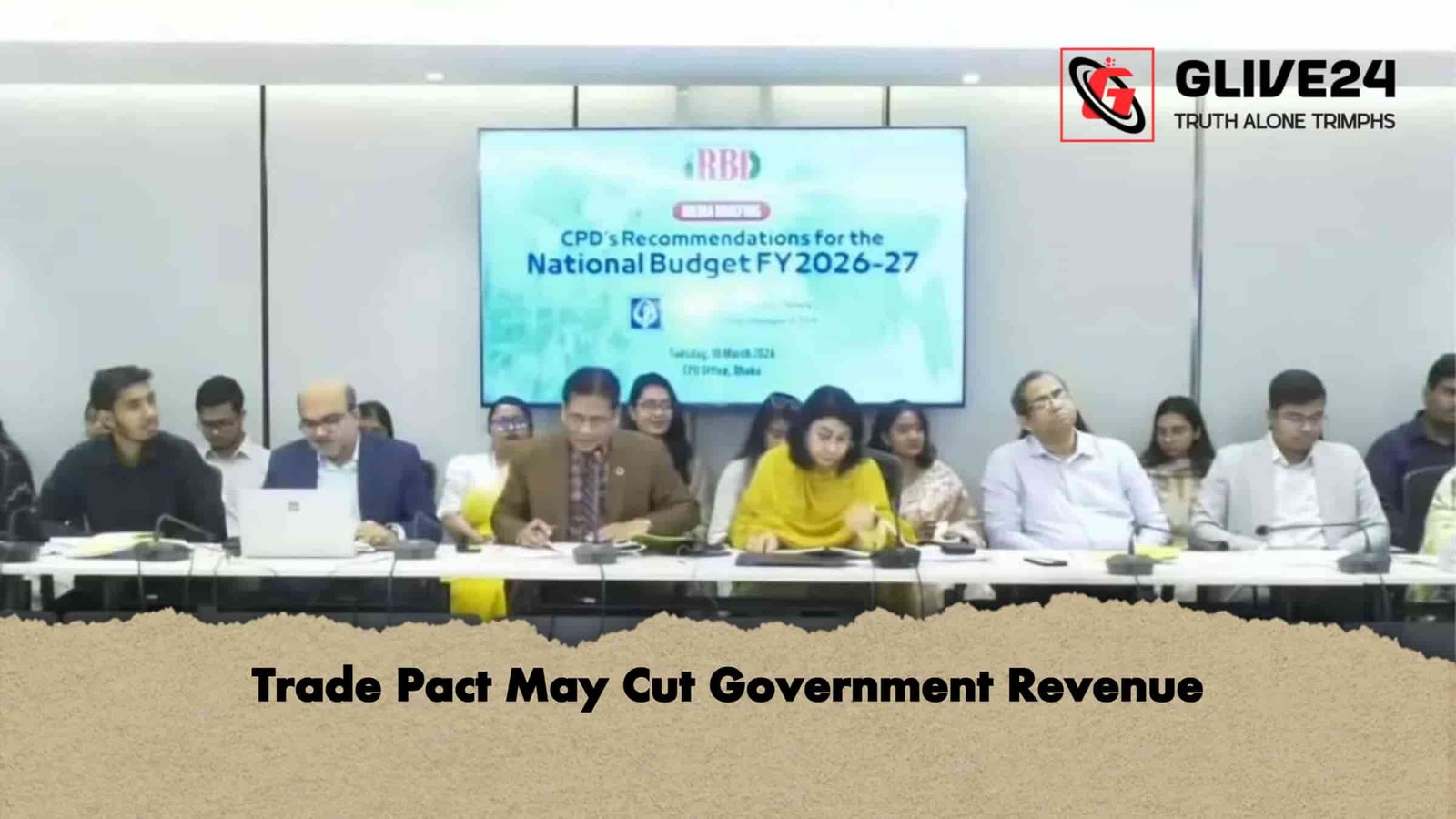
The assessment was presented during a roundtable discussion titled “Budget Recommendations for Fiscal Year 2026–27”, organised by the Centre for Policy Dialogue at its office in the capital. The discussion brought together economists, researchers and policy analysts to review fiscal challenges and the broader implications of the trade arrangement.
The organisation’s Executive Director, Fahmida Khatun, delivered the keynote presentation, highlighting the fiscal implications of the recently concluded Agreement on Reciprocal Trade between Bangladesh and the United States. According to her analysis, the agreement requires Bangladesh to provide duty-free access to roughly 4,500 categories of American goods. In addition, a further 2,210 product categories are expected to receive tariff-free treatment within the next five to ten years.
Such concessions are expected to reduce import duty collections, creating an immediate revenue shortfall in the current fiscal year. Economists at the institute also warned that the arrangement could generate additional obligations under global trade rules, potentially requiring Bangladesh to extend similar tariff concessions to other member states within the international trading system.
Estimated Impact of Tariff Concessions
| Indicator | Estimated Figure |
|---|---|
| Immediate revenue loss from tariff reductions | 13.27 billion taka |
| Number of products receiving duty-free access immediately | 4,500 |
| Additional products to receive tariff exemption | 2,210 |
| Implementation period for additional concessions | 5–10 years |
Another concern raised during the discussion relates to procurement provisions reportedly included in the agreement. These provisions may require the government or private sector importers to purchase certain goods specifically from the United States. Economists argue that such requirements could increase government expenditure if incentives or subsidies are needed to encourage businesses to source products from American suppliers rather than alternative international markets.
Mustafizur Rahman, an Honorary Fellow at the organisation, noted that global trade relations have increasingly been influenced by strategic considerations. According to him, the growing tendency to use trade policy as a geopolitical instrument has weakened the effectiveness of multilateral trade governance mechanisms.
He also emphasised the need for greater transparency in the agreement, suggesting that undisclosed provisions may contain financial and regulatory implications that could affect Bangladesh’s long-term economic interests. Implementation of many aspects of the arrangement will depend heavily on private sector participation, which could require government incentives to make imports from the United States commercially viable.
Fiscal Indicators Highlighted at the Roundtable
| Economic Indicator | Latest Figure |
|---|---|
| Revenue growth until January of current fiscal year | 12.9 percent |
| Revenue growth target | 34.5 percent |
| Required growth to meet annual target | 59.4 percent |
| Current revenue shortfall | 600 billion taka |
| Government borrowing from banking sector | 596.55 billion taka |
| Annual development programme implementation (January) | 20.3 percent |
| Export earnings growth | −3.2 percent |
| Import growth | 3.9 percent |
| Tax to gross domestic product ratio | 6.8 percent |
The organisation also expressed concern about the country’s widening fiscal imbalance. Revenue growth has remained far below the government’s ambitious target, creating a large shortfall. As a result, authorities have relied increasingly on borrowing from the banking sector to finance expenditures, a trend that analysts warn could increase financial sector vulnerabilities and reduce credit availability for private investment.
Inflation has remained above eight percent, placing additional pressure on households and businesses. Economists warned that continued instability in energy markets, particularly due to conflicts in the Middle East, could further increase fuel costs and intensify inflationary pressures, given Bangladesh’s dependence on imported energy.
Researchers also pointed to a slowdown in the implementation of the annual development programme, with spending levels reaching the lowest rate in fifteen years by January.
The policy institute advised the government to adopt a more realistic approach while preparing the next national budget. Analysts argued that overly ambitious revenue and expenditure targets could undermine fiscal credibility unless accompanied by comprehensive tax reforms, improved revenue administration and measures to reduce unnecessary public spending.
They further stressed that strengthening domestic investment and employment creation would be essential for improving long-term economic resilience.