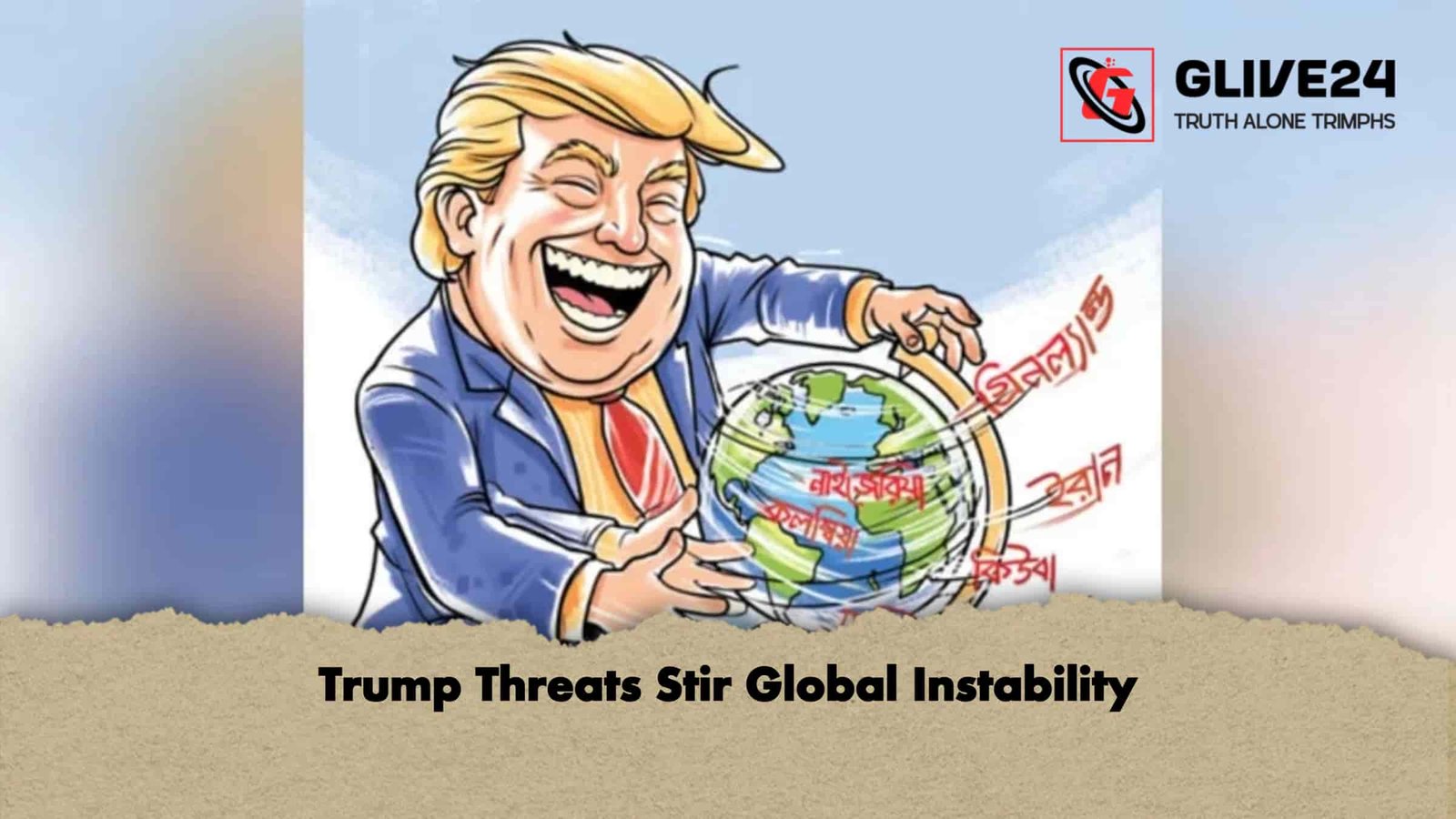
The recent actions and military threats by United States President Donald Trump have sent shockwaves across the international political landscape, fuelling widespread instability. Upon assuming office on 20 January 2025 at the Capitol in Washington, Trump presented himself as a “peacemaker” and a “unifier.” Yet, in less than a year, his policies and pronouncements have largely contradicted this self-portrayal, generating tensions worldwide.
Within his first twelve months in office, Trump has issued military threats against 11 countries and authorised airstrikes in seven. In addition, his administration has imposed stringent tariffs on over 90 nations and enacted full or partial travel bans targeting citizens of 38 countries. Analysts argue that these measures sharply diverge from the image of a “peace ambassador” that Trump initially sought to project.
Latin America has emerged as a particularly tense region. In Venezuela, US military posturing and attempts to undermine President Nicolás Maduro’s authority are widely regarded as violations of international law. Meanwhile, Iran, Greenland, Colombia, Cuba, and Mexico have also faced escalating threats. Tariff measures of up to 500 per cent on Chinese and Indian goods have further unsettled global trade, affecting supply chains and economic stability.
| Country | Type of Threat | Impact / Measures Taken |
|---|---|---|
| Venezuela | Military aggression | Attempted seizure of President Maduro’s authority |
| Iran | Threats | Pressure to suppress protests and enforce punitive measures |
| Greenland | Land acquisition plan | Armed vigilance by Denmark |
| Mexico | Threat to drug cartel operations | Proposal to amend constitution |
| China & India | Tariff imposition | Trade pressure and economic repercussions |
Trump has publicly signalled a dismissive stance towards international law, stating in an interview: “I do not need international law. I do not want to harm people.” Experts warn that such rhetoric may pressure comparatively weaker nations to acquiesce to US demands.
China maintains strong ties with several Latin American countries, particularly Venezuela and Cuba. Venezuela alone possesses an estimated 300 billion barrels of oil, roughly 17 per cent of global reserves, while significant Chinese investments across the region amplify the economic stakes of US military intervention. Similarly, Chinese goods and services in Mexico, Brazil, and Peru influence regional market balances.
Greenland’s strategic location has also drawn attention. NATO member Denmark has cautioned that any US military action there could precipitate serious international complications. Eurasian analysts warn that such manoeuvres could indirectly benefit Russia’s position in Ukraine.
Beyond these regions, Taiwan, Africa, Syria, and several Middle Eastern countries are increasingly vulnerable to the Trump administration’s threats. Observers conclude that this assertive approach—characterised by disregard for international norms and a readiness for military intervention—is destabilising political, economic, and military equilibriums worldwide.