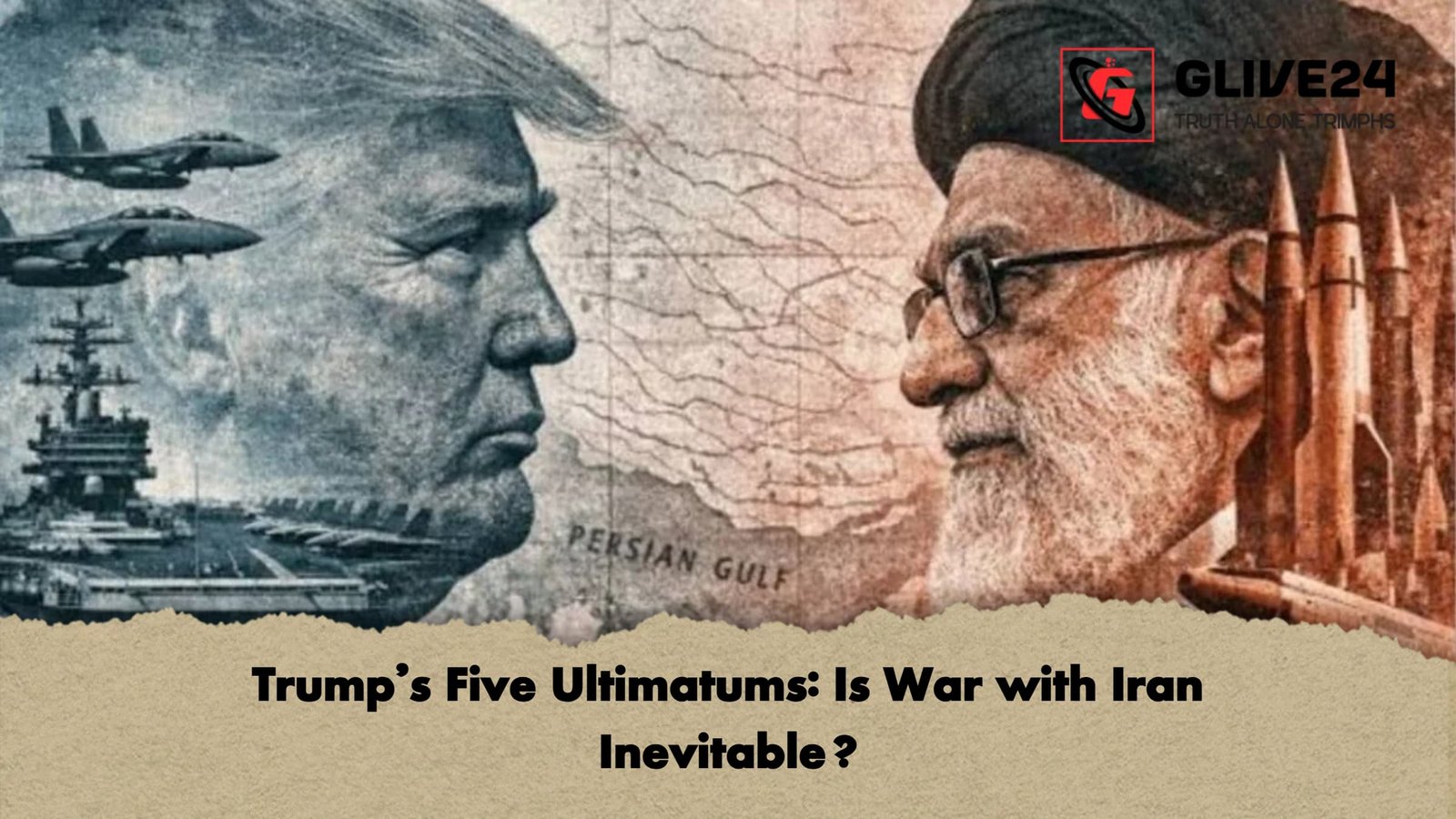
While diplomatic whispers echo through the halls of Muscat, Oman, a far more ominous scene is unfolding across the waters of the Indian Ocean. A massive contingent of the United States Navy is currently massing, signaling that President Donald Trump—buoyed by his recent political maneuvers in Venezuela—has set his sights firmly on Tehran. Diplomatic circles suggest that the White House has presented a five-point list of demands so stringent they are described not as a basis for negotiation, but as a deliberate prelude to conflict.
Table of Contents
The Five “Impossible” Demands
According to reports from the Israeli newspaper Ma’ariv, Washington’s primary conditions for avoiding military escalation strike at the very heart of Iran’s national sovereignty. The administration’s demands include the immediate transfer of Iran’s 400kg stockpile of enriched uranium to a third party, the total dismantling of all nuclear facilities, the complete cessation of its ballistic missile programme, and the withdrawal of support for regional allies across the Middle East.
| Trump’s Key Demands | Iranian Strategic Counter-Position | Potential Impact |
| Uranium Transfer | Will only consider capping enrichment at 3.67%. | Loss of nuclear leverage. |
| Missile Dismantling | Non-negotiable; viewed as a “defensive shield.” | Exposure to Israeli/US air strikes. |
| Regional Proxies | Essential for “forward defence” doctrine. | Collapse of the “Axis of Resistance.” |
| Nuclear Inspections | Restricted access to military sites. | High risk of intelligence breaches. |
| Regime Conduct | Rejection of “Western-imposed” standards. | Domestic political instability. |
A Hardline Doctrine
President Trump has adopted an emboldened stance, fresh from forcing concessions from Venezuela’s Maduro. In a recent interview with NBC News, he stated that Iran’s Supreme Leader, Ayatollah Ali Khamenei, “should be very worried.” However, geopolitical experts warn that equating Tehran with Caracas is a dangerous fallacy. Iran has spent the better part of 45 years preparing for exactly this type of asymmetric confrontation.
Bronwen Maddox, Director of Chatham House, argues that the ballistic missile programme is Iran’s sole deterrent. “To abandon this programme would be an act of national suicide,” she noted, highlighting that it would leave the country completely vulnerable to American B-2 stealth bombers and the Israeli Air Force.
The Shift to Offensive Posture
The rhetoric from Tehran has turned equally sharp. Major General Abdolrahim Mousavi, Chief of Staff of the Iranian Armed Forces, has announced a pivot from a purely defensive military doctrine to an “offensive-ready” posture. Learning from previous skirmishes, Iran has integrated advanced asymmetric warfare tactics designed to cripple regional energy supplies and target US assets across the Gulf.
Meanwhile, the regional temperature continues to rise. Israeli Prime Minister Benjamin Netanyahu and his cabinet remain deeply cynical of the Muscat talks, with Energy Minister Eli Cohen claiming that diplomatic agreements with Tehran are “worthless.” Simultaneously, Hezbollah leader Sheikh Naim Qassem has clarified that should a spark ignite in the Middle East, the group will not remain neutral, framing the coming conflict as an existential struggle for the entire region.
The Path to Escalation
While US Secretary of State Marco Rubio insists that the regional network and missile programmes must be addressed, Tehran remains unyielding on its military capabilities. The White House has privately admitted that they are participating in the Muscat talks primarily to satisfy the requests of regional allies, rather than out of a belief that success is possible.
With President Trump facing fluctuating approval ratings at home, a confrontation with a long-standing adversary like Iran is often viewed as a calculated domestic political tool. Observers fear that these “impossible” conditions were designed specifically to be rejected, effectively forcing Iran into a corner where the only exit is a devastating regional war.